In the spherical-collapse model, a bound overdense region initially expands with the background, but its additional Newtonian gravity slows that expansion. Its outer shell reaches a maximum turnaround radius, where its radial velocity is zero, and then falls inward. A perfectly spherical pressureless solution formally collapses to zero radius. In a realistic collisionless system, deviations from that idealization, shell crossing and violent relaxation convert coherent infall into random motions, producing a roughly stationary bound object.
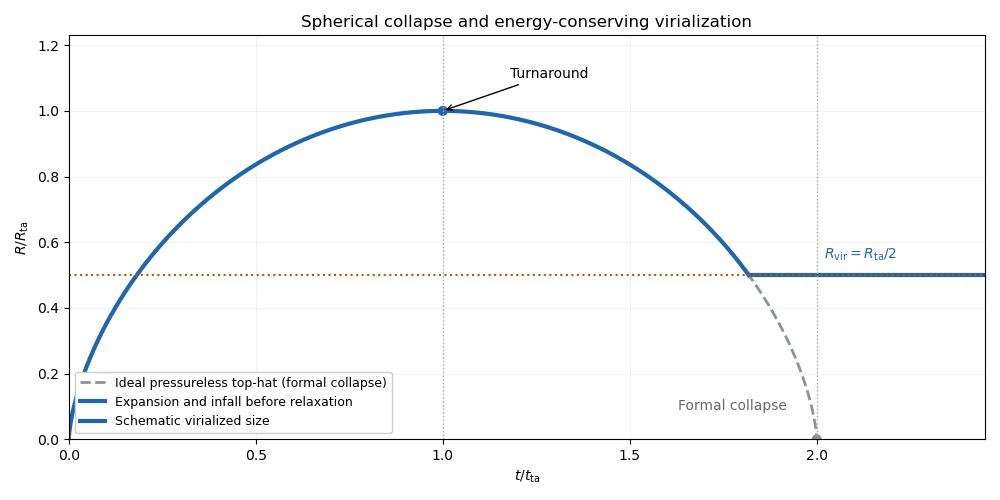

Let the Newtonian gravitational potential energy of the homologous sphere be , where for a uniform sphere. At spherical-collapse turnaround, the kinetic energy of the bulk motion vanishes, so . For the settled object, the virial theorem gives and hence . If energy and mass are conserved and the structure coefficient is unchanged,This is the virial radius from turnaround energy. It assumes negligible external pressure, mass loss and energy exchange. If the final structure coefficient differs, instead. Half the turnaround radius is an idealized equilibrium size, not the radius at which each collisionless particle stops moving. The plotted settling time is schematic; the usual collapse-time convention is .
Use the Einstein-de Sitter universe relations and . Write and . Since ,The dimensionless first integral with zero velocity at is . On the expanding branch this givesEvaluating the integral gives the inverse-trigonometric expression in the source. Alternatively, differentiate it: , so differentiation of the first integral gives exactly the required equation of motion. At , the integral equals . Thus fixes . The collapsing branch is , not the same increasing inverse function.
For the early-time density contrast, expand the integral directly:The leading coefficient in the printed small-radius approximation needs correction to . The printed coefficient is inconsistent with both the exact integral and approach to the homogeneous background. Indeed, the nonlinear density contrast satisfiesHence . In the Einstein-de Sitter universe the growing linear cosmological density perturbation is proportional to , so its extrapolation isThe formal collapse occurs at , giving the linear spherical-collapse thresholdThe actual nonlinear density contrast diverges at collapse; the finite number is the extrapolated linear amplitude. Equivalently, the full spherical-collapse model has and , with turnaround at and formal collapse at . Combining the half-radius estimate with the background-density decrease up to gives .
The physical radius comes from the angular diameter distance, not the luminosity distance. In the specified flat cosmology,Using the supplied distance-integral approximation at and gives . The angular radius in radians is . ThusThis is a proper radius at the observation epoch; its comoving counterpart would be twice as large. The supplied approximate integral is sufficient here; integrating the specified Hubble parameter numerically gives a slightly smaller radius, about .
Take the retained disc mass to be the cosmic baryon fraction of the total dark matter halo mass: , where . Adopt and describe the disc gravity by . The structure coefficient must be stated: the scale-free Mestel disc gives when its flat rotation speed and enclosed mass are used, while a finite disc requires boundary and thickness information. The equality of edge specific angular momentum gives , with . Combining these relations gives the angular-momentum-conserving self-gravitating disc radius:With the commonly intended approximation,The corresponding masses are and , where is the solar mass.
For a definite formation estimate, assume the dark matter halo acquired this mass and radius at virial equilibrium, retained them afterward, and had mean density with . This uses the matter-dominated spherical-collapse model as an approximation to the specified matter-plus-vacuum cosmology. Since ,The approximate distance therefore gives formation modestly before observation. Using the numerical rather than approximate distance integral gives , within the accuracy of these structural assumptions. The calculation also assumes inclination-corrected spectroscopy, negligible disc pressure support, conserved edge specific angular momentum, no substantial later accretion or mergers, and no significant baryon loss.
This formation redshift is model-dependent, not uniquely fixed by the stated disc data. Keeping explicit gives . In particular, replacing the mean-density convention by times the critical density gives and , later than the observation. That inconsistent chronological result cannot be silently used as the formation epoch.
There is a further idealization in applying exactly at the edge: an abruptly truncated razor-thin disc with nonzero edge surface density of a disk has a logarithmically divergent in-plane force at that edge. Locally the available mass occupies a half-plane, and its radial contribution is proportional to , with no opposite exterior half-plane to cancel it. Finite thickness or a smooth taper removes that sharp-edge force singularity of a thin disk. Thus is an explicitly qualified Mestel disc or monopole-scale approximation, not an exact finite-disc calculation; enclosed mass does not determine a disc rotation curve.
For an optically thin low-density gas in collisional ionization equilibrium, the astrophysical cooling function collects losses per pair of hydrogen nuclei into . Its units are ; the time unit is missing from the printed guide to the vertical-axis labels. For the primordial atomic cooling curve, only hydrogen and helium provide bound-state coolants.
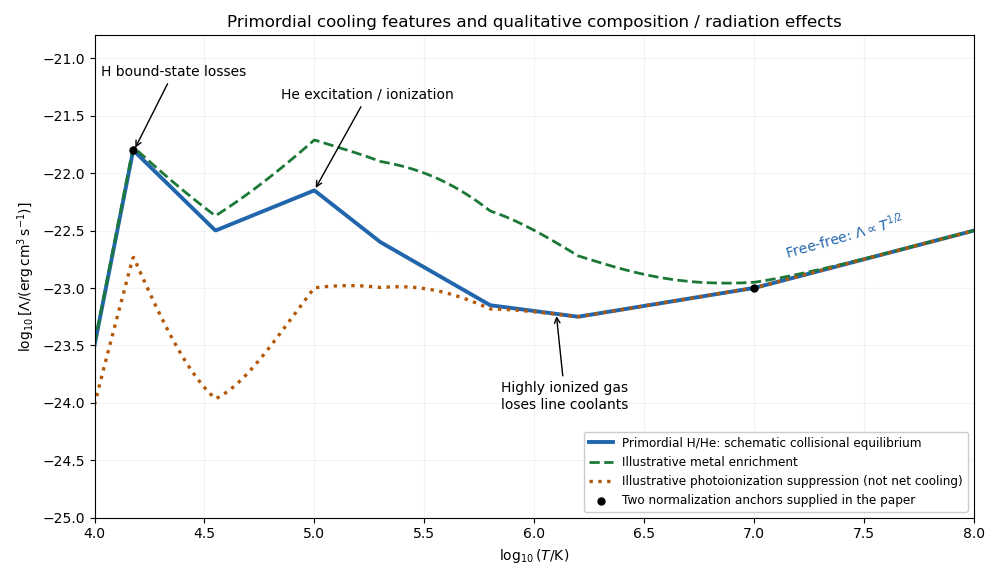
Schematic primordial cooling function with hydrogen and helium features, metal enrichment and photoionization effects
. Details. 
Near , collisional excitation of hydrogen becomes effective and subsequent photon emission removes thermal energy. The excitation rate is exponentially suppressed below the atomic energy threshold. Atomic line cooling and collisional ionization generate a strong hydrogen feature around a few ; helium excitation and ionization produce further structure around . Radiative recombination also contributes. Once the gas is highly ionized, these bound-state losses weaken. At –, thermal bremsstrahlung dominates, with approximately apart from slowly varying factors. The figure is an original qualitative sketch anchored to the two supplied values, not an atomic-rate calculation.
Increasing galactic metallicity adds many ionic transitions, producing metal-line cooling and substantially enhancing cooling, particularly in the – range. Metals also provide low-energy fine-structure transitions below . The change is not a uniform vertical shift: the positions and strengths of features depend on the elemental abundances and ionization state.
Photoionization removes bound electrons even where collisions alone would leave atoms neutral, often suppressing the hydrogen and helium line peaks and changing the metal-ion population. It also adds photoionization heating. The net thermal loss is then , with possible heating-cooling equilibrium near . A single density-independent no longer describes every irradiated cloud: the answer also depends on radiation intensity, spectrum, shielding and density. The illustrative photoionized curve denotes altered cooling alone, not the net loss including heating.
Below , primordial gas can use molecular line cooling, especially rotational and vibrational transitions of molecular hydrogen and, in suitable chemical conditions, hydrogen deuteride. Molecule formation and protection against photodissociation are essential. Enriched gas can additionally use metal-line cooling, other molecular species and dust thermal emission, with gas-dust energy exchange important at high density. At high cosmological redshift, residual free electrons can transfer energy to the cosmic microwave background through Compton cooling by the cosmic microwave background if the gas is hotter than the radiation. Expansion can also cool gas adiabatically, but neither that process nor Compton cooling by the cosmic microwave background is an atomic loss law. The atomic threshold is a cooling-channel limitation, not a universal minimum gas temperature.
Let be the hydrogen mass fraction, the gravitating gas fraction, and the total-particle-to-hydrogen ratio. The optically thin gas cooling time and free-fall time of a uniform sphere arewhere . Equating them gives the cooling-to-free-fall equality curve:At fixed composition, its shape is . Gas above this curve cools faster than it falls; gas below it cools more slowly. Strong line cooling produces a deep low-density trough. In the high-temperature free-free regime, gives .
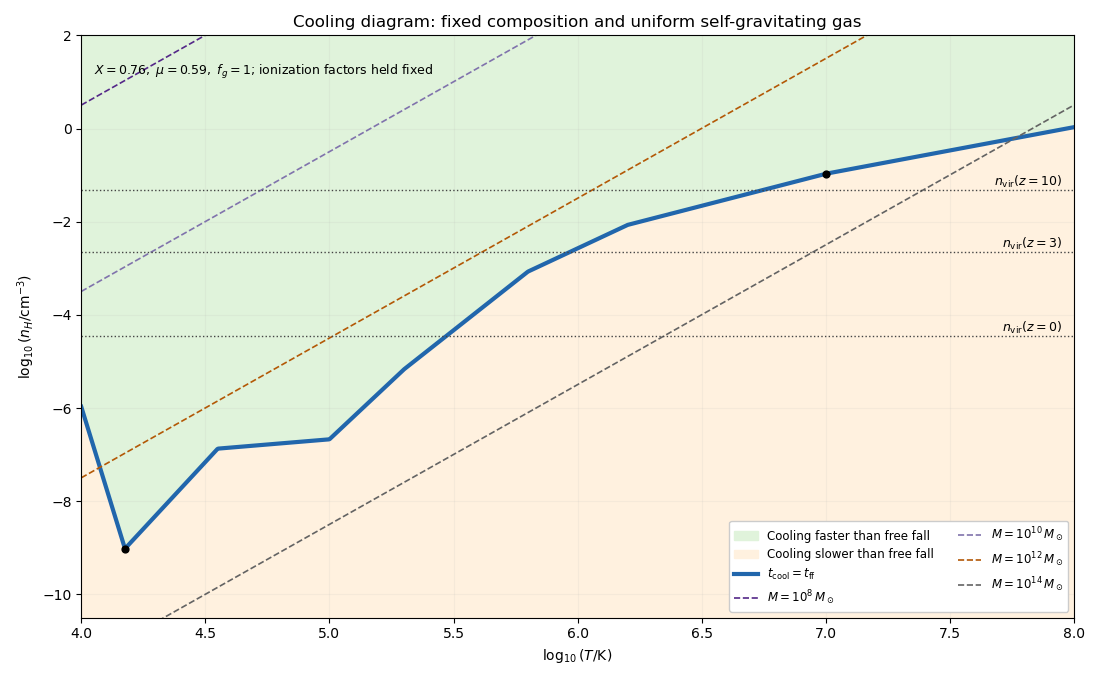
Cooling versus free-fall diagram with uniform-cloud virial mass contours and illustrative virial densities
. Details. 
The displayed uniform self-gravitating-cloud example uses , , and . Holding these ionized-gas factors fixed makes the diagram transparent, but near the atomic threshold their actual temperature dependence changes numerical normalizations. With these conventions the supplied cooling values imply and . For gas supported in a dark-matter-dominated dark matter halo, take : at fixed the free-fall time of a uniform sphere is shorter and the critical curve shifts upward by .
To add virial mass contours in a cooling diagram, use the uniform self-gravitating sphere consistently. Its Newtonian gravitational potential energy is and its thermal kinetic energy is . The virial theorem gives , while . Eliminating givesThus constant total gravitating mass gives slope three in the logarithmic density-temperature plane, with larger mass contours lying at smaller density. A different density profile changes the structural coefficient; the customary halo temperature scale shifts the mass contours but preserves their slopes. The horizontal illustrative formation-density lines are , using . They show why increasing formation cosmological redshift helps gas reach the rapid-cooling region.
At the low-mass end, a dark matter halo's virial temperature may not reach the atomic threshold. The atomic and molecular cooling thresholds for galaxy formation therefore favor an atomic-cooling mass of order at early formation epochs, with its precise value varying as approximately . Smaller primordial systems require molecules; photoheating and stellar feedback further suppress their luminous output.
At the high-mass end, the virial temperature at a fixed assembly density scales as . Beyond the line-cooling interval the gas becomes increasingly hot, while thermal bremsstrahlung improves only as . Hence at fixed assembly density in that regime. Large systems can remain pressure-supported hot atmospheres for many dynamical times, instead of promptly fragmenting into one stellar object. This is the upper galaxy mass from gas cooling: it associates efficient condensation with roughly galactic, rather than group or cluster, masses and motivates the broad – interval.
The diagram gives characteristic cooling scales, not exact universal mass bounds. Density profiles, gas fraction, enrichment and formation epoch move the boundaries; the two supplied values alone do not determine a complete numerical cutoff. Some gas can cool in dense cores of larger dark-matter haloes, early smaller progenitors can form stars before merging, and subsequent galaxy mergers can assemble more massive galaxies. Long-lived hot atmospheres also require heating to prevent excessive late-time cooling. These qualifications explain why the cooling criterion for galaxy formation is useful without equating each dark dark matter halo to one galaxy.
The dark matter halo population follows gravitational hierarchical galaxy formation: many low-mass dark-matter haloes and an exponentially rare high-mass tail. The Press-Schechter halo mass function captures this broad form. A constant conversion from dark matter halo mass to luminosity would simply rescale that distribution and predict too much light from both very small and very large systems. The luminosity function instead has a shallower faint end and a sharp bright-end decline, often described by a Schechter function,Define the halo star-formation efficiency as , distinguishing this integrated baryon conversion from the star-formation efficiency per free-fall time. If the stellar mass-to-light ratio is , a simple one-central-galaxy mapping is . For a monotone mapping without scatter,Thus a mass-dependent conversion efficiency and its Jacobian change the shape, not just the horizontal scale, of the luminosity function. Scatter, satellites and the stellar mass-to-light ratio add further differences.
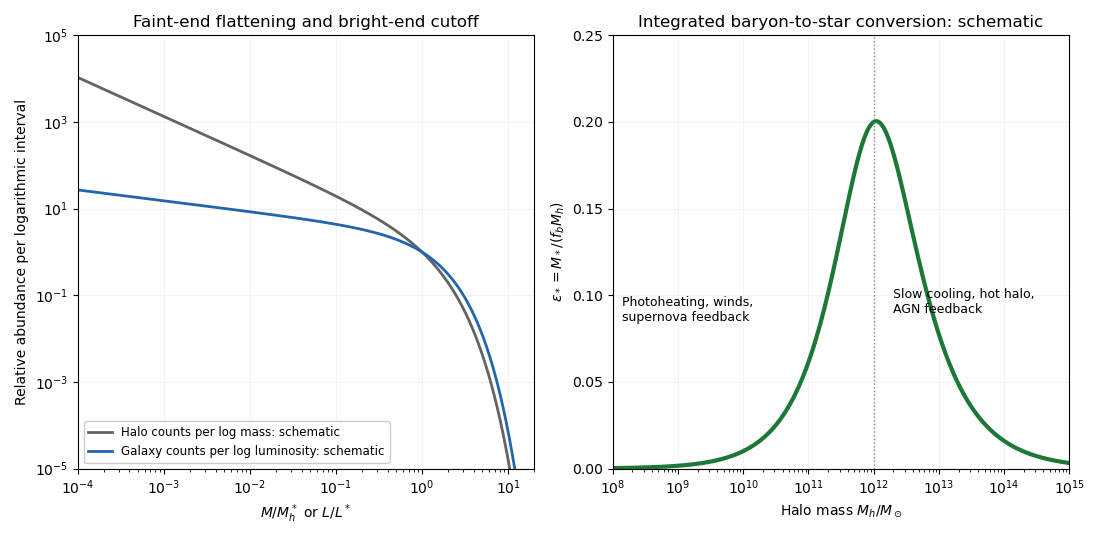
Schematic halo and galaxy abundance shapes and the integrated baryon-to-star efficiency versus halo mass
. Details. 
In shallow potential wells, photoheating can prevent gas accretion, while stellar feedback from radiation, stellar winds and supernovae heats or ejects gas. These effects lower halo star-formation efficiency toward low mass, helping flatten the faint end. The need for atomic or molecular line cooling also affects the smallest systems. Intermediate-mass dark-matter haloes retain gas and cool efficiently, so the integrated conversion reaches a maximum around galactic dark matter halo masses.
In massive dark-matter haloes, long optically thin gas cooling times and stable hot atmospheres reduce fresh cold-gas supply. Active-galactic-nucleus feedback can replenish the thermal energy lost in cooling and suppress a cooling flow, reducing halo star-formation efficiency and sharpening the bright cutoff. Massive group or cluster dark-matter haloes contain many distinct galaxies rather than one object with luminosity proportional to their entire mass. Galaxy mergers redistribute stars and can grow already formed bright galaxies, but do not turn all hot dark matter halo gas into new stars. The luminosity function is the gravitational dark matter halo population filtered through strongly mass-dependent baryonic physics. The plotted abundance and efficiency curves are qualitative examples, not observational fits or calibrated mass-to-light relations.
Let be the linear spherical-collapse threshold and let be the linear growth factor, normalized to one at the epoch to which the random density field has been extrapolated. The time-dependent barrier is . The smoothed matter density variance is the variance of the linear density contrast smoothed with a spherical top-hat window function whose comoving mass is . Both quantities must refer to the same linear normalization; equivalently use .
Let denote the comoving number density and write for the positive differential Press-Schechter halo mass function. With the mean comoving mass density, the mass fraction obeysDifferentiating the complementary error function and using givesThis is the requested mass function; is the abundance per unit natural logarithmic mass. For physical rather than comoving number density, multiply by . The normalization in the Press-Schechter formalism includes its factor of two relative to the positive Gaussian tail, so tends to one as the smoothing mass tends to zero when diverges. It is a collapse prescription, not the probability that an arbitrary already nonlinear density field stays Gaussian.
Assume matter-dominated growth over the two epochs, so . A fixed definition of the characteristic mass selects fixed peak height . Therefore is constant. With , the observed ratios giveSince a spherical top-hat window function has , the rms slope isFor a cosmological density power spectrum , the smoothed matter density variance isThe dimensionless integral converges for . Thus , andFor reference, substituting into the differential Press-Schechter halo mass function gives a low-mass prefactor and an exponential argument proportional to , so its displayed-form exponents are , . The prefactor normalization varies with epoch.
The effective galactic-scale index need not equal the primordial nearly scale-invariant index one. The cosmological transfer function modifies perturbations between the primordial epoch and galaxy formation: modes entering the horizon in the radiation-dominated era grow differently from larger modes. Schematically , with , while the cold-dark-matter transfer function decreases toward small scales. The result is a much redder late-time cosmological density power spectrum, with a scale-dependent slope. The inferred is a local power-law approximation to the processed matter spectrum, not a measurement of the primordial index.
Interpret the requested abundance as comoving number density and use this question's mean density, rather than importing the different cosmology of Question 2. The mass-to-radius relation for a spherical top-hat window function givesThe normalization radius is , not . Using ,These are linearly extrapolated rms amplitudes, even when the numerical value at late times exceeds one. The high-redshift matter-dominated approximation is appropriate to the crossing sought below.
For , the Press-Schechter halo mass function yieldsEquating this to gives . On the rare-object branch, solving gives . HenceThis is the first crossing as the Universe evolves from very early times. It retains the supplied scale-free extrapolation across a substantial range of scales; it is not a precision prediction using a full matter spectrum.
The abundance factor peaks at . Therefore the same target has a second mathematical root, , corresponding to if matter-dominated growth is extrapolated indefinitely. This extremely remote future branch is not the formation epoch and would not be physically justified by that growth approximation in a universe with late vacuum domination. This illustrates the two abundance crossings of the Press-Schechter mass function.
There is also an input-normalization qualification. If the characteristic cutoff is defined exactly by , the variance normalization here gives , rather than the earlier approximate quoted cutoff. The numerical estimate uses the explicit rms normalization in this part and the mass-scaling exponent from the preceding part; both cutoff normalizations cannot be imposed as exact simultaneously.
Articles by others on the same topic
There are currently no matching articles.