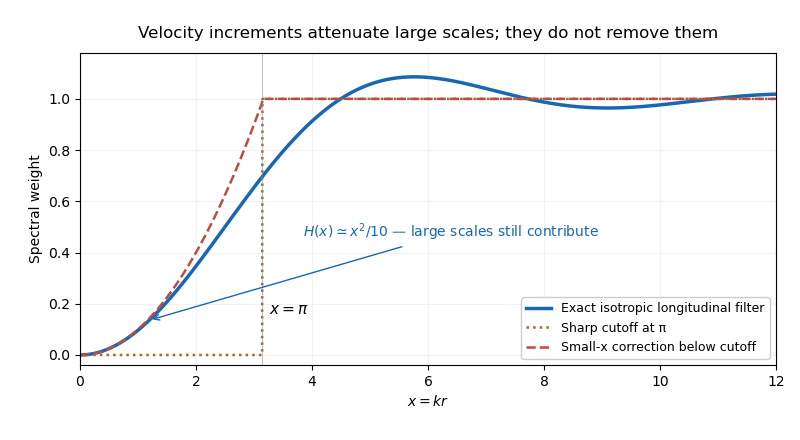
Write and normalize the turbulent energy spectrum by . In isotropic incompressible turbulence the longitudinal velocity correlation isCombining with gives the exact spectral filterThe expression has a smooth removable limit at . Its asymptotic forms areAn eddy much larger than contributes nearly the same velocity at the two points and mostly cancels in the increment. An eddy much smaller than contributes decorrelated velocities and does not cancel. Replacing the smooth transition of by a step at therefore gives the common estimate . The cutoff corresponds roughly to a half wavelength equal to the point separation; its exact numerical location is conventional.
Keeping the leading nonzero low-wavenumber term gives the improved estimateIt remains imperfect because is not small throughout the whole low-wavenumber interval and the exact kernel oscillates above the transition. The data sheet's alternative coefficient is a nearby approximate matching prescription; is the exact Taylor coefficient. Neither piecewise filter is an exact identity.

Higher-order longitudinal structure functions also retain large-scale information. Decompose , where varies on a length much larger than . Its longitudinal increment is , which is small but not zero. Expanding gives its own moments and mixed moments with the small-scale increment. Rare large gradients or correlated amplitude modulation can matter particularly strongly at large .
Thus a velocity increment is not an exact scale-local bandpass filter. Its moments may retain large-scale strain and forcing information, undermining an unqualified claim of universal small-scale statistics determined by one local parameter. This observation alone does not refute an asymptotic inertial range theory: for a three-dimensional spectrum, the low-wavenumber correction is mainly supplied by wavenumbers of order , while an isolated integral-scale smooth contribution behaves as and is subleading to . The issue is whether large-scale contamination and mixed moments actually become negligible in the regime and moment order being used.
Articles by others on the same topic
There are currently no matching articles.