Use the usual essential two-person Nash bargaining problem: is a compact convex set, is the disagreement point, and some satisfies for both players. The Nash bargaining solution isThe positive maximum exists by compactness and essentiality. On positive gains, maximizing this Nash product is equivalent to maximizing , a strictly concave function. Convexity then gives a unique maximizer. The essentiality and compactness hypotheses matter: for example, with and , the product is zero everywhere and its argmax alone is not a single-valued definition.
The rule satisfies all four axioms. Pareto efficiency: a feasible vector dominating the chosen vector with at least one strict improvement would increase its positive Nash product. Bargaining symmetry: if the problem is unchanged by swapping players, uniqueness makes the answer unchanged, so the two payoffs agree. Positive affine invariance in bargaining: for with , gains transform to and the product is multiplied by the positive constant , preserving its maximizer. Bargaining independence of irrelevant alternatives: if is another admissible feasible set containing the chosen vector and the same disagreement point, that vector remains the unique product maximizer over .
To prove characterization, let be any feasible single-valued rule satisfying these axioms, and let . Normalize payoffs by the positive affine transformationThe transformed set has disagreement point zero and product maximizer . For any , convexity puts in ; for sufficiently small both gains remain positive. The one-sided derivative of the product at its maximum is therefore nonpositive:Thus . By compactness choose so every coordinate of every is at least . The supporting triangle for Nash bargaining isIt contains , is compact, convex, symmetric and essential, and contains disagreement zero. Symmetry forces onto the diagonal; Pareto efficiency then forces it to be . Since , bargaining independence of irrelevant alternatives gives . Undoing the normalization by positive affine invariance in bargaining gives . Hence the four axioms uniquely characterize the Nash bargaining solution on this domain.
A security level payoff maximizes what a player guarantees against the opponent. Let be the row player's probability of the first action. Its guaranteed payoff isThe decreasing and increasing terms cross at , attaining ; moving either way lowers the smaller term. For the column player, any mixture has zero payoff against the first row, while its second-row payoff is nonnegative. Therefore andThe feasible set is the convex hull of the four joint pure-action payoff vectors. Its upper Pareto frontier connects to to . Write the row payoff as and column payoff as . On the first Pareto frontier segment, for . The Nash product isa concave quadratic with derivative , maximized at , , giving product . On the portion of the other Pareto frontier segment satisfying bargaining individual rationality, and . Its product derivative is positive throughout, so its largest product is at , smaller than . All dominated points can be discarded by Pareto efficiency. ConsequentlyThis payoff is implemented by a correlated payoff lottery choosing the payoff with probability and with probability . The convex hull permits such lotteries over joint outcomes; it is not restricted to independent mixed strategies.
Transposing the second player's matrix leaves the row player's security level payoff at . The column player's second action now yields payoffs and , while its first yields zero for either row. Its security level payoff is therefore , guaranteed by the second action; against the first row no mixture can guarantee more. Thus .
The relevant upper Pareto frontier joins the payoff vectors and , so . On the segment satisfying bargaining individual rationality , the Nash product becomesIts derivative is and its second derivative is . HenceThe implementing correlated payoff lottery chooses with probability and with probability . Both players' gains are strictly positive: and . The new disagreement point must be recomputed after transposition; reusing the previous column security payoff would solve a different Nash bargaining problem.
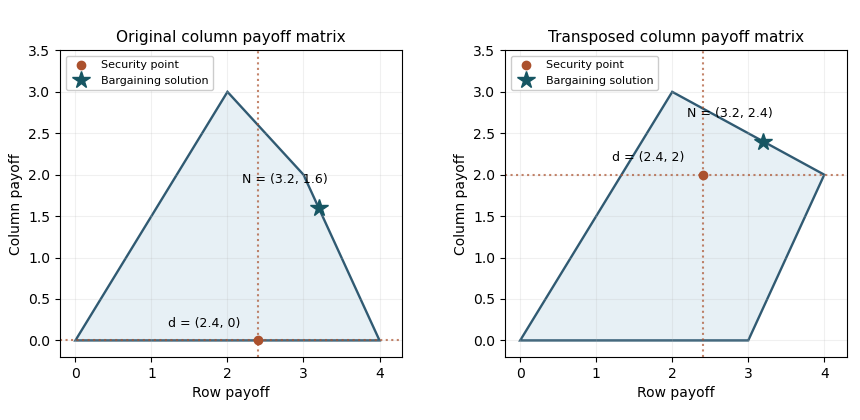
Feasible payoff polygons, security points and Nash bargaining solutions before and after transposing the column payoff matrix
. Details. 
Articles by others on the same topic
There are currently no matching articles.