Write the negative-flux Inviscid Burgers equation as , with . Along a characteristic curve,so a characteristic starting at has andThis formula is a classical solution only while the method of characteristics is one-to-one; after characteristic crossing one must select an entropy solution.
For a discontinuity with left and right values and , the Rankine-Hugoniot condition follows by integrating conservation across a moving small interval:For a nonzero jump, factor the difference of squares to obtainThe negative flux makes increasing jumps compressive. Decreasing jumps spread into rarefaction waves; they cannot be retained as nonphysical expansion shock waves.
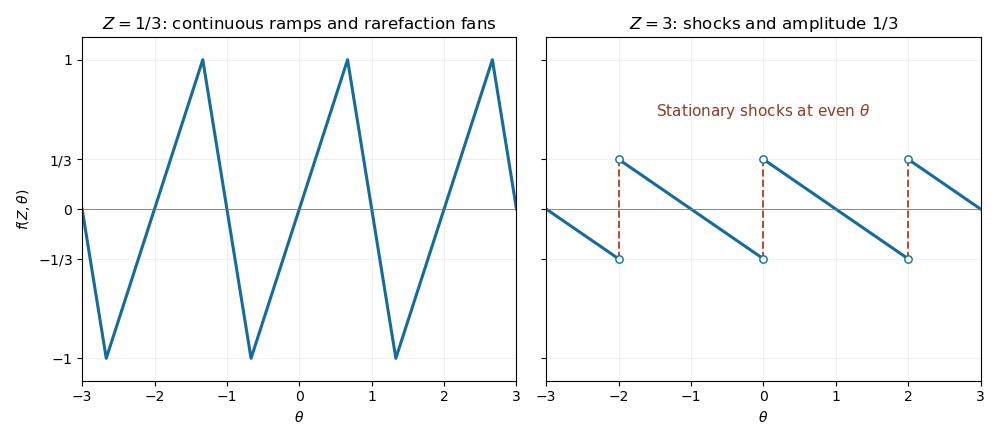
In the central ramp of each period, , so its method of characteristics is . For , the retained ramp therefore occupies . At the odd boundary , the initial limiting values are on the left and on the right. Their characteristic speeds are and , giving the fan on . Together these give the periodic backward-sawtooth Burgers solutionThese intervals tile the real line up to their matching endpoints, where both formulas agree at . The increasing ramp steepens, but the wave's maximum magnitude remains one before breaking. A steep continuous regularization of the original downward jump produces exactly the limiting fan, as suggested by the characteristic construction.
At , each increasing ramp collapses at . The fans on either side meet there with values and , producing a compressive stationary shock wave. For all the fan between successive shock waves remains centered at the odd point, givingAt a shock wave the limiting values are and . Their average is zero, so the Rankine-Hugoniot condition keeps the shock wave fixed. Their characteristic speeds satisfy , confirming compression into the shock wave. The arbitrary pointwise value at a shock wave does not affect the weak solution. The post-breaking amplitude decays as , despite the lack of explicit viscosity, because shock wave dissipate the wave.
Articles by others on the same topic
There are currently no matching articles.