Write the negative-flux Inviscid Burgers equation as , with . Along a characteristic curve,so a characteristic starting at has andThis formula is a classical solution only while the method of characteristics is one-to-one; after characteristic crossing one must select an entropy solution.
For a discontinuity with left and right values and , the Rankine-Hugoniot condition follows by integrating conservation across a moving small interval:For a nonzero jump, factor the difference of squares to obtainThe negative flux makes increasing jumps compressive. Decreasing jumps spread into rarefaction waves; they cannot be retained as nonphysical expansion shock waves.
In the central ramp of each period, , so its method of characteristics is . For , the retained ramp therefore occupies . At the odd boundary , the initial limiting values are on the left and on the right. Their characteristic speeds are and , giving the fan on . Together these give the periodic backward-sawtooth Burgers solutionThese intervals tile the real line up to their matching endpoints, where both formulas agree at . The increasing ramp steepens, but the wave's maximum magnitude remains one before breaking. A steep continuous regularization of the original downward jump produces exactly the limiting fan, as suggested by the characteristic construction.
At , each increasing ramp collapses at . The fans on either side meet there with values and , producing a compressive stationary shock wave. For all the fan between successive shock waves remains centered at the odd point, givingAt a shock wave the limiting values are and . Their average is zero, so the Rankine-Hugoniot condition keeps the shock wave fixed. Their characteristic speeds satisfy , confirming compression into the shock wave. The arbitrary pointwise value at a shock wave does not affect the weak solution. The post-breaking amplitude decays as , despite the lack of explicit viscosity, because shock wave dissipate the wave.
For the requested sketches, has ramp slope on and fan slope around odd points on width . It is still continuous. At , the profile decreases linearly with slope between even points and jumps from to at each even point:
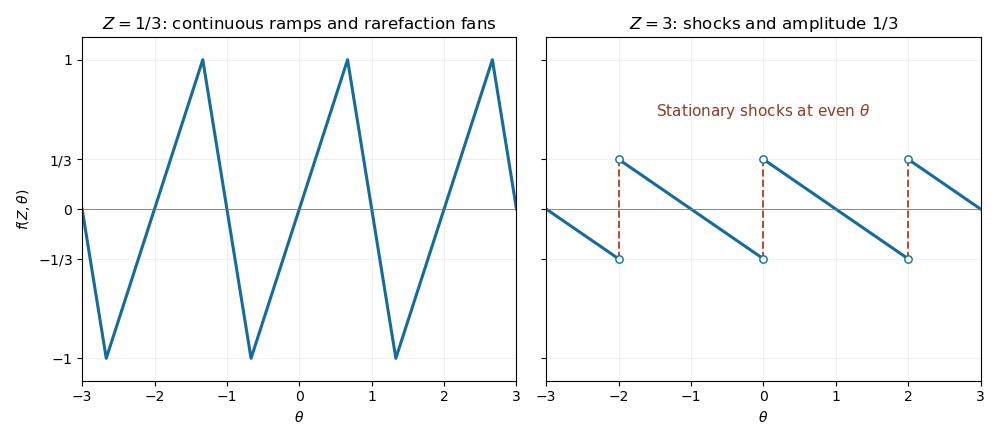
Periodic Burgers wave before breaking at Z equals one third and after breaking at Z equals three, with stationary shocks at even theta
. Details. 
Let , with , and set . Direct differentiation givesThe heat equation implies , so the bracket vanishes. Conversely its being independent of can be absorbed into a -dependent multiplicative normalization of , leaving unchanged. This proves the Cole-Hopf transformation with the positive sign appropriate to the negative-flux Burgers convention. Although the algebra works for nonzero , the given forward Gaussian function diffusion kernel and a physical vanishing-viscosity limit require .
Take for the stated Burgers N-wave. Integrating and normalizing the exterior value to one givesThis function is continuous at ; its logarithmic derivative has the specified jumps. Convolution with the heat kernel is positive and solves the heat equation for . Splitting the integral into the exterior baseline and the interior correction yieldsPut . Completing the square givesChanging the interior integration variable to changes its limits to and the Gaussian function width to . The Jacobian and normalization leave the factor . Thus the Cole-Hopf solution for a Burgers N-wave isHere is the normalized Gaussian function mass of its indicated interval. Its explicit error function representation isFor fixed , the Gaussian function concentrates at as . Consequentlyaway from the endpoints; at the limit is . The transition layer has width . This is an approximate identity argument, not a uniform step approximation across the endpoints.
For fixed and , both interval masses tend to one, and the exponentially large positive dominates the exterior correction. Its logarithmic derivative therefore givesFor , both interval masses are exponentially small and the weighted interior integral is also negligible, while the exterior contribution tends to one. Therefore in the specified far exterior.
An exponentially weighted Gaussian function tail should not be discarded solely because its unweighted interval mass tends to zero. In fact, comparing the order-one exterior term with gives the sharper inviscid Burgers N-wave fronts , not . Away from these fronts, the vanishing-viscosity limit isInside , this follows from the sign of in the exponential. Outside , the constrained Gaussian function maximum lies at an interval endpoint and has negative exponent. The right shock wave's speed is , equal both to the derivative of and to minus half the sum of its two limiting states; the left shock wave is its reflection. This checks consistency with the Rankine-Hugoniot condition and shows that the requested near-center and far-exterior approximations are compatible with the full entropy limit.
Articles by others on the same topic
There are currently no matching articles.