We use the Bolzano-Weierstrass theorem: every bounded real sequence has a convergent subsequence. If were unbounded on , there would be with . The Bolzano-Weierstrass theorem gives a subsequence , and the closed interval contains . Since is a continuous function, , contradicting . Thus is bounded.
Let . By the definition of the supremum, choose with . Again the Bolzano-Weierstrass theorem gives . Continuity yields . Applying the same argument to gives a point where attains its infimum. Therefore both the supremum and the infimum are attained. This proves the extreme value theorem for a closed bounded interval.
Away from integer multiples of , the function is a composition of continuous functions. At zero, the bound gives by the squeeze theorem. This is oscillation multiplied by a vanishing amplitude.
Fix and set and . Then , , andSo is discontinuous at every nonzero integer multiple of . Its set of continuity points is
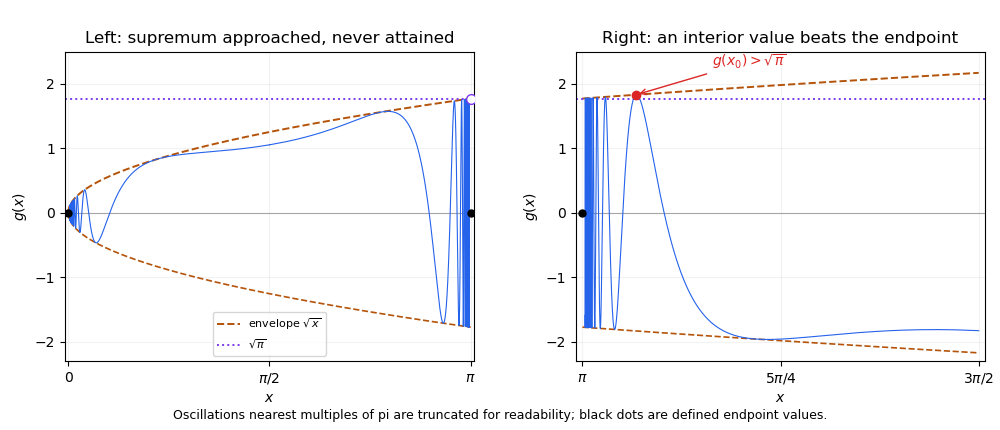
On , for , while . With as above, . Consequently the supremum is and is not attained. This illustrates that supremum can fail to be attained at an oscillatory endpoint.
On , set . It lies strictly inside the interval, and , so . Choose . On ,On , is a continuous function, so the extreme value theorem gives a maximum there, at least . It exceeds every value on the discarded interval. Therefore does attain its supremum on . This is the interior-value criterion for an attained maximum.
Articles by others on the same topic
There are currently no matching articles.