The degree and its local signs. Orient and let generate its top reduced homology . The mapping degree is the integer characterized byFor this is the usual top homology definition using the fundamental class; using reduced homology also covers .
Suppose is smooth and is a regular value. Each has invertible tangent map , so the inverse function theorem makes discrete. It is also closed in the compact sphere, hence finite. Choose disjoint small neighborhoods of these points on which is a local diffeomorphism. The Excision theorem identifies the source local homology with the direct sum of one copy of for each inverse image. The induced local map is multiplication by or according as preserves or reverses orientation. The map from the global fundamental class to these local orientation classes therefore proves the degree as a sum of local degrees formula:Here the determinant is computed in positively oriented tangent bases. Thus the mapping degree counts inverse images with signs, rather than just their cardinality.
The quotient map. Put and write . Give its standard orientation and its boundary the induced orientation. The connecting homomorphismis an isomorphism: the disk has zero positive reduced homology. It sends the relative fundamental class to . If the map on relative homology induced by multiplies this class by , naturality givesThus . Collapsing the boundary gives a sphere , and the quotient map identifies its top reduced homology with the top relative homology of the disk pair. Give this quotient sphere the orientation determined by that identification. The relation now showsThis is the quotient-sphere degree identity.
The graph intersection. Orient by the product orientation, orient by its first factor, and orient the graph of a function by . An intersection is precisely a zero of , and no such zero lies on the boundary because . At an intersection, transverse intersection means that is surjective, hence invertible. The zeros are consequently isolated and finite.
For the smooth intersection number use the ordered tangent spaces first and second. Relative to the product basis their concatenated basis has matrixIts determinant is , so the intersection sign is . By the same local Excision theorem argument, now in relative homology at the interior point , the sum of these signs equals the multiplier of on . Therefore the graph intersection formula for mapping degree isIf the tangent spaces are ordered first and second, every sign changes by ; the order above specifies the appropriate convention.
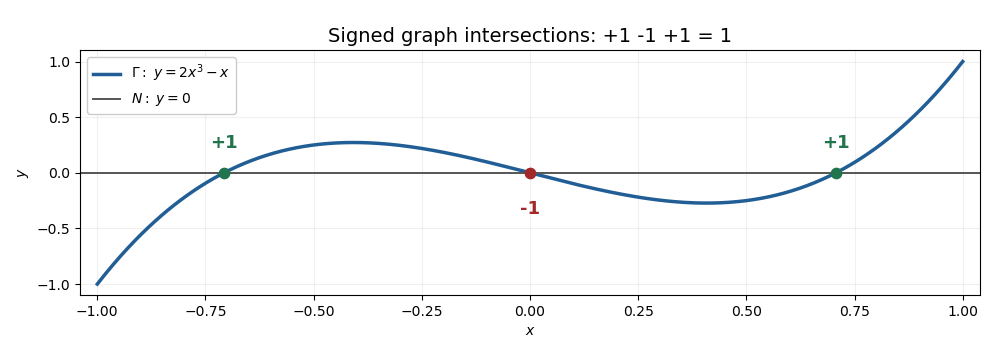
Three transverse graph intersections with signs plus, minus, plus and total degree one
. Details. 
The one-dimensional model on illustrates the graph intersection formula for mapping degree: its three zeros have signs , and its endpoint map has mapping degree on reduced homology.
Articles by others on the same topic
There are currently no matching articles.