The degree and its local signs. Orient and let generate its top reduced homology . The mapping degree is the integer characterized byFor this is the usual top homology definition using the fundamental class; using reduced homology also covers .
Suppose is smooth and is a regular value. Each has invertible tangent map , so the inverse function theorem makes discrete. It is also closed in the compact sphere, hence finite. Choose disjoint small neighborhoods of these points on which is a local diffeomorphism. The Excision theorem identifies the source local homology with the direct sum of one copy of for each inverse image. The induced local map is multiplication by or according as preserves or reverses orientation. The map from the global fundamental class to these local orientation classes therefore proves the degree as a sum of local degrees formula:Here the determinant is computed in positively oriented tangent bases. Thus the mapping degree counts inverse images with signs, rather than just their cardinality.
The quotient map. Put and write . Give its standard orientation and its boundary the induced orientation. The connecting homomorphismis an isomorphism: the disk has zero positive reduced homology. It sends the relative fundamental class to . If the map on relative homology induced by multiplies this class by , naturality givesThus . Collapsing the boundary gives a sphere , and the quotient map identifies its top reduced homology with the top relative homology of the disk pair. Give this quotient sphere the orientation determined by that identification. The relation now showsThis is the quotient-sphere degree identity.
The graph intersection. Orient by the product orientation, orient by its first factor, and orient the graph of a function by . An intersection is precisely a zero of , and no such zero lies on the boundary because . At an intersection, transverse intersection means that is surjective, hence invertible. The zeros are consequently isolated and finite.
For the smooth intersection number use the ordered tangent spaces first and second. Relative to the product basis their concatenated basis has matrixIts determinant is , so the intersection sign is . By the same local Excision theorem argument, now in relative homology at the interior point , the sum of these signs equals the multiplier of on . Therefore the graph intersection formula for mapping degree isIf the tangent spaces are ordered first and second, every sign changes by ; the order above specifies the appropriate convention.
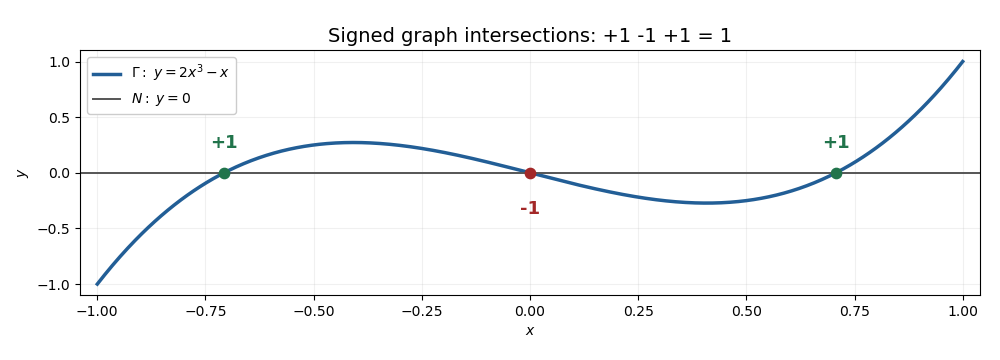
Three transverse graph intersections with signs plus, minus, plus and total degree one
. Details. 
The one-dimensional model on illustrates the graph intersection formula for mapping degree: its three zeros have signs , and its endpoint map has mapping degree on reduced homology.
The tensor differential. Use homological grading, so each differential lowers degree by one. The tensor product of chain complexes hasfor . This Koszul sign rule givesThus the graded tensor product is a chain complex.
The Hom differential. Write . For a degree- element of this graded Hom complex of chain complexes, use the prescribed differentialThe next application uses degree , soIn degree zero, , so its kernel consists exactly of chain maps. A degree-one element has , which is exactly the change between two chain maps related by a chain homotopy. ConsequentlyThis is natural: precomposition and postcomposition by chain maps preserve both degree-zero cycles and degree-zero boundaries.
The dual complex and the sign adjustment. Define the reversed dual chain complexHere is a functional on , so it belongs to , and . The absence of an additional sign in is intentional.
Interpret finite generation of the free chain complexes as finiteness of their total graded free modules. Then only finitely many degrees occur, and the finite-free evaluation isomorphisms assemble into a graded isomorphismwhere , , and this component is zero outside . The dual module construction and evaluation make natural. Finite rank is needed for evaluation to be an isomorphism; finite total support also makes the sums on the tensor side agree with the products on the Hom functor side.
Under , the Hom functor differential has the formThe usual tensor product of chain complexes instead has second coefficient . SetThis is integer-valued for every , including negative , and satisfies . Conjugating the usual tensor differential by leaves the first term unchanged and changes its second coefficient to . Hence , giving the sign conjugation for the tensor-Hom identificationThis is an isomorphism of chain complexes, not merely of their homology. If one instead assumes only degreewise finite rank with unbounded grading, the ordinary tensor need not identify with the product defining ; the finite-total convention is essential to this last conclusion.
Integral groups for . Put . The space is the inversion mapping torus of a torus, fibred over with fiber . The cohomology ring of a torus is the exterior algebra on degree-one generators. Inversion acts as on each such generator, hence as on .
The Wang sequence therefore givesThe right-hand term is free, so this short exact sequence splits as a sequence of groups. In even fiber degree, ; in odd fiber degree it is multiplication by . For this computes the integral cohomology of an inversion mapping torus:The top torsion group is consistent with being nonorientable: inversion of its three-dimensional fiber reverses orientation.
Mod-two groups. Over , inversion acts as the identity on the fiber cohomology. The Wang sequence givesThuswith out-of-range binomial coefficients interpreted as zero. These are exactly the dimensions of the graded groups .
The intersection pairing for . The mapping torus of reflection of the circle is the Klein bottle. Let be the section loop through a fixed point of the reflection and a fiber circle. They form a basis of . The section has a normal neighborhood homeomorphic to a Möbius band, so it is one-sided and a transverse displacement meets it once modulo two. The fiber is two-sided and can be displaced disjointly. The two loops meet once. The mod-two intersection pairing of the Klein bottle therefore has matrixTake the evaluation-dual basis , with and . By Poincare duality, the cup product matrix in this dual basis is , not :Writing for the nonzero top class gives , and . Hence the cohomology ring isThese relations already force all degrees above two to vanish.
The ring for general . For each of the fiber coordinates, projection induces . Pull back the classes above, calling the common base class and the fiber-coordinate classes . Naturality of the cup product gives and . The square-free products restrict to the exterior algebra basis of the fiber cohomology. The Leray-Hirsch theorem then says that and form an additive basis. This proves the full mod-two cohomology ring of an inversion mapping torus:For , is nonzero by this basis description. In the cohomology ring of a torus every degree-one class squares to zero: the generators square to zero and the cross terms occur twice in characteristic two. The degree-one cup-square obstruction to ring isomorphism therefore proves that the rings are not isomorphic for any , despite their isomorphic graded groups. For , both spaces are circles and the rings are isomorphic. Even if grading is forgotten, the rings differ for : every element of the torus ring has square either zero or one, whereas is nonzero and is not the unit.
Integral cup products in . To specify also as a ring, let be the pullback of the positive generator of . Let denote reduction modulo two and set using the integral Bockstein homomorphism. The degree-one Bockstein square identity gives , so the are the three independent order-two classes in degree two. Choose free classes which restrict to the corresponding two-fold fiber products and have reductions . Such choices exist: reduction in degree two is surjective because is free, and adding the removes any terms from an initial lift.
The Wang sequence identifies as a free basis of . Let generate , with . Reduction in degree four is an isomorphism. The integral cup products in the four-dimensional inversion mapping torus are consequently determined byTogether with the unit, graded commutativity and vanishing above degree four, these give every product. For example, , whereas . The products vanish because they are torsion in the free group .
Cells and attaching maps. Regard as the lines in and include as the lines whose last coordinate is zero. Its complement consists of lines with a unique representative , and is therefore an open -cell. Inductively this makes Real projective space a CW complex with one cell in each dimension from zero to .
A characteristic map is obtained from the northern closed hemisphere of : send a unit vector to the line it spans. Its interior maps homeomorphically onto the open cell, while its equator has the antipodal identification. Thus the -cell is attached by the quotient mapwhich is the antipodal two-sheeted covering. This includes the two endpoints of the one-cell attaching to the zero-cell.
The cellular chain complex has for and zero otherwise. To compute its differential, follow the attaching map by collapse of the -skeleton. The resulting map to has two local contributions. They differ by the mapping degree of the antipodal map on . With compatible cell orientations,For the two oriented endpoints cancel, giving the same formula. Consecutive differentials compose to zero, as required.
The mod-two cup products. Modulo two every cellular differential vanishes, so cellular cohomology gives a one-dimensional group in each degree . Let be the Poincare dual of a projective hyperplane. This class is nonzero: a projective line transverse to that hyperplane meets it once. Intersecting generic projective hyperplanes produces , and the cup product of their Poincare duals is the Poincare dual of that intersection. In particular, evaluates to one on the mod-two fundamental class. Therefore every , , is nonzero, since otherwise multiplying it by would contradict . Dimension makes . The mod-two cohomology ring of real projective space isFor this simply means the cohomology of a point.
The product with integral coefficients. The final product's coefficients are unstated; take as the default. Dualizing the cellular chain complex above giveswith all unlisted groups zero. The integral Künneth theorem has tensor terms with and Tor functor terms with :For these finite free cellular complexes it splits additively, though not canonically. Both the tensor and Tor functor of two summands give , so no order-four summands occur.
For an efficient count, write for the free-rank polynomial and for the number of summands in each degree. The integral Künneth torsion polynomial rule isThe last two factors record respectively the tensor contribution in summed degree and the Tor functor contribution one degree lower. The three factors haveThe first two give and . Multiplying by the third givesConsequently the integral cohomology of a product of finite real projective spaces in this case isIf the intended coefficients were instead , the Künneth theorem over a field gives the dimension polynomialThus the mod-two groups in degrees zero through nine are respectivelyand all other degrees vanish.
Euler number and self-intersection. Orient the rank-two normal bundle by the orientations of and : the ordered tangent and normal spaces have the ambient orientation. Choose a smooth normal section transverse to the zero section. Its zeros are isolated, and their signed number is the evaluation of the Euler class on the fundamental class. Scale the section sufficiently small to lie in a tubular neighborhood. Its graph is a push-off isotopic to .
The intersections of with occur exactly at the zeros of . In a positively oriented local splitting , the basis formed from the tangent spaces to and to the graph has block matrixIts determinant is , so the local intersection sign is precisely the local zero index of the section. Summing proves the Euler number equals self-intersection identity
The conic. The given map is the degree-two Veronese map followed by the projective linear transformationThe Veronese map is injective with nonvanishing differential: on the chart its coordinates are , and on they are . It is therefore a smooth embedding, and is a smooth plane conic diffeomorphic to . Its equation in the given coordinates is .
Let be a projective line, with its complex orientation. The cohomology ring of complex projective space gives in . The hyperplane meets at and . The zeros of are simple in the respective local coordinates, and complex intersections have positive signs. Hence , so . The self-intersection number and the normal Euler class arewhere has .
The boundary of the tubular neighborhood. Write for the closed disk tubular neighborhood and for its boundary. This distinguishes the disk neighborhood from the vector normal bundle . The space is the oriented circle bundle of , with Euler class . The Gysin sequence containsThe middle map is multiplication by four, yielding and . The same Gysin sequence gives . The total space is a closed connected oriented three-manifold, so Poincare duality gives
The exterior. Work first with . A collar neighborhood of shows that its interior, the requested , has the same homotopy equivalence type: push the boundary a small positive distance into the collar. The Excision theorem and Thom isomorphism theorem identifyOnly degrees two and four are nonzero, each a copy of .
In degree four the map sends the ambient fundamental class to the relative fundamental class of . Under the Thom isomorphism theorem this becomes . Thus this map is multiplication by one with compatible orientations. The long exact sequence in homology givesso .
In degree two, the Thom isomorphism theorem identifies the map with intersection against . A projective line intersects the conic twice, so this map is multiplication by two. The long exact sequence in homology isIt yields and . In degree zero the relative groups vanish, so . This computes the homology of the complement of a smooth conic:The normal Euler number , the degree-two intersection map and the degree-four restriction map play different roles; distinguishing them explains why the boundary has first homology while the exterior has first homology .
Articles by others on the same topic
There are currently no matching articles.