A representation of a quiver assigns a -vector space to each vertex and a linear map to each arrow . Here and are its source and target. A quiver representation morphism is a family of linear maps such that every arrow square commutes:Composition and identities are defined vertex by vertex. A quiver representation morphism is an isomorphism precisely when every is invertible.
Use the following Jacobson radical facts for a unital algebra: a nilpotent ideal is contained in the Jacobson radical; under a surjective algebra homomorphism the image of the Jacobson radical is contained in the radical of the quotient; and a finite product of fields has zero Jacobson radical. For completeness, if and , then for every , and is invertible with inverse . The usual unit criterion for the Jacobson radical therefore gives . The quotient assumption gives . HenceThis is the nilpotent ideal with semisimple quotient radical criterion.
For the finite quiver under consideration, let be the arrow ideal of a path algebra, spanned by paths of positive length. If has vertices and no oriented cycle, a path cannot repeat a vertex, so . Meanwhile , with the constant paths giving the coordinate idempotents. The criterion just proved yields .
The condition on cycles is necessary. A quiver with one loop has path algebra , whose arrow ideal is . But : the maximal ideals , , have intersection zero, since the algebraically closed field is infinite and a nonzero polynomial has only finitely many roots. Thus the arrow ideal need not be the Jacobson radical when oriented cycles are present.
Rows in the following matrix index the source, columns the target, in the order . Solving the arrow-square equation for a quiver representation morphism givesIn particular, the nonzero morphisms between distinct representations are and , each a one-dimensional family of scalar multiples of the vertexwise inclusion or projection. A map is forced to vanish at the source by the identity arrow of ; similarly a map is forced to vanish at the target. Maps between and are zero. Each endomorphism ring is .
The extension complex of quiver representations for the one-arrow quiver isIts cokernel is . Substitution of the three representations givesHere the first argument is the quotient endpoint of a short exact sequence. Thus the only possible nonsplit endpoint pair is subobject , quotient . The sequenceis nonsplit, since is indecomposable. More explicitly, all extensions with these endpoints have a middle arrow : gives the split short exact sequence, while each gives a middle representation isomorphic to . With endpoint identifications fixed the extension classes form ; up to endpoint automorphisms all nonzero classes give this same nonsplit sequence. There are no other nonsplit sequences with the listed endpoints, including equal endpoints.
The path algebra is the -vector space with basis all directed paths, including the length-zero path at each vertex. Extend path composition bilinearly, declaring the product zero when the paths cannot be composed. We use the left-module convention: means first traverse , then ; for an arrow , .
The constant paths are mutually orthogonal idempotents. For any path ,Consequently, for the finite vertex set used here,It acts as an identity on every basis path, hence on the entire path algebra. Finiteness of the vertex set is what makes this a genuine element of the algebra; an infinite-vertex path algebra instead has finite vertex sums as local units.
There is one constant path and loop generators; every other path is a word in those loops. Distinct words are distinct basis paths, so there are no relations among the generators. Thereforethe free associative algebra on generators, with each loop sent to its corresponding generator. For this is ; for it is noncommutative. The quiver with one loop is the case of the quiver with r loops.
Number the source vertices and the sink , and write for the arrows. The only basis paths are . Using standard matrix units, defineThe relations , orthogonality of the vertex idempotents, and agree exactly with multiplication of these matrix units. The map is therefore an algebra homomorphism, and its images form a basis of the algebraThis is an explicit isomorphism of the path algebra of the subspace quiver with a -dimensional triangular matrix algebra.
First split off the kernel of each source-to-sink arrow. Each kernel contributes copies of the simple representation supported at that source. The remaining arrows are injective, so identify the three source spaces with subspaces of the sink space . We now give an elementary three-subspace decomposition.
Split off the common intersection : any projection onto it preserves all three subspaces. Next split off each pairwise intersection. For example, once the triple intersection has gone, is disjoint from ; a projection onto that kills preserves . This extracts blocks whose membership is exactly . Repeating for the other pairs leaves pairwise disjoint subspaces.
For each , choose a complement to in . A projection onto killing preserves the triple, so these complements split off as blocks of membership exactly . In the remaining triple, every lies in the sum of the other two and all pairwise intersections are zero. Thus the sum is , and both projections of onto are isomorphisms. Hence is the graph of an isomorphism . Choose a basis of and the basis of ; this graph decomposes into two-dimensional blocks with three distinct lines. A complement to in contributes sink-only simple blocks.
The complete list of indecomposable blocks is therefore:
Each of the first eleven blocks has endomorphism ring . For the exceptional indecomposable of the three-subspace quiver, an endomorphism of preserving the first two lines is diagonal; preserving the third makes its two diagonal entries equal. Its endomorphism ring is also , so all twelve are indecomposable. Their dimension vectors of quiver representations distinguish them. The decomposition argument proves completeness, and hence there are exactly isomorphism classes. No general classification theorem is needed.
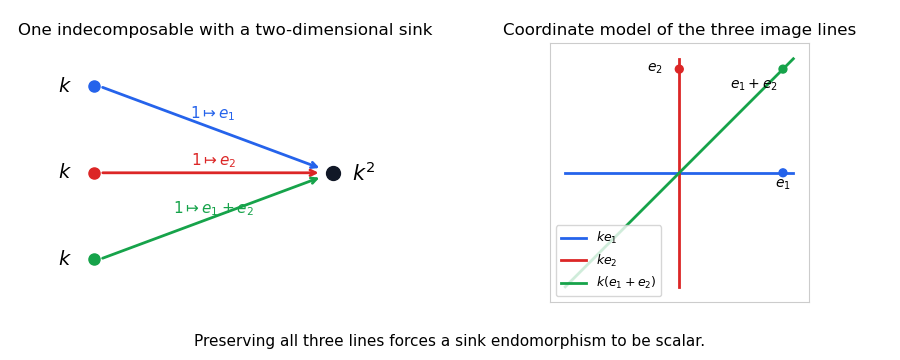
Exceptional three-subspace representation with a two-dimensional sink and three distinct image lines
. Details. 
Set , , and let be the action of the arrow on . Write , a left projective module. The standard projective resolution of a quiver representation isThe algebra acts on the first tensor factor. The augmentation is . On the summand for , the differential sends to in the -summand minus in the -summand. Here , so . These formulas specify every term and map, and .
Exactness is the standard path resolution fact: the relations identify a path acting on a vector with successively applying its arrows; uniqueness of the first traversed arrow supplies injectivity of the relation map. Each is a direct summand of because is an idempotent, and tensoring with a -vector space gives a direct sum of copies of . Both terms preceding are consequently projective modules. Thus the displayed sequence is a projective resolution of length at most one.
The same path resolution works for arbitrary left modules, with possibly infinite-dimensional and arbitrary direct sums of projective modules. Hence every left -module has projective dimension at most one. Equivalently, is a left hereditary ring: if with projective, dimension shifting gives for every , so is projective. This argument also covers quivers with oriented cycles.
For dimension vectors , define the Ringel formApply to the projective resolution. Evaluation at identifies with . Consequently there is an exact sequencewhereThis is the extension complex of quiver representations. Taking its alternating dimension sum yields
Let and . Consider the map from the arrow term of the extension complex of quiver representations to that restricts its -component to and then takes the quotient in . This map is surjective: a map can be lifted to and extended from to .
Every coboundary is killed by this map, since for ,It therefore induces a surjectionBoth vector spaces in the final Hom functor are nonzero, so its dimension is positive. Hence . This is the kernel-cokernel obstruction to splitting a quiver extension and remains valid for loops and repeated arrows elsewhere in the quiver.
If an arrow map failed to have maximal matrix rank, it would have both a nonzero kernel of a linear map and a nonzero cokernel. Apply the preceding obstruction with . It would give , contrary to the assumption. Therefore every arrow map is injective or surjective, equivalently its rank is the minimum of the two vertex dimensions. This is a necessary property of a rigid quiver representation.
We first record why rigid quiver representations have open orbits. Let , and . The stabilizer is , the nonempty open set of units in , so it has dimension . The dimension formula for an algebraic group homomorphism, or the same constant-fiber argument for the orbit map, givesBy the Ringel form identity and , this equals . An algebraic-group orbit is locally closed; since is an irreducible affine space, this full-dimensional orbit is open and dense.
Write for the composed path. Each matrix entry of is a polynomial function on . Since , change of basis makes it zero on all of , hence on all of by density. Suppose instead that . The condition ensures that every vertex space visited by is nonzero. Choose a vector and a functional with at every vertex visited by . Assign to every arrow occurring in the map , and assign arbitrary maps, say zero, to the other arrows. At this representation, the path carries its initial chosen vector to its final chosen vector, so is nonzero, a contradiction.
The construction uses a single assigned map per arrow, so it still works if an arrow or vertex occurs repeatedly in the path. ThereforeThis proves the path identities in a rigid quiver representation claim for an arbitrary quiver. Maximal rank of the individual arrows alone would not justify the conclusion about their composition.
The dimension of a topological space by irreducible chains is the supremum of the integers for which there is a chain of nonempty irreducible closed subsets of the space. Closedness here is relative to the given locally closed space. For varieties this is their Krull dimension.
An algebraic group is a group whose underlying space is an algebraic variety and whose multiplication and inversion are morphisms. An algebraic group action on a variety is a morphism satisfying the identity and associativity axioms of a group action.
For the homomorphism , the kernel is , so the kernel is closed. To prove closedness of the image, use the Chevalley constructibility theorem: the image of a morphism of varieties is constructible. Thus is a constructible subset of a variety and an abstract subgroup. Its closure is also a subgroup: translation by elements of preserves , and continuity then extends multiplication and inversion to .
A dense constructible subset contains a dense open subset of its closure. For , both and are dense open subsets of , so their intersection is nonempty. If with , then . Hence , proving that the image is closed. This is the principle that a constructible subgroup is closed.
Every nonempty fiber of is a translate of and has that same dimension. The fiber dimension theorem therefore givesThis dimension formula for an algebraic group homomorphism is a dimension statement, so it does not require separability of .
For a dimension vector of a quiver representation , setThe base change action on quiver representations isThe entries are regular functions on the product of the general linear groups and the quiver representation space, because inverse entries are cofactors divided by the invertible determinant. Thus this is an algebraic group action.
For nonzero , let be the common scalar subgroup and define . Common scalars act trivially, so the formula descends to an algebraic group action of this projective base change group of a quiver. This is a quotient by one common scalar, not a product of the individual projective groups. If every , the representation space is a point and both actions are taken to be trivial.
An algebraic group is connected when its underlying Zariski topology is a connected space. An unipotent algebraic group is a linear algebraic group whose elements, in a faithful matrix realization, satisfy that is nilpotent. A reductive algebraic group, in the connected convention, is a connected linear algebraic group whose unipotent radical is trivial: it has no nontrivial connected normal unipotent algebraic subgroup.
Let . It is a finite-dimensional associative algebra, and . The latter is the nonempty open subset where the determinant on is nonzero. Since the affine space is irreducible, this open subset is irreducible and hence connected. It is a linear algebraic group: within it is cut out by the linear equations of preserving the vertex summands and commuting with the arrow maps. Thus the automorphism group is connected.
By the Krull–Schmidt theorem, write , with pairwise nonisomorphic indecomposables . The Fitting lemma makes each a local algebra. Its residue division algebra is : every element of a finite-dimensional division algebra over the algebraically closed field has an eigenvalue for left multiplication, and subtracting that scalar gives a noninvertible element, hence zero.
The standard radical description of the endomorphism algebra of a Krull-Schmidt decomposition therefore givesConcretely, maps between nonisomorphic summands lie in the radical, while on each isotypic block one reduces all entries modulo the local radical. The off-diagonal rule follows because a composition cannot be a unit for : it would split off the indecomposable , forcing an isomorphism. The finite-dimensional radical description then identifies the kernel of this block reduction with . Put . The Jacobson radical of the finite-dimensional algebra is nilpotent, so every is a unit and is unipotent on . Also is closed, being the translate of the linear subspace , and normal, being the kernel ofThis map has an explicit algebraic section: after fixing the direct-sum decomposition, a matrix acts on the copies by . These block actions give a subgroup with trivial intersection with . Every unit is uniquely a product of an element of and one of . HenceThis Levi decomposition of a quiver automorphism group holds in every characteristic; the section is constructed directly from the multiplicity spaces.
A representation of the one-arrow quiver is an matrix . If , changes of basis put it in the form with an identity block and all other entries zero. Since multiplication by invertible matrices preserves matrix rank,This describes the orbit for every , including the zero orbit. Its dimension isIndeed, choosing its -dimensional image contributes parameters in a Grassmannian, and choosing a surjective map from onto that image contributes . This is a rank orbit of a matrix under left-right multiplication.
If , the component maps are invertible and satisfy . Thus they define a quiver representation isomorphism . Conversely, any such isomorphism consists of invertible maps , and its commuting squares rearrange to . ThereforeThe base change action on quiver representations consequently identifies its orbits exactly with isomorphism classes at fixed dimension vector of a quiver representation.
Split the sequence as vector spaces at each vertex. In these coordinates, the middle arrow maps have block formFor , change basis by at every vertex. It changes the off-diagonal block to . These arrow matrices depend polynomially on and at give . Thus the split extension as a degeneration showsWe must check that the two orbits are different. If , apply to the original short exact sequence. Exactness makes the kernel of equal to . The assumed isomorphism of the middle representation gives , so this map is surjective. In particular the identity of lifts to , splitting the sequence, a contradiction. Hence the orbits are indeed distinct.
The group is irreducible, so is irreducible. An algebraic-group orbit is locally closed, hence open in its closure; its boundary is a proper closed subset of smaller dimension. The distinct orbit lies in that boundary. Therefore
An acyclic finite quiver has integer vertex weights such that for every arrow ; for example, let be the maximum length of a path ending at . For , act by . ThenEvery exponent is positive. The arrow matrices therefore extend polynomially to with all arrows zero, which is the origin of the quiver representation space. The values for lie in , soThis proves that acyclic quiver representations degenerate to zero, also when some vertex spaces are zero.
A nonzero finite-dimensional quiver representation is a brick module when . If with both summands nonzero, projection onto is an idempotent endomorphism different from zero and the identity. That is impossible in . Hence every brick is indecomposable.
For the requested converse counterexample, take the dual-number algebra and its left regular module . The algebra is local with maximal ideal , and it is not simple because this is a nonzero proper ideal. The module is indecomposable: its endomorphism ring is , which has no nontrivial idempotents. But this ring has dimension two over , so the regular module is not a brick. Thus indecomposable need not mean brick without the positive-definiteness hypothesis used below.
Use the allowed Ringel lemma on bricks in the following precise form: a finite-dimensional indecomposable quiver representation that is not a brick module contains a nonzero brick with .
Suppose such a nonbrick indecomposable existed, and let . The Tits form of a quiver is , so the Ringel form identity would givePositive definiteness gives for nonzero , a contradiction. Therefore every indecomposable is a brick.
If is indecomposable, part (i) makes it a brick module. For its nonzero dimension vector of a quiver representation ,The Tits form of a quiver takes integer values on integer vectors, so and has no self-extensions.
Conversely, suppose has nonnegative integer entries and . Choose a representation of that dimension vector whose orbit has maximal dimension. Such an orbit exists because dimensions are integers bounded by . If with nonzero , a nonzero extension in either direction would, by part 5(c), produce a middle representation of the same dimension vector with larger orbit. Hence .
Writing and , the Ringel form identity then givesThe last inequality uses positive integral values of at both nonzero vectors. This contradiction makes indecomposable. Thus the indecomposable dimension vectors are exactly the positive roots .
An indecomposable of dimension vector is a brick module and has by the previous parts. Its automorphism group of a quiver representation has dimension one. ThereforeIt follows that its orbit is open and dense in the irreducible quiver representation space. Two different indecomposables of the same dimension vector would give two disjoint nonempty open orbits. Nonempty open subsets of an irreducible space must intersect, so this is impossible. Hence an indecomposable is uniquely determined by its dimension vector, up to isomorphism. This is the positive definite Tits form indecomposable classification.
If is empty, there are no nonzero indecomposables and the conclusion is immediate. Otherwise positive definiteness of the Tits form of a quiver gives a constant with for every real vector : take the minimum of on the compact unit sphere. Every positive root of a quiver therefore satisfies . Only finitely many nonnegative integer vectors lie in this bounded set. Parts (ii) and (iii) give exactly one indecomposable isomorphism class for each such root, and no others. Consequently has finite representation type.
Number the vertices consecutively along the underlying chain. Orientation does not affect the quadratic Tits form of a quiver:If has nonnegative integer coordinates and , the sum of integer squares on the right is . There are therefore exactly two nonzero consecutive differences, each of absolute value one. Their sum is zero, so one is and the other . Nonnegativity forces the to occur first. Thus the positive roots of type A are exactly the vectors with a single nonempty interval of ones and zeros elsewhere.
There is one such vector for every pair of endpoints , givingFor , the full list isThe difference-of-coordinates proof includes and is independent of the chosen arrow orientation.
Articles by others on the same topic
There are currently no matching articles.