Decompose the original scalar field as , where has support in and has support in . This is a momentum-shell decomposition of a scalar field. The two collections of integration variables are disjoint. Define the lower-scale Wilsonian effective action by integrating out the second collection:A field-independent normalization may be retained as a vacuum term or absorbed into the measure. Integrating this identity over the low modes recovers the original Euclidean path integral, so it preserves all observables depending only on those modes.
Put . The quadratic cross terms integrate to zero: in Fourier transform variables each pairs a low momentum with its negative, which cannot be a shell momentum. Expanding the interaction therefore givesFactoring out of the shell integral and taking minus its logarithm yieldsThis definition is a Wilsonian effective action, rather than a Legendre transform generating only one-particle-irreducible Feynman diagrams.
Let the shell-restricted scalar propagator beWrite and average with the normalized Gaussian shell measure. The cumulant expansion givesThe subtraction removes disconnected Feynman diagrams; the logarithm retains connected Feynman diagrams made from shell contractions. This is the connected shell-contraction expansion. An external line denotes the background low field, not an additional low-momentum propagator.
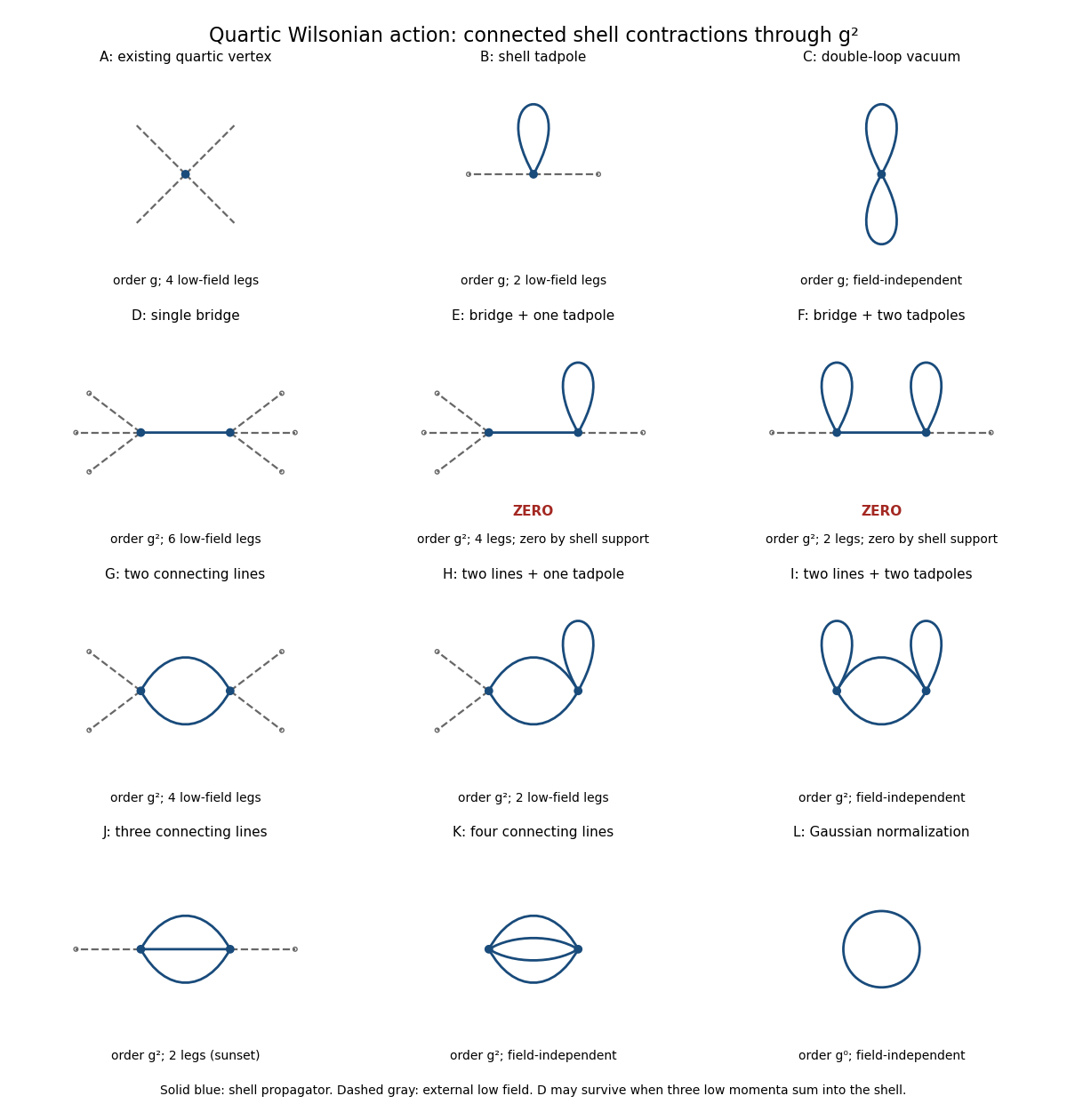
Connected quartic shell diagrams through second order, including vacuum terms and the two momentum-support zeros
. Details. 
At order , panel A is the existing four-field interaction vertex. The new shell contractions are B, a tadpole diagram contributing a two-field vertex, and C, a Vacuum Feynman diagram contributing a constant. The Gaussian functional determinant in panel L is another field-independent term, of order ; the original quadratic kinetic term and mass term are retained as well.
For completeness, all two-vertex topologies from Wick contractions at order are shown. Let be the number of shell lines joining the vertices and their numbers of self-contractions. The external-field counts areInterchanging the two vertices identifies the same topology. Enumerating these conditions gives exactly the following eight possibilities:
- D: , with ; a six-field vertex kernel.
- E: , with ; a formal four-field kernel, which vanishes for the sharp shell split.
- F: , with ; a formal two-field kernel, which also vanishes for the sharp shell split.
- G: , with ; a four-field vertex kernel.
- H: , with ; a two-field vertex kernel, containing a tadpole diagram.
- I: , with ; a connected Vacuum Feynman diagram.
- J: , with ; the two-field sunset diagram kernel.
- K: , with ; a connected Vacuum Feynman diagram with four joining lines.
The support qualification is important. In E or F, a vertex with one external low field and one bridge also has a tadpole whose two momenta cancel. Conservation forces the bridge momentum to equal that single low momentum, outside the shell. Equivalently, convolution by annihilates . This is momentum-support exclusion for Wilsonian bridge diagrams. D is different: its bridge carries the sum of three low momenta, which can lie in the shell. Its kernel is proportional to and need not vanish. Thus one-particle-reducible Feynman diagrams must not be excluded merely because the object being computed is an effective action.
These kernels need not be local before a derivative expansion. Their momentum dependence generates derivative interactions where such an expansion is valid. If all external momenta are sufficiently far below , D vanishes too; in particular it does not produce a zero-momentum local coupling at order . A local six-field term is allowed and is generated at higher orders, for example by a three-vertex shell triangle.
To all orders, expect every scalar interaction allowed by the original symmetries: arbitrary even powers of the field and their allowed derivative couplings, together with vacuum terms. The Z2 symmetry excludes odd-field vertices. The original quartic form is therefore not closed under exact Wilsonian integration.
After integrating out the shell, let a chosen operator's coefficient be and write the two-derivative quadratic term as . Here is the shell-induced change before rescaling, and is the shell correction to the wavefunction renormalization. Work in an operator basis in which that quadratic term has this form; the other generated operators remain in the Wilsonian effective action.
Under , the volume element changes by and each derivative by . Canonical field normalization is restored by definingIndeed, the volume factor, two derivatives and two field factors cancel in the kinetic term. A term with fields and derivatives consequently obtains the factor . HenceThis is Wilsonian rescaling of a scalar coupling. The exponent is minus the coupling's engineering mass dimension, . The rescaling also returns the low-momentum cutoff to , because .
Articles by others on the same topic
There are currently no matching articles.