Spectrum and symmetry. Choose a vacuum expectation value . In unitary gauge the scalar field is , with real . The Pauli matrix multiplication law gives . Since is symmetric in gauge indices, only this symmetric product contributes. The kinetic and potential terms therefore becomeComparison with and givesThese are the scalar interactions after complete SU2 breaking. The scalar mass uses the specified potential normalization: the prefactor is important.
A nonzero complex doublet has trivial stabilizer in : a matrix fixing must have second column , and unitarity and determinant one then fix the first column too. Thus all three gauge generators are broken. Three scalar angular directions are absorbed by the Higgs mechanism, giving each gauge boson a longitudinal polarization. The physical degrees of freedom count isThere is no surviving electromagnetic in this theory: it contains only the gauged , not the electroweak product group. The would-be Goldstone bosons are not additional physical massless particles. This is complete breaking by an SU2 scalar doublet.
Scalar interactions. In unitary gauge, all interaction terms containing the physical scalar areThese give , , , and Feynman vertices. Their factors are respectively , , , and , including the identical-leg multiplicities. Gauge-dependent descriptions also contain the absorbed scalar modes; the above are all physical-scalar interactions in the chosen gauge.
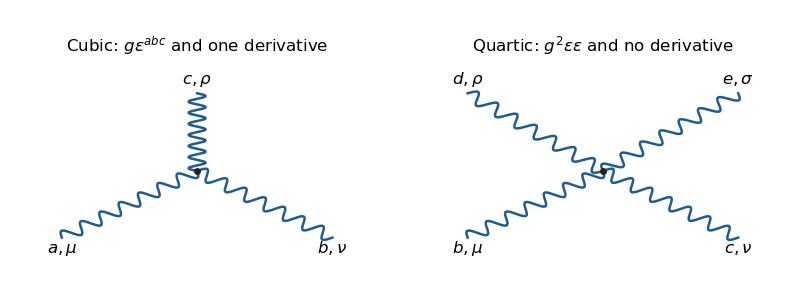
Gauge self-interactions. Write . Expanding the field-strength square gives the cubic and quartic piecesThe sign of the cubic term follows from the minus sign in the given nonlinear field strength. The quartic term can also be written using . The cubic Feynman vertex joins three wavy gauge lines, has one momentum factor, and is proportional to . The quartic Feynman vertex joins four wavy lines, is proportional to , and has products of structure constants with metric contractions. There are no higher pure-gauge vertices in this Lagrangian. These are the SU2 gauge self-interaction vertices.
Articles by others on the same topic
There are currently no matching articles.