Field transformation. The mode expansion of a Dirac field isCharge conjugation exchanges particle and antiparticle operators. Choose their phases so thatThe conjugate relations for creation and annihilation operators preserve their canonical anticommutation relations. Thus the transformed expansion is times the same integral with replaced by and replaced by . On the other hand, transposing the adjoint expansion gives . The given spinor identities identify these expressions, proving
Symmetry of the spin matrix. Transposing gives . Substitute and multiply on the right by :The complex four-dimensional Clifford algebra representation generated by the gamma matrices is irreducible; equivalently its sixteen independent gamma products span the full matrix algebra. The Schur lemma therefore gives . Hence . Transposing once more gives , so andThis is the transpose symmetry of a charge-conjugation matrix. The given antisymmetric choice is consistent with this conclusion.
Equation of motion. Taking the adjoint of the free Dirac equation yields . Its transpose, multiplied by , isThe defining matrix relation converts this intoThus the charge conjugation of a Dirac field maps free solutions to free solutions. With an external electromagnetic field, its charge would also reverse; no such background is present here.
Chirality. Define the chiral projectors and . The operator acts on the field operators and commutes with these numerical matrices:The transformed component is therefore left-chiral, as requested. There is a useful distinction: the algebraic charge conjugate of a left-chiral spinor is right-chiral. Indeed and giveThis is the operator conjugation of a chiral field component; it avoids confusing projection after operator conjugation with charge conjugation of the already projected spinor.
Baryogenesis. Consider equal initial populations of a heavy particle and its antiparticle, with two baryon-number-violating decay channels carrying different final baryon numbers . Let and be the branching fractions into a channel and its antiparticle channel. The net baryon number produced per initial particle-antiparticle pair isExact charge conjugation symmetry equates the conjugate branching fractions and makes this vanish. Exact CP symmetry also equates the fully summed conjugate decay rates, because parity reverses momenta and helicities without changing baryon number. Thus both violation of charge conjugation and CP violation are necessary for generating an asymmetry from a symmetric initial state.
Violation of charge conjugation alone can generate a helicity asymmetry while leaving total baryon number zero. For example, with denoting helicities, CP symmetry may enforce and the analogous relation with exchanged, even when same-helicity charge-conjugate rates differ. The CP rate cancellation in baryogenesis means that summing over helicities cancels the baryon asymmetry. These are the symmetry requirements in the Sakharov conditions; baryon-number violation and departure from thermal equilibrium are also needed in the conventional decay mechanism.
Spectrum and symmetry. Choose a vacuum expectation value . In unitary gauge the scalar field is , with real . The Pauli matrix multiplication law gives . Since is symmetric in gauge indices, only this symmetric product contributes. The kinetic and potential terms therefore becomeComparison with and givesThese are the scalar interactions after complete SU2 breaking. The scalar mass uses the specified potential normalization: the prefactor is important.
A nonzero complex doublet has trivial stabilizer in : a matrix fixing must have second column , and unitarity and determinant one then fix the first column too. Thus all three gauge generators are broken. Three scalar angular directions are absorbed by the Higgs mechanism, giving each gauge boson a longitudinal polarization. The physical degrees of freedom count isThere is no surviving electromagnetic in this theory: it contains only the gauged , not the electroweak product group. The would-be Goldstone bosons are not additional physical massless particles. This is complete breaking by an SU2 scalar doublet.
Scalar interactions. In unitary gauge, all interaction terms containing the physical scalar areThese give , , , and Feynman vertices. Their factors are respectively , , , and , including the identical-leg multiplicities. Gauge-dependent descriptions also contain the absorbed scalar modes; the above are all physical-scalar interactions in the chosen gauge.
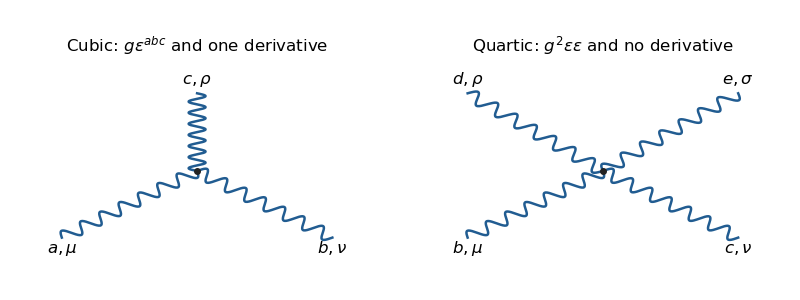
Gauge self-interactions. Write . Expanding the field-strength square gives the cubic and quartic piecesThe sign of the cubic term follows from the minus sign in the given nonlinear field strength. The quartic term can also be written using . The cubic Feynman vertex joins three wavy gauge lines, has one momentum factor, and is proportional to . The quartic Feynman vertex joins four wavy lines, is proportional to , and has products of structure constants with metric contractions. There are no higher pure-gauge vertices in this Lagrangian. These are the SU2 gauge self-interaction vertices.

Only a -channel Z boson connects the muon-neutrino line to the electron line. Its endpoints are the weak neutral current vertices and . A W boson couples to a muon, so it cannot produce an additional elastic charged-current diagram with external electrons. There is no photon-neutrino vertex, and a strictly massless Standard Model neutrino has no Higgs Yukawa vertex. There is one diagram.
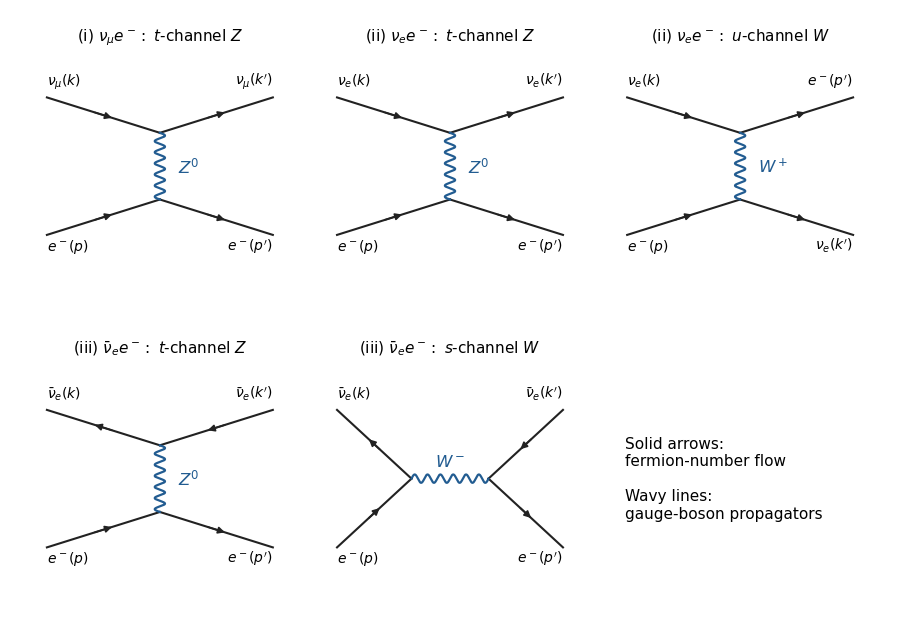
All five tree-level weak diagrams for muon-neutrino, electron-neutrino, and electron-antineutrino scattering on electrons
. Details. 
There are two diagrams: the -channel Z boson exchange from the weak neutral current, and a crossed -channel W boson exchange from the weak charged current. The charged-current vertices pair the incoming neutrino with the outgoing electron and the incoming electron with the outgoing neutrino . The exchanged momentum has square . With charge flow from the first vertex to the second, the exchanged boson is . The corresponding panels show both topologies; no photon or Higgs diagram survives the stated neutrino assumptions.
There are two diagrams: -channel Z boson exchange and -channel W boson exchange. The incoming electron and electron-antineutrino can annihilate into , which then produces the outgoing pair. The charged-current propagator carries momentum , hence invariant . The solid-line arrows in the diagram indicate fermion-number flow; those on antineutrino legs run opposite their physical motion.
Flavour issue in the printed effective interaction. The displayed charged-current factor uses an electron field even for the muon-neutrino term. Taken literally, this introduces an extra charged-current interaction, contradicting the Standard Model diagrams in part (a). In the Standard Model that factor uses the charged lepton of the same flavour; for electron scattering the charged-current contribution is therefore present only for . The weak flavour selection in neutrino-electron scattering fixes the physically consistent assignment used below. The literal printed consequence is given afterwards, so the discrepancy is explicit.
At leading order in the electron mass and in the four-fermion regime, define . The weak neutral current yields the scattering amplitudeAn overall amplitude phase has no observable effect. The Fermi interaction is valid when the exchanged invariants are small compared with the squared weak-boson masses.
Average over the two initial electron spin states, and sum over final spins. There is no averaging over a sterile right-handed incoming neutrino. Using the fermion spin sum, the averaged square isTo display the trace contraction, defineThe supplied gamma matrix trace identities give the two tensors and . Symmetric-antisymmetric mixed contractions vanish. Set and . The remaining contractions are and , using the stated negative epsilon-contraction sign. Their sum givesThe massless Mandelstam variables satisfy , and the two products are and , respectively. Therefore
In the centre-of-momentum frame, momentum conservation gives . If is the angle cosine between and , then . The massless two-body Lorentz-invariant phase space is , while the flux is . ThusIntegrate and :Consequently the intended coefficients areThis is the massless neutrino-electron contact cross-section.
For completeness, the literal printed muon-neutrino charged-current term would instead shift both couplings by one, exactly as in part (c):For arbitrary real , its linear terms cannot be represented by the requested quadratic form with coupling-independent constants. The Standard Model result and the literal printed interaction are not the same problem.
For electron-neutrino scattering the weak charged current adds an electron left-current. The supplied Fierz rearrangement has a minus sign for matrix components; the extra minus from ordering the external fermions cancels it. Accordingly the charged contribution is constructive in the neutrino-current/electron-current ordering used in part (b):Thus is obtained from the physically consistent by , . The right-electron coupling is unchanged, while the left-electron coupling increases by two. This is the charged-current shift in neutrino-electron scattering.
For the antineutrino, choose the external phase convention in whichThe reversed ordering of the antineutrino spinors implements crossing symmetry; the displayed overall sign can be changed by an external-state phase. Its neutrino trace has the opposite antisymmetric part, so the and weights exchange:The phase-space integration already performed in part (b) immediately givesEquivalently, with , these are and . This is the neutrino-antineutrino interchange of chiral scattering weights. It uses the contact limit, not the full resonant -channel propagator.
If the printed flavour-mismatched interaction is retained literally, its amplitude already equals the displayed amplitude. There is then no further flavour shift between those two processes, although antineutrino crossing still exchanges the weights. The distinction identified in part (b) is therefore necessary for the Standard Model interpretation of all three processes.
Use the weak hypercharge normalization . Write and the hypercharge transformation as . A left-handed doublet transforms as , while a right-handed singlet transforms as . The Higgs doublet transforms as .
The representations per fermion generation are:
| Field | in | in | ||
|---|---|---|---|---|
There is no right-handed neutrino in the minimal Standard Model. If such a sterile singlet were added, its hypercharge would be zero. The two hypercharge columns give equivalent normalizations, not different physical assignments. This is the electroweak representation and hypercharge table.
Yukawa interactions use for down-type quarks and charged leptons, but for up-type quarks. The conjugate doublet transforms as , using the pseudoreality of the fundamental representation. For example, the hypercharge sums in the down, charged-lepton, and up terms areThe doublet indices contract between and the scalar, and colour indices contract in the quark terms. This verifies gauge invariance.
The indices label fermion generations, specifying which left-handed family and right-handed family are coupled. They are not weak-isospin indices. Each fermion type has its own complex Yukawa matrix. After symmetry breaking these matrices determine masses; the mismatch of the two quark left-handed mass rotations produces the CKM matrix. Left fields are weak doublets, right fields are weak singlets, and the scalar is a hypercharge- doublet in the stated convention.
Allowed via a charged-current weak decay. The quark emits a virtual in , followed by . The relevant terms are the quark and lepton weak charged currents, with amplitude proportional to the CKM matrix element . At low energy their product gives a four-fermion interaction of the form plus its conjugate.
Allowed through second-order weak interactions, not a tree-level neutral-current vertex. This is the flavour-changing transition responsible for neutral kaon mixing, with change of strangeness by two. Box Feynman diagrams contain two W bosons and internal up-type quarks. Their vertices come from the weak charged current and contain CKM matrix factors. At low energy they generate an operator plus its conjugate. The GIM mechanism cancels the flavour-independent part of the internal-quark sum; unequal quark masses leave a nonzero loop amplitude.
The coupling is allowed, with an on-shell threshold condition. The Higgs field kinetic term producesand hence a tree-level Feynman vertex. A decay into two real W bosons requires for nonzero phase space. Below that threshold the vertex still mediates or decays through two virtual bosons into fermions. Thus an allowed Lagrangian coupling does not by itself guarantee an on-shell two-body decay.
Absent in the minimal Standard Model. The single charged-lepton Yukawa matrix supplies both the fermion mass matrix and the Higgs coupling, so the same left/right rotations diagonalize both. There is no off-diagonal vertex. With massless neutrinos, the separate charged-lepton family numbers prevent this transition perturbatively. If neutrino masses and mixing are added, loop-induced charged-lepton flavour violation can occur but is extremely suppressed; a sizeable rate would require an additional source of flavour violation. Part (c) provides one such source.
A larger-than-predicted rate can be described by adding new fields and symmetry-respecting renormalizable interactions, or, when those fields are much heavier than the energy being probed, by an effective field theory. In the latter description, add gauge-invariant operators with Wilson coefficients divided by appropriate powers of a heavy scale. Their interference with existing amplitudes, or their leading contribution to an otherwise forbidden amplitude, can enhance a decay. The operators should respect the Standard Model gauge group and be consistent with other observables; writing an arbitrary flavour-changing term without its electroweak completion is insufficient.
For charged leptons, the proposed operator has mass dimension six: the fermion bilinear contributes three, the scalar doublet one, and two. Its hypercharge vanishes by the same calculation as the renormalizable lepton Yukawa interaction, and the extra factor is a gauge singlet. Thus its coefficient scales as .
In unitary gauge, , so the renormalizable and dimension-six terms combine intoThe charged-lepton fermion mass matrix and the single-Higgs Yukawa matrix are thereforeThis is the dimension-six Higgs Yukawa misalignment. Let and . In the mass basis,The two matrices need not be aligned. Choosing a nonzero off-diagonal or produces the required charged-lepton flavour violation while keeping the fermion mass matrix diagonal.
For example, the amplitude for is, up to an overall phase,Neglecting the final lepton masses, summing spins gives . The conjugate charge channel has the same rate. The summed width isThis demonstrates an enhancement that is absent in the minimal renormalizable theory. It requires flavour misalignment: an added matrix aligned with the original Yukawa matrix would not generate these decays. The same operator also predicts double-Higgs and triple-Higgs lepton interactions through the remaining powers of .
Articles by others on the same topic
There are currently no matching articles.