Only a -channel Z boson connects the muon-neutrino line to the electron line. Its endpoints are the weak neutral current vertices and . A W boson couples to a muon, so it cannot produce an additional elastic charged-current diagram with external electrons. There is no photon-neutrino vertex, and a strictly massless Standard Model neutrino has no Higgs Yukawa vertex. There is one diagram.
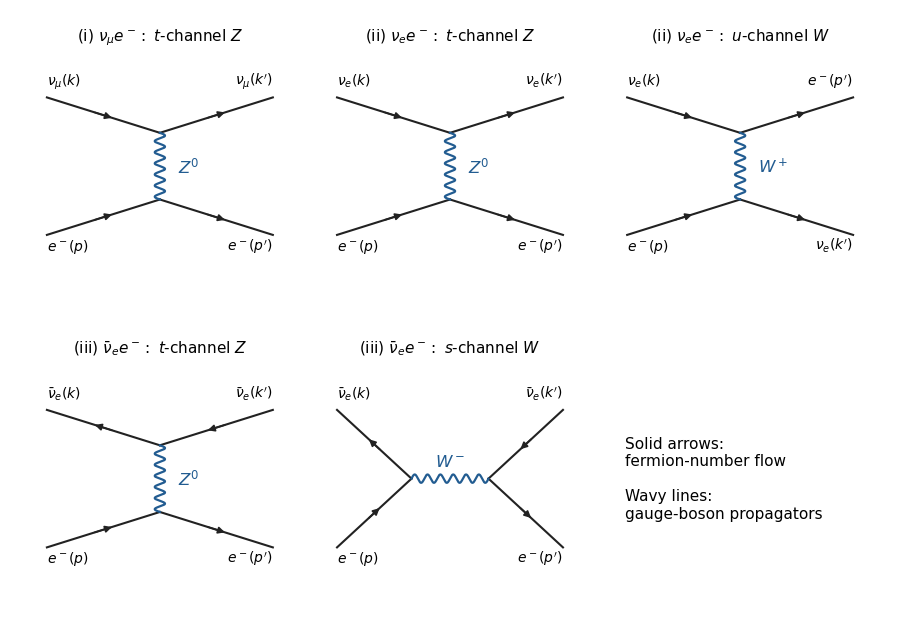
All five tree-level weak diagrams for muon-neutrino, electron-neutrino, and electron-antineutrino scattering on electrons
. Details. 
There are two diagrams: the -channel Z boson exchange from the weak neutral current, and a crossed -channel W boson exchange from the weak charged current. The charged-current vertices pair the incoming neutrino with the outgoing electron and the incoming electron with the outgoing neutrino . The exchanged momentum has square . With charge flow from the first vertex to the second, the exchanged boson is . The corresponding panels show both topologies; no photon or Higgs diagram survives the stated neutrino assumptions.
There are two diagrams: -channel Z boson exchange and -channel W boson exchange. The incoming electron and electron-antineutrino can annihilate into , which then produces the outgoing pair. The charged-current propagator carries momentum , hence invariant . The solid-line arrows in the diagram indicate fermion-number flow; those on antineutrino legs run opposite their physical motion.
Flavour issue in the printed effective interaction. The displayed charged-current factor uses an electron field even for the muon-neutrino term. Taken literally, this introduces an extra charged-current interaction, contradicting the Standard Model diagrams in part (a). In the Standard Model that factor uses the charged lepton of the same flavour; for electron scattering the charged-current contribution is therefore present only for . The weak flavour selection in neutrino-electron scattering fixes the physically consistent assignment used below. The literal printed consequence is given afterwards, so the discrepancy is explicit.
At leading order in the electron mass and in the four-fermion regime, define . The weak neutral current yields the scattering amplitudeAn overall amplitude phase has no observable effect. The Fermi interaction is valid when the exchanged invariants are small compared with the squared weak-boson masses.
Average over the two initial electron spin states, and sum over final spins. There is no averaging over a sterile right-handed incoming neutrino. Using the fermion spin sum, the averaged square isTo display the trace contraction, defineThe supplied gamma matrix trace identities give the two tensors and . Symmetric-antisymmetric mixed contractions vanish. Set and . The remaining contractions are and , using the stated negative epsilon-contraction sign. Their sum givesThe massless Mandelstam variables satisfy , and the two products are and , respectively. Therefore
In the centre-of-momentum frame, momentum conservation gives . If is the angle cosine between and , then . The massless two-body Lorentz-invariant phase space is , while the flux is . ThusIntegrate and :Consequently the intended coefficients areThis is the massless neutrino-electron contact cross-section.
For completeness, the literal printed muon-neutrino charged-current term would instead shift both couplings by one, exactly as in part (c):For arbitrary real , its linear terms cannot be represented by the requested quadratic form with coupling-independent constants. The Standard Model result and the literal printed interaction are not the same problem.
For electron-neutrino scattering the weak charged current adds an electron left-current. The supplied Fierz rearrangement has a minus sign for matrix components; the extra minus from ordering the external fermions cancels it. Accordingly the charged contribution is constructive in the neutrino-current/electron-current ordering used in part (b):Thus is obtained from the physically consistent by , . The right-electron coupling is unchanged, while the left-electron coupling increases by two. This is the charged-current shift in neutrino-electron scattering.
For the antineutrino, choose the external phase convention in whichThe reversed ordering of the antineutrino spinors implements crossing symmetry; the displayed overall sign can be changed by an external-state phase. Its neutrino trace has the opposite antisymmetric part, so the and weights exchange:The phase-space integration already performed in part (b) immediately givesEquivalently, with , these are and . This is the neutrino-antineutrino interchange of chiral scattering weights. It uses the contact limit, not the full resonant -channel propagator.
If the printed flavour-mismatched interaction is retained literally, its amplitude already equals the displayed amplitude. There is then no further flavour shift between those two processes, although antineutrino crossing still exchanges the weights. The distinction identified in part (b) is therefore necessary for the Standard Model interpretation of all three processes.
Articles by others on the same topic
There are currently no matching articles.