Use the fluid displacement , with velocity perturbation . Denote Eulerian perturbations by and the corresponding Lagrangian pressure perturbation by . For adiabatic perturbations, the linearized mass conservation, momentum, adiabatic equation of state and Poisson equation areThese self-gravitating adiabatic displacement equations retain the perturbation of the star's own Newtonian gravitational potential. In the uniform-density interior, , , and . The dynamical frequency of a uniform-density star sets the natural timescale. For a normal mode with time factor , replace by . The requested interior analysis needs no surface or exterior matching conditions.
The spatial factor is a regular solid harmonic. Besides the Laplace equation , homogeneity gives . The divergence of the fluid displacement isDefine the scalar dilation amplitude ; this is the quantity denoted in the question, not the notation for a Lagrangian pressure perturbation. Then mass conservation gives .
The equilibrium pressure gradient and homogeneity identity giveConsequently the adiabatic equation of state yieldsFor the force equations, the product rule givesEquating the coefficients of and in the self-gravitating adiabatic displacement equations givesFinally, applying the Laplacian to the gravitational perturbation givesso the Poisson equation becomesThese are the required interior equations for uniform-density stellar oscillation.
There is a radial degeneracy at : is spatially constant and , so the displacement is independent of . The second force equation then cannot be inferred by equating independent vectors. For nonzero it may be imposed as an auxiliary definition of , but it is not an additional physical radial equation. At zero frequency the radial equations should be used directly. This distinction matters for interpreting the zero factor in (c).
For the polynomial stellar-mode coefficient reduction, write the highest coefficients asSet , and . The highest powers in the equations of (b) giveThe factor follows from ; the positive term comes from the highest, negative coefficient of the equilibrium pressure.
For , the final spectrum found below has . Eliminating first givesThe remaining pressure relation isA nontrivial leading coefficient has , soThusor, in dimensional form,
For the printed stability continuation, define . The two branches for nonradial stellar oscillations areFor every , their product is . Therefore one branch oscillates and the other grows exponentially, for every positive . With the chosen time dependence, gives and growth rate . Increasing does not remove this nonradial instability. At large or large , is a stiff compressive branch, while is a slower unstable buoyancy branch.
The buoyancy frequency supplies the physical explanation. The background density has zero gradient, but pressure decreases outward:The specific entropy of the perfect gas decreases outward, because does. An adiabatically displaced fluid parcel therefore experiences destabilizing buoyancy. The model has convective instability of a uniform-density star, even when its radial compression modes are stable. The divergence of this expression at the zero-pressure surface also reflects the artificial equilibrium; the interior negative sign is already decisive.
For , the formal quadratic factors asThe physical radial displacement has no component. Using its equations directly givesIndeed , , and yield this result directly in the radial momentum equation. The extra identically zero factor in the two-component determinant need not represent an independent radial mode, since is redundant when .
The lowest allowed degree, , has . Hence all these radial modes are stable for ; the fundamental radial mode is marginal at and unstable below it. Higher have their individual thresholds . These radial stability of a uniform-density star thresholds coexist with nonradial convective instability. They are conclusions within the polynomial interior family assumed in the question; no boundary-condition quantization is being asserted.
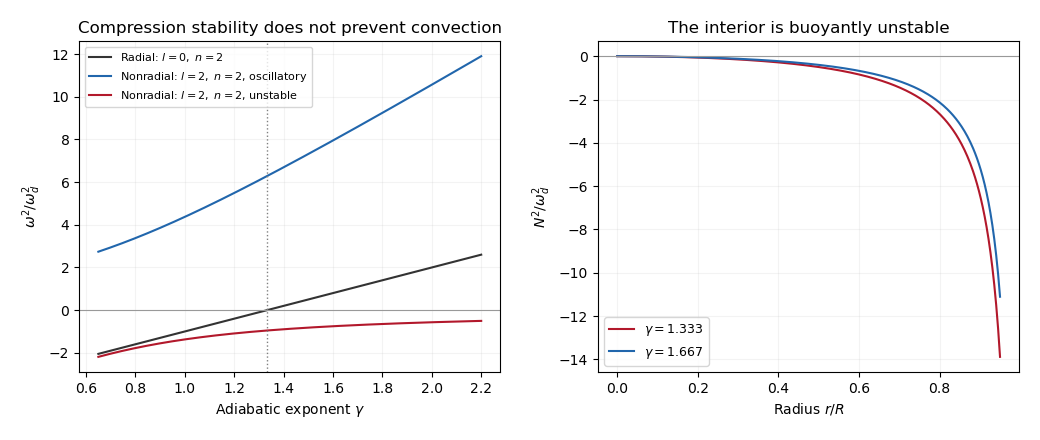
Radial and nonradial squared mode frequencies and the negative buoyancy frequency of a uniform-density gas star
. Details. 
Articles by others on the same topic
There are currently no matching articles.