On a sphere of radius rotating at angular speed , the Coriolis parameter is . Near latitude , write , use locally eastward and northward Cartesian coordinates, and expandThe beta plane retains the first northward variation of planetary vorticity while neglecting higher latitude dependence and metric curvature. A midlatitude local calculation assumes and ; near the equator the distinct equatorial beta plane has , so the midlatitude low-frequency reduction used below does not apply.
For a homogeneous shallow layer, the hydrostatic approximation gives and hence , , independently of depth. The approximation follows from the small aspect ratio and neglect of vertical acceleration. Differentiate the linear horizontal momentum equations in . Their depth derivatives obeyStarting from rest gives initially, and the unique solution remains zero. This establishes depth independence of hydrostatic shallow-water flow; an arbitrary pre-existing shear would not be removed merely by taking the hydrostatic approximation. Integrating the continuity equation between the rigid bottom and the moving surface gives at linear order. With the depth-integrated shallow-water transports , , one obtains
It is useful to make the coefficient approximation in the height reduction explicit. Put . Differentiating the two momentum equations in time and eliminating the other transport givesSince , taking their horizontal divergence and using the continuity equation givesApplying proves the exact variable-Coriolis shallow-water height equationAt the reference latitude, or after the usual local freezing of undifferentiated factors to , this gives the height relation written with . With over a finite region, that constant-coefficient version is a local approximation, not an exact identity. Keeping as above avoids silently commuting a variable Coriolis parameter through a spatial derivative.
For the slow Rossby wave branch, take , approximate by , and discard the two time-derivative terms on the right compared with . This is the regular midlatitude long-time ordering, with nondegenerate zonal variation. If , the result isThe printed low-frequency equation has the opposite right-hand sign. The minus sign follows directly from the preceding eliminated equation and is also the sign needed for the printed isofrequency-circle centre. An independent check uses geostrophic balance: , , and the shallow-water quasi-geostrophic potential vorticity is . Linear potential-vorticity conservation gives .
For , the shallow-water Rossby-wave dispersion relation isFor fixed and , it is odd in , zero at , negative for , and tends to zero from below as . Its minimum occurs at with . Thus both long and short waves have small frequency. The zonal phase velocity is westward, , whereas the zonal group velocity isIt changes sign at the frequency minimum.
At fixed nonzero frequency, completing the square yields the Rossby-wave isofrequency circleThe radius is real only if . For , the branch with has and a circle centred on the positive -axis. If instead the printed plus-sign wave equation is taken literally with this same Fourier convention, its dispersion is and its circle is centred at . These two conventions cannot be mixed.
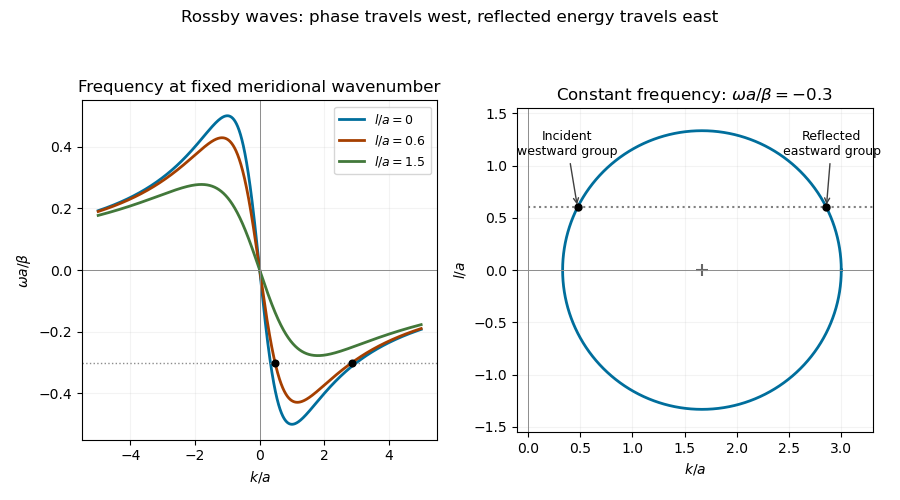
Rossby-wave frequency curves and a constant-frequency wavenumber circle showing a westward-group incident wave and an eastward-group reflected wave at a meridional wall
. For reflection of a Rossby wave at a meridional wall, the stationary wall preserves frequency, and its translation invariance in preserves the tangential wavenumber. Thus , . Both values solveTheir sum and product giveAn incident wave in travels toward the wall in group velocity, not necessarily in phase velocity. For , has , while its partner has . The double-root case has zero normal group velocity and does not describe a wave packet incident on the wall.
At leading quasi-geostrophic approximation, the impermeability condition is . For , the boundary condition givesThe reflected height therefore has equal amplitude and a phase change of . Equality here concerns the height or quasi-geostrophic streamfunction amplitudes in the reduced model. At the degenerate , geostrophic no-normal-flow is automatically satisfied and alone does not determine their ratio; the usual homogeneous wall-streamfunction condition supplies if imposed. Retaining the small ageostrophic transport changes the boundary condition towhich tends to in the regular low-frequency ordering but is not generally of unit modulus. In particular, gives in that more complete boundary relation. Thus the printed equal-amplitude assertion requires the nondegenerate leading quasi-geostrophic approximation, or an explicit homogeneous wall condition; it is not a general exact shallow-water reflection law.
Articles by others on the same topic
There are currently no matching articles.