Use three states of a continuous-time Markov chain: disease-free , pre-clinical , and clinical . The transition intensities are for onset and for progression. Clinical disease is an absorbing state. The mandatory pre-clinical phase excludes a direct jump, and this untreated progression model has no reverse transitions.
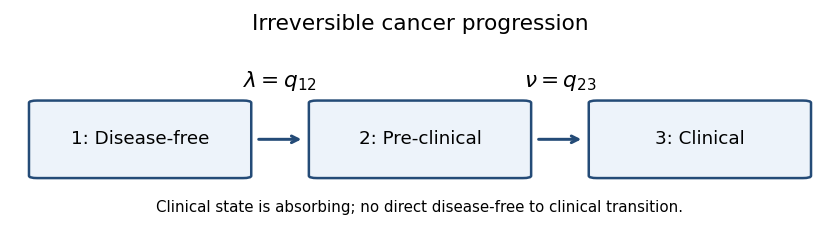

With row-vector probabilities and state order , the generator matrix isIts rows sum to zero, so only the two off-diagonal transition intensities are unknown. This is a continuous-time multi-state model with sequential irreversible progression.
Starting in state , the onset waiting time has the exponential distribution of rate . Thus the probability of onset before the next screen is . This counts individuals who have already progressed to clinical disease as well as those still pre-clinical.
Conditional on onset at time , the Markov property makes the remaining progression time exponential with rate . Thus the probability of clinical progression before the screen, conditional on that onset time, is .
Integrating over the onset density gives the unconditional clinical probabilityThe probability of being pre-clinical at the next screen is insteadTogether with and the exponential distribution for a patient initially in state , the transition matrix isThis equals the matrix exponential . The assumed unequal intensities avoid a zero denominator; at the continuous limit is .
Assume the 1000 individuals are initially disease-free. The event being counted is onset during the ten-year period, not occupancy of the pre-clinical state at its end. Using the estimated transition intensity as a constant onset rate and linearity of expectation, the expected number of onsets isThe first-order approximation is close, but does not account for depletion of the disease-free group.
Let be age in years at follow-up time and let indicate the genetic risk factor. An age-dependent log-linear transition intensity model isHere is the onset baseline hazard for a 50-year-old without the factor; is the genetic hazard ratio, and is the hazard ratio per additional year of age. A smooth function of age could replace the linear age term if a constant age hazard ratio were unsuitable.
Under the stated constant multiplicative hazard ratios, the requested extrapolation is therefore the baseline rate times both multipliers:
Age changes during follow-up, so the generator matrix changes with time. The transition matrix must solve , with . It is generally not the matrix exponential of one constant matrix; even is not generally valid because the matrices at different times need not commute.
For example, write the age-dependent onset rate as and keep progression rate constant. ThenEven when the integrated onset rate is elementary, this remaining integral need not have an elementary closed form. Special cases can have closed forms; time dependence does not by itself prove universal impossibility.
For a tractable likelihood function, freeze age at its left-endpoint value, or a midpoint value, on each observation interval . The genetic covariate is already constant. This piecewise-constant covariate approximation gives a constant matrix on each interval and a product of closed-form interval probabilities:Here is the observed state at , and the likelihood function is conditional on the initial state. The approximation improves when intervals are short relative to the variation in the age effect.
Let be the false positive rate for a genuinely cancer-free person, encompassing the harmless-tumour misclassification, and assume screening errors are conditionally independent given the latent states. A pre-clinical case tests positive with probability one; a clinical case is separately recognized. Thus a negative screen identifies latent state , whereas a positive pre-clinical screen can arise from state or . This is a Hidden Markov model with a screening misclassification model.
Conditional on the negative baseline screen, the state at year is . The negative screen at year requires staying in state for two years and then testing negative. From that state, the positive screen at year can arise either with probability while still disease-free or through pre-clinical disease. Consequently the conditional likelihood isIf the study instead specifies an initially disease-free patient and includes the baseline screening result in the likelihood function, its probability contributes a further factor , givingThe formulas use the positive emission for a pre-clinical screen, with no clinical diagnosis in this record. A persistent harmless-tumour subtype producing correlated screening errors would need an additional latent-state or emission specification; its likelihood is not determined by the single parameter .
Articles by others on the same topic
There are currently no matching articles.