For a representative hydrogen-rich hot Jupiter, increasing altitude lowers pressure, slows collision-driven chemistry, and increases exposure to stellar UV. Three principal regimes follow.
At high pressures, illustratively -- bar, collisions and sufficiently high temperature make thermochemical equilibrium a useful approximation. Molecular abundances minimize the free energy subject to elemental conservation. Condensation and atmospheric condensate rainout can remove selected elements from the gas.
At intermediate pressures, illustratively bar, vertical mixing and horizontal winds can outrun chemical relaxation time. The chemical quench level is defined by ; above it, some abundances retain values from a deeper or hotter region. Horizontal chemical quenching similarly occurs when chemical adjustment is slower than advection between the day and night hemispheres.
At low pressures, illustratively bar, atmospheric photochemistry becomes important: photodissociation and radical reactions change equilibrium abundances and can produce hydrocarbons and atmospheric hazes. At still lower pressures, roughly bar and above in altitude, photoionization and an escaping thermosphere can become important.
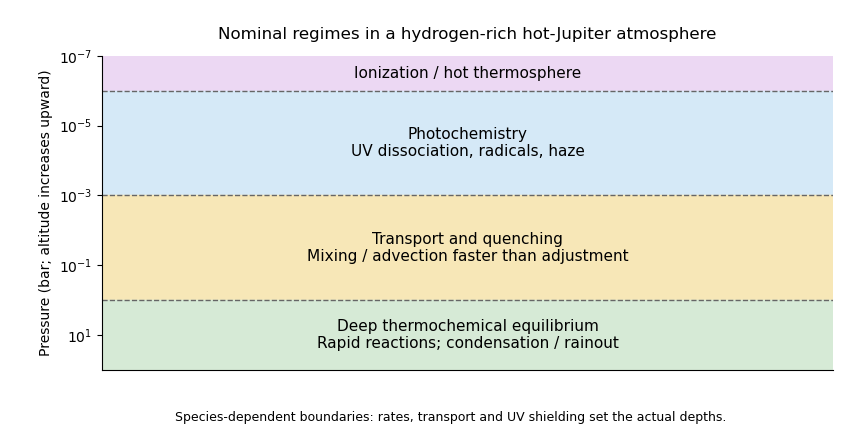
Nominal deep-equilibrium, transport-quenching and photochemical regimes in a hydrogen-rich irradiated atmosphere
. Details. 
These pressures label a representative sketch, not universal interfaces. UV optical depth, stellar spectrum, gravity, metallicity, reaction rates and eddy diffusivity determine the transitions; quenching is species-dependent.
Articles by others on the same topic
There are currently no matching articles.