For a representative hydrogen-rich hot Jupiter, increasing altitude lowers pressure, slows collision-driven chemistry, and increases exposure to stellar UV. Three principal regimes follow.
At high pressures, illustratively -- bar, collisions and sufficiently high temperature make thermochemical equilibrium a useful approximation. Molecular abundances minimize the free energy subject to elemental conservation. Condensation and atmospheric condensate rainout can remove selected elements from the gas.
At intermediate pressures, illustratively bar, vertical mixing and horizontal winds can outrun chemical relaxation time. The chemical quench level is defined by ; above it, some abundances retain values from a deeper or hotter region. Horizontal chemical quenching similarly occurs when chemical adjustment is slower than advection between the day and night hemispheres.
At low pressures, illustratively bar, atmospheric photochemistry becomes important: photodissociation and radical reactions change equilibrium abundances and can produce hydrocarbons and atmospheric hazes. At still lower pressures, roughly bar and above in altitude, photoionization and an escaping thermosphere can become important.
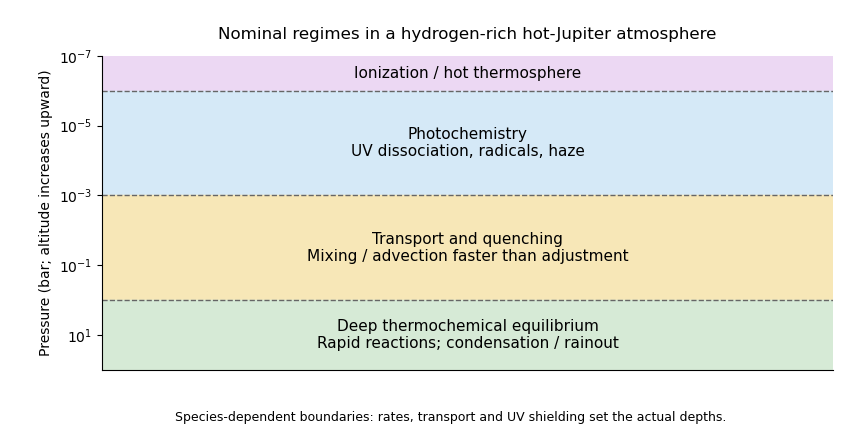
Nominal deep-equilibrium, transport-quenching and photochemical regimes in a hydrogen-rich irradiated atmosphere
. Details. 
These pressures label a representative sketch, not universal interfaces. UV optical depth, stellar spectrum, gravity, metallicity, reaction rates and eddy diffusivity determine the transitions; quenching is species-dependent.
Assume a hydrogen-rich gas with approximately solar elemental ratios and local thermochemical equilibrium when identifying the limiting compositions. At , a representative set of dominant molecules is . In the deeper regime, it is . Helium is an abundant atom, not a molecule. The carbon and nitrogen switches, carbon monoxide–methane quenching and nitrogen–ammonia quenching when frozen by mixing, are represented byLow temperature and high pressure favor the right-hand sides, while hotter gas favors carbon monoxide and . Exact boundaries depend on pressure and composition; can become important at high metallicity. If mixing is strong, the cool upper atmosphere need not retain its local-equilibrium four-species ordering.
To preserve the hot-region reactant aloft, require transport to beat its conversion at the quench region. With a mixing length and vertical eddy diffusivity ,For the simplest use of the supplied atmospheric scale height reference, assume the same temperature and mean molecular weight as the reference atmosphere and take . Since , , giving .
The hotter quench layer requires a temperature correction if the reference is ordinary Jupiter; the temperature of that scale-height reference was not specified. An explicit estimate using , dimensionless mean molecular weight , and givesThus a scale-height-based estimate using the hot layer is of order . Both estimates state their assumptions: the reference scaling alone does not include the temperature ratio. Choosing lowers the threshold by a factor of , and a full quench calculation needs the reaction timescale along the profile. The dependence of a quench diffusivity on mixing length shows why the stated reaction timescale supplies a mixing constraint, not a unique measured coefficient.
The inferred dayside water mixing ratio is about times below the solar-equilibrium reference. Several explanations are possible. A high atmospheric carbon-to-oxygen ratio, especially near or above unity in hot carbon monoxide-dominated gas, locks much of the oxygen in CO and leaves little water. A genuinely oxygen-poor or low-metallicity envelope also reduces water, although bulk elemental abundances must apply to both hemispheres. Atmospheric photochemistry can destroy water at low pressures. In portions of the dayside that are substantially hotter than the stated minimum, thermal dissociation can also reduce water, especially at low pressure; alone does not establish strong dissociation throughout the emitting region. Temperature/opacity degeneracies or incomplete treatment of exoplanet clouds and horizontal structure in an atmospheric retrieval can bias the inferred abundance.
At the cooler terminator, is only a factor of five below the reference. Moderately reduced oxygen abundance, an enhanced C/O ratio, and exoplanet cloud/atmospheric haze dilution of spectral features are plausible explanations. Water is comparatively stable at , so strong thermal dissociation is not the natural explanation there. A exoplanet transmission spectrum samples a slant path through the limb, and the degeneracy among exoplanet cloud height, reference pressure and gas abundance can mimic a lower mixing ratio.
The two measurements need not describe the same pressure range or longitude. Local dissociation/photochemistry on the hotter dayside and reformation on the cooler limb can produce a real spatial difference. Even at one elemental C/O ratio, hot carbon monoxide-rich chemistry can leave less oxygen for water than cooler methane-rich chemistry, an example of carbon partition and atmospheric water abundance. Transport can modify or homogenize those tendencies, depending on the reaction and advection timescales. Alternatively, inconsistent assumptions in the emission and transmission retrievals can create an apparent discrepancy. A reconciliation should use one bulk elemental inventory, separate dayside/limb temperature profiles and contribution pressures, and consistent exoplanet cloud and transport physics; it should not assign independent planetary metallicities to the two hemispheres.
Articles by others on the same topic
There are currently no matching articles.