For a proper convex function on a real Hilbert space, its subdifferential at isIn a Banach space, interpret the pairing with an element of the dual space. For a chosen subgradient , the Bregman distance isIf also , its symmetric Bregman distance isThe subgradient inequality proves nonnegativity. These quantities depend on the chosen subgradients and generally are not metrics: they need not distinguish different points or obey the triangle inequality.
For the maximum-entropy regularization functional, differentiation of the scalar integrand gives . Thus the Fréchet derivative at a positive reference function is , and the stated differentiability result gives . Consequently,This is the generalized Kullback–Leibler divergence. When both functions integrate to the same mass, the last two terms cancel after integration; for probability density functions it becomes the usual Kullback-Leibler divergence. For two positive functions, adding the reverse distance givesA sufficient setting for the differentiability argument is with bounded away from zero. For nonnegative , use wherever appropriate. Positivity alone in does not automatically provide an open domain on which the Fréchet derivative exists.
For , the subdifferential at zero is . Choose the allowed interior subgradient . Its supporting line is horizontal, so the Bregman distance is the vertical gap from to at the selected input:More generally, an interior choice gives . The sketch shows the particular choice .
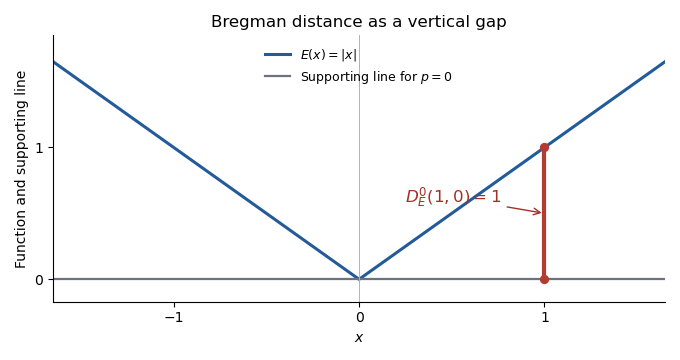
Bregman distance for the absolute-value function at x=1 from the reference point zero, using the subgradient p=0
. Details. 
Interpret the normal-operator source condition as the displayed intersection condition: there is with . Fix any and put . The subgradient optimality condition for the artificial-data objective isIt holds because its first term equals . By convexity, this is sufficient for global minimality, proving the forward implication. Conversely, if minimizes that objective, the same optimality condition givesTaking proves the intersection condition. Thus the two conditions are equivalent when the source vector is allowed to be zero.
The printed additional requirement is not equivalent in general. For and , the displayed source condition holds, and choosing makes the minimizer, but forces . A nonzero-source version needs an additional hypothesis, such as requiring ; it cannot be inferred from the printed intersection alone.
Let from the normal-operator source condition, and set . Since is a least-squares solution, the normal equation for a linear inverse problem gives . Expand the objective difference and use the Bregman distance definition:The cross term with the residual of the least-squares solution vanishes by the normal equation; exact data are not required. Compare the minimizing with . At , the completed square is zero. Dividing the resulting inequality by proves the stronger shifted-comparator Bregman boundDropping the nonnegative squared term gives the requested estimate. If the comparator lies outside the effective domain of , its distance is infinite and the inequality is valid but gives no finite error bound.
The relevant nonlinear generalized singular vector relation, without imposing unit-data normalization, isThis is a generalized eigenfunction in the forward-operator metric, rather than a distributional generalized eigenfunction of a linear operator. It supplies the normal-operator source condition with . For a convex positively one-homogeneous functional, the subgradient inequality applied at zero and at gives . If , thenAssume the usual positive eigenvalue and . By positive homogeneity,The shifted-comparator Bregman bound therefore yieldsThe vector is itself a minimizer: remains a subgradient along the nonnegative ray, and substitution satisfies the subgradient optimality condition. If is injective, this also proves . Otherwise distinct minimizers can differ in the kernel while sharing the same predicted data.
For a nonnegative convex positively one-homogeneous functional, the branch continues as above the threshold, since there. Nonnegativity is needed for that clipping argument; bare positive homogeneity allows signed linear functionals.
Zero Bregman distance does not imply exact recovery. For , , and , the minimizer is , but . Both points touch the same supporting line, as described by zero Bregman distance and supporting faces.
Articles by others on the same topic
There are currently no matching articles.