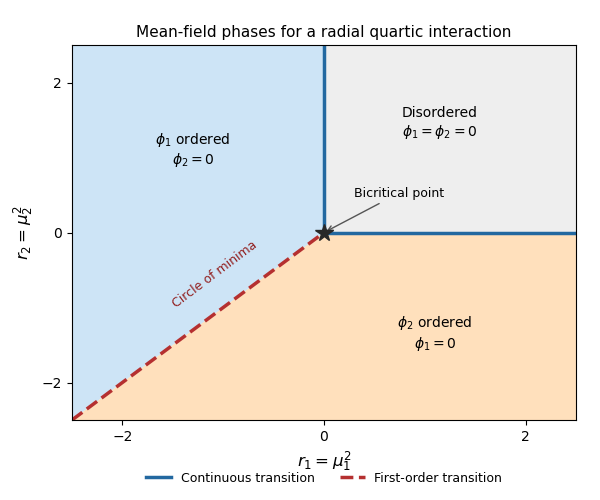
Write and assume , as required for quartic stability. In the mean-field approximation, the two-component radial quartic Landau potential isSet , . At fixed , the quartic term is fixed and the quadratic term is minimized by assigning all of to the component with smaller . Minimizing over then givesThe resulting phase diagram has these regions:
- If and , : the disordered phase preserves both Z2 symmetries.
- If , and : the first Z2 symmetry undergoes spontaneous symmetry breaking.
- If , and : the second Z2 symmetry undergoes spontaneous symmetry breaking.
On , the symmetry is enhanced to the orthogonal group , and the minima form the circleMixed-component minima occur on this line, rather than in an open coexistence region. Crossing the negative diagonal swaps the selected component discontinuously: this is a first-order phase transition, also called a spin-flop transition. For example, holding fixed and moving across , the derivative jumps from to zero. The angular degeneracy exactly on the line does not remove this discontinuity.
The positive half-axis , is a continuous phase transition, as is , . Their endpoint at is a bicritical point, where the two continuous boundaries meet the first-order negative diagonal. Approaching the origin radially makes the ordered amplitude vanish continuously. The negative half-axes lie inside ordered phases and are not additional transition lines. There are two continuous half-axis boundaries and one first-order negative diagonal, meeting at the origin.

At the Gaussian fixed point, , so all three quartic couplings have engineering dimension . ThusTake and , as in the perturbative epsilon expansion. Define , , . The renormalization-group fixed point equations becomeIf , each of is independently or , giving four renormalization-group fixed points. If , subtracting the first two equations givesThe branch forces ; inserting this in the first equation yields a repeated root . Hence every nonzero- solution has . Then , andhas roots and . The complete list of six coupled Ising fixed points near four dimensions, in coordinates , isThe internal symmetries of these renormalization-group fixed points are:
- The Gaussian fixed point has an orthogonal group acting on the two identical free massless fields.
- is one Ising model Wilson-Fisher fixed point and one free field. Its linear internal symmetry is ; the two sectors cannot be exchanged. The point has the same symmetry with the roles reversed.
- describes two identical decoupled Ising models. It additionally permits field exchange, giving , the eight-element dihedral group .
- has . Its interaction is , so it is the O(N) model Wilson-Fisher fixed point with and symmetry.
- has . Its symmetry is again the eight-element dihedral group , not .
The last point displays the field-rotation equivalence of decoupled Ising theories. With the orthogonal transformation ,It is the same pair of decoupled Ising models written in fields rotated by , but remains a distinct coordinate solution of the stated renormalization-group beta functions. Here denotes the dihedral group of order eight; an alternative convention calls it . We have described linear internal transformations preserving the gradient energy; free massless sectors also have constant scalar-field shift symmetries. At , the six coordinates coalesce at the Gaussian fixed point.
Assume for stability. With equal quadratic coefficients and , the internal symmetry is the full orthogonal group . In two dimensions at positive temperature, with short-range interactions, the Mermin-Wagner theorem forbids spontaneous symmetry breaking of this continuous symmetry. Thus in both phases in the infinite system; a nonzero average order parameter does not distinguish them.
Instead measure the correlation functionThe low-temperature phase has quasi-long-range order and algebraic correlations; the high-temperature phase has a finite correlation length and exponential correlations. More precisely,A finite order parameter amplitude allows . Its long-distance Goldstone-mode effective free energy is . Restoring the Boltzmann constant and using the renormalized phase stiffness, the thermal phase fluctuations giveThe Berezinskii–Kosterlitz–Thouless transition separates vortex-antivortex binding from unbound vortex defects. At the boundary, the universal stiffness jump gives and . The low-temperature phase stiffness is nonzero; it vanishes at long distances in the disordered phase. The exact transition location is fluctuation dependent and cannot be obtained just by setting the bare to zero.
Articles by others on the same topic
There are currently no matching articles.