For , differentiate the logarithm of the proposed Poynting–Robertson drag invariant:Substitution of the orbit-averaged Poynting–Robertson drag rates gives, over the common denominator , the numerator . HenceEquivalently, eliminating time gives , whose integral is . An exactly circular orbit remains circular; the expression for is singular at and is replaced by that separate solution.
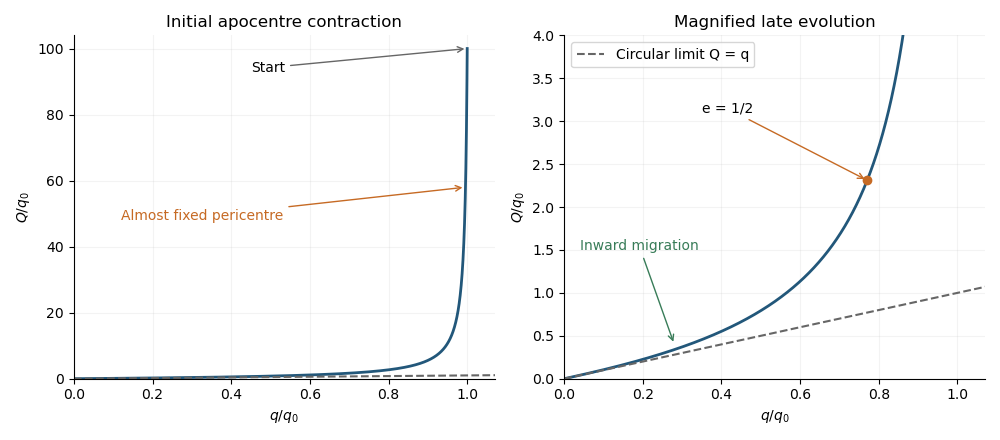
Using and , differentiate each apsidal distance. The apsidal evolution under Poynting–Robertson drag isBoth the pericentre distance and apocentre distance decrease. Since and , the same rates areTheir ratio isIn particular gives , whereas the circular limit gives slope .
Parameterize the trajectory by the decreasing orbital eccentricity. The Poynting–Robertson drag invariant givesFor , . Initially , and the orbit moves almost vertically down a plot of against : the apocentre distance shrinks rapidly while the pericentre distance changes little. Integrating the high-eccentricity slope givesOnce the orbit has moderate orbital eccentricity, both distances change appreciably. For example gives and in the limit. Eventually , , and the trajectory approaches the diagonal before reaching the origin. Thus the two approximate phases are apocentre contraction at nearly fixed pericentre, followed by nearly circular inward migration. They are a smooth crossover, not two separate exact solutions.

For a circular Kepler orbit, remains an exact solution of the averaged Poynting–Robertson drag equations, and . Integrating gives , so the point-star inspiral time under Poynting–Robertson drag isFor a star of radius , contact occurs instead at within this model. Sublimation or other forces can remove a real grain earlier.
Eliminate using the Poynting–Robertson drag invariant, . The eccentricity rate becomesSince the point-star limit corresponds to and , the inspiral time under Poynting–Robertson drag isFor , the integral is , recovering despite the apparent singularity of .
For , use and . The endpoint asymptotic integral is , givingMost of this long lifetime is spent near the initially large apocentre distance, before substantial circularization. The result assumes weak drag and a valid orbital average; near-parabolic release can violate that assumption.
Assume negligible fragment release speed relative to a circular parent planetesimal. Its initial speed is , but radiation pressure reduces the grain's gravitational parameter to . Its specific orbital energy and specific angular momentum areFor , the resulting dust orbit released from a circular parent ring hasRelease is at periapsis: the inherited tangential speed exceeds the new circular speed. Low- grains remain near the dust birth ring; higher bound gives increasingly eccentric orbits extending well outside it. Uniform release longitude produces an approximately axisymmetric dust halo, with long residence times near apoapsis. At the conservative release orbit is parabolic; above this radiation-pressure blowout threshold it is initially unbound. For , zero or repulsive effective gravity also prevents a bound ellipse.
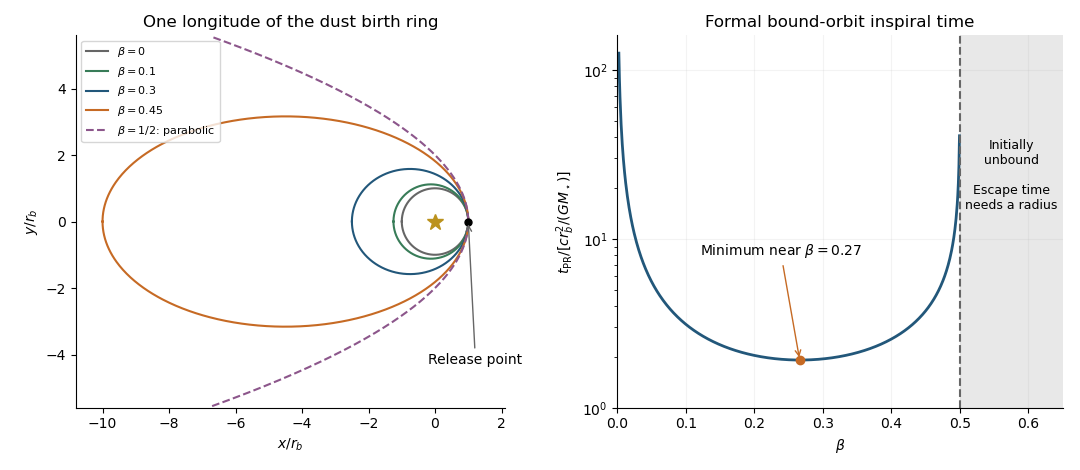
Dust release orbits and inspiral time under Poynting–Robertson drag
. Left: representative orbits released at one point on the birth ring, including the parabolic release limit. Right: the formal averaged lifetime of bound grains as a function of the radiation-pressure coefficient. Details.
The left panel shows one release longitude; rotating it around the ring fills the halo. At longer times Poynting–Robertson drag also carries bound grains inward, so an initially outward-spanning release distribution does not imply an empty inner region in a continuously supplied, collision-free population.
For the bound release orbits, use andThe inspiral time under Poynting–Robertson drag is thenThe limiting branches areThus the formal bound-grain curve, shown in the right panel of the preceding figure, diverges at both ends and has a minimum at an intermediate . At there is no Poynting–Robertson drag and the circular grain survives indefinitely in this collision-free model.
Initially unbound grains do not have a bound-orbit inspiral lifetime. For the release calculation gives outward trajectories; their residence time in a specified finite observation region is a dynamical escape time, not the averaged above. A numerical escape lifetime cannot be assigned without specifying the outer boundary. Extremely close to , energy lost on the first passage can alter even this bound/unbound classification: orbital averaging requires roughly . Accordingly the divergence is a formal limit of the supplied secular equations, not an exact prediction for marginal grains.
Articles by others on the same topic
There are currently no matching articles.