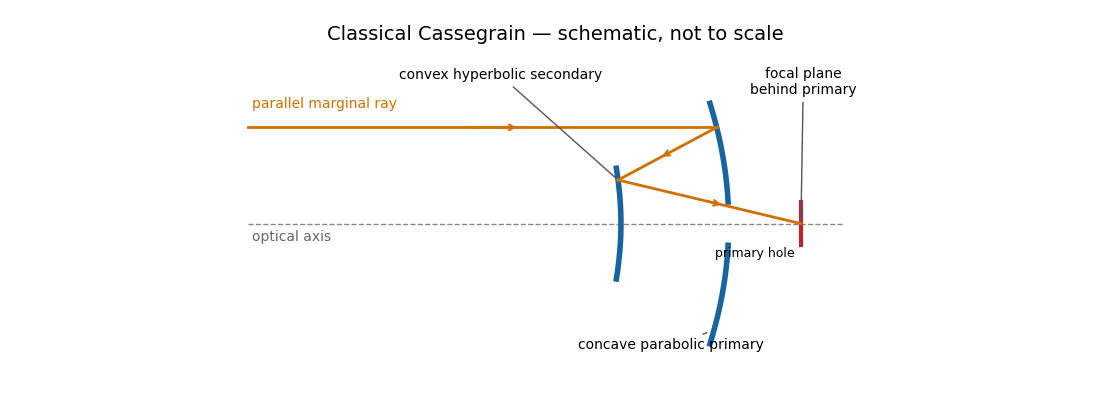
In a classical Cassegrain reflector, a concave parabolic primary sends light toward an intermediate focus, but a convex hyperbolic secondary intercepts it before it reaches that focus. The secondary returns the beam through a central hole in the primary to a focal plane behind the primary. The two relevant foci of the secondary’s hyperbola are the primary’s would-be focus and the final focus.

The secondary magnifies the effective focal length, giving a compact tube and convenient rear-mounted instruments. The classical conics correct on-axis spherical aberration, but not the off-axis coma, astigmatism or field curvature. There is secondary obscuration, diffraction from its supports, and sensitivity to mirror alignment. A long effective focal length is useful for a small angular image scale per detector pixel, but yields a small field for a fixed detector size.
Parabolic primary → convex hyperbolic secondary before prime focus → rear focus.
Articles by others on the same topic
There are currently no matching articles.