A Newtonian reflector uses a concave primary generated by a parabola, followed by a flat secondary inclined at to the optical axis. Parallel marginal rays converge toward the primary focus; the secondary intercepts that converging beam and folds it sideways to an accessible focal plane.
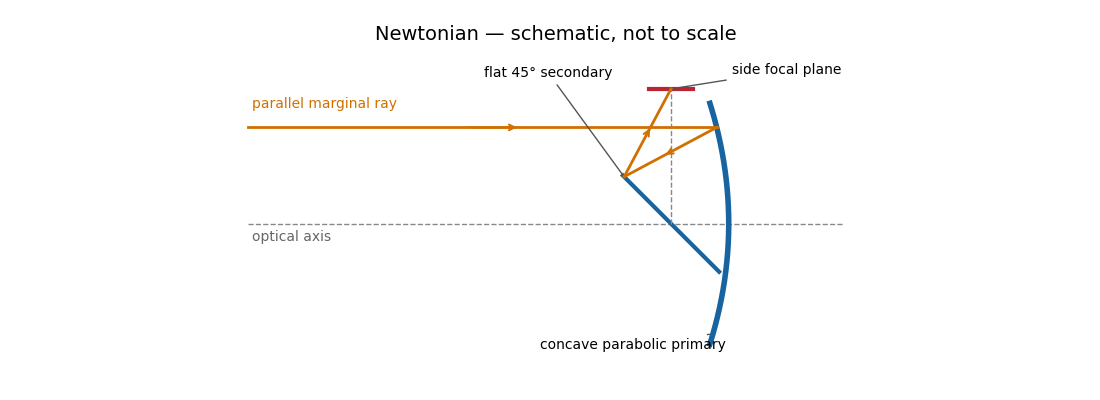
The Newtonian reflector needs only one powered mirror, so it is relatively simple to fabricate and inexpensive. A parabolic primary has no on-axis spherical aberration. Its principal wide-field limitation is coma, accompanied by field curvature and off-axis astigmatism. The diagonal and its supports obstruct the entrance pupil and introduce diffraction; the tube is long compared with a folded two-powered-mirror design, and heavy instruments at the side focus can be awkward to support. These comments also answer the unheaded design-comparison clause on the next PDF page.
Parabolic primary → flat diagonal → side focus.
In a classical Cassegrain reflector, a concave parabolic primary sends light toward an intermediate focus, but a convex hyperbolic secondary intercepts it before it reaches that focus. The secondary returns the beam through a central hole in the primary to a focal plane behind the primary. The two relevant foci of the secondary’s hyperbola are the primary’s would-be focus and the final focus.
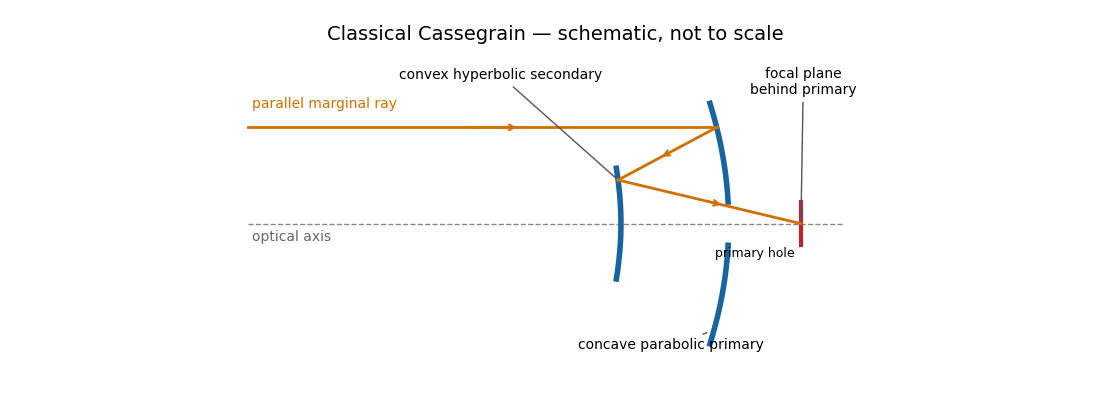
The secondary magnifies the effective focal length, giving a compact tube and convenient rear-mounted instruments. The classical conics correct on-axis spherical aberration, but not the off-axis coma, astigmatism or field curvature. There is secondary obscuration, diffraction from its supports, and sensitivity to mirror alignment. A long effective focal length is useful for a small angular image scale per detector pixel, but yields a small field for a fixed detector size.
Parabolic primary → convex hyperbolic secondary before prime focus → rear focus.
The Ritchey–Chrétien reflector follows the same folded path as a Cassegrain reflector, but both the concave primary and convex secondary are hyperbolic. Their conic constants and separation are chosen to cancel third-order spherical aberration and coma. The focal plane is behind the perforated primary.
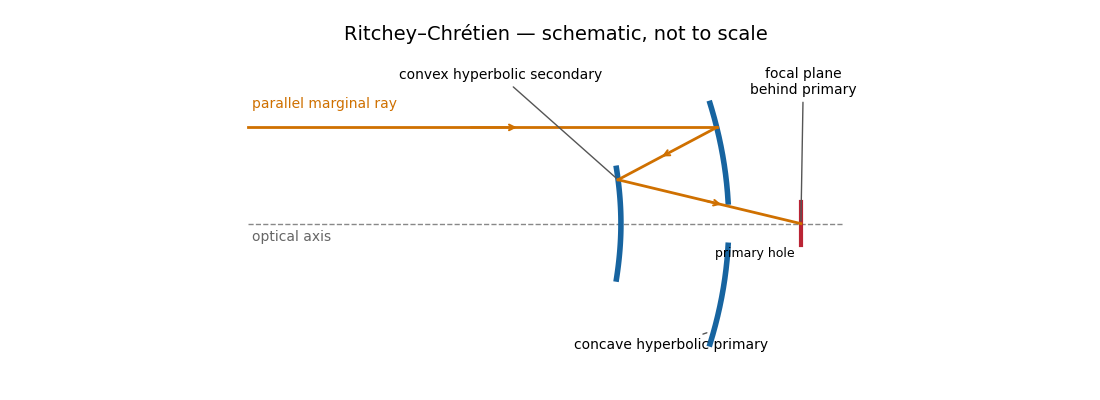
The absence of third-order coma gives a much more useful wide field than a classical Cassegrain reflector, making this design attractive for research imaging. It retains astigmatism and field curvature, so a large flat detector generally needs corrective optics; higher-order optical aberrations are not all removed. Both aspheric mirrors are more demanding to manufacture and align, and the usual secondary obstruction remains. The sketch illustrates the beam routing and mirror types; its conics are not an optimized aplanatic prescription.
Two hyperbolic mirrors give a compact system corrected for third-order spherical aberration and coma.
A classical Schmidt telescope combines a concave spherical primary with a thin aspheric corrector plate at its centre of curvature. The plate is also near the aperture stop. It supplies just the extra ray bending needed to cancel the mirror’s spherical aberration; rays then return toward an internal focus roughly halfway between the plate and primary. The native best-focus surface is curved, as indicated in red.
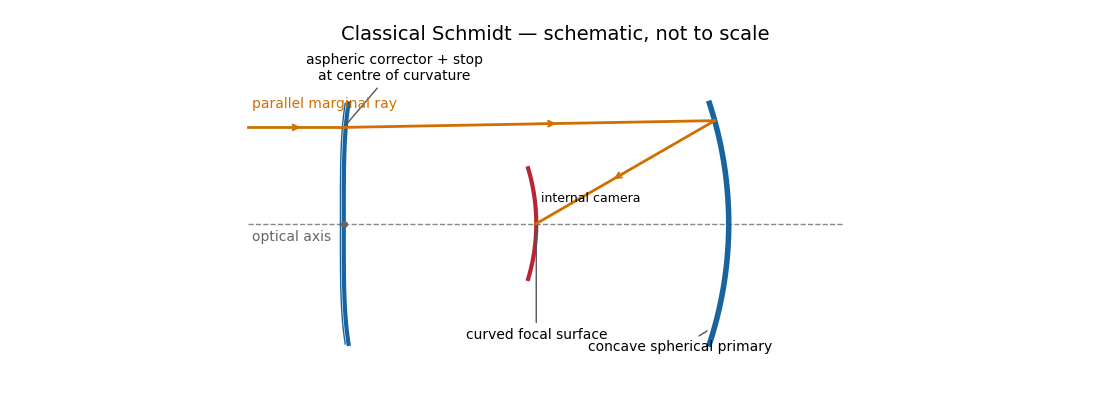
The spherical primary is easy to manufacture, and the stop at its centre of curvature gives a nearly symmetric optical geometry that suppresses coma and astigmatism over a large field. Fast Schmidt cameras are consequently excellent survey instruments. The costs are a long enclosed optical assembly, a large precision corrector, an internal camera that obstructs the beam, and a curved focal surface. A flat detector needs field flattening. The transmissive corrector introduces wavelength-dependent effects and transmission losses, unlike an entirely reflecting system.
Spherical primary + aspheric corrector at the centre of curvature → wide field on a curved internal focal surface.
A Gregorian telescope has a concave parabolic primary and a concave ellipsoidal secondary. Unlike the Cassegrain reflector, the secondary is beyond the primary focus: the rays cross that focus before reaching it. The two foci of the secondary’s ellipse are the intermediate focus and final rear focus, so the reflected rays return through the primary hole to the detector.
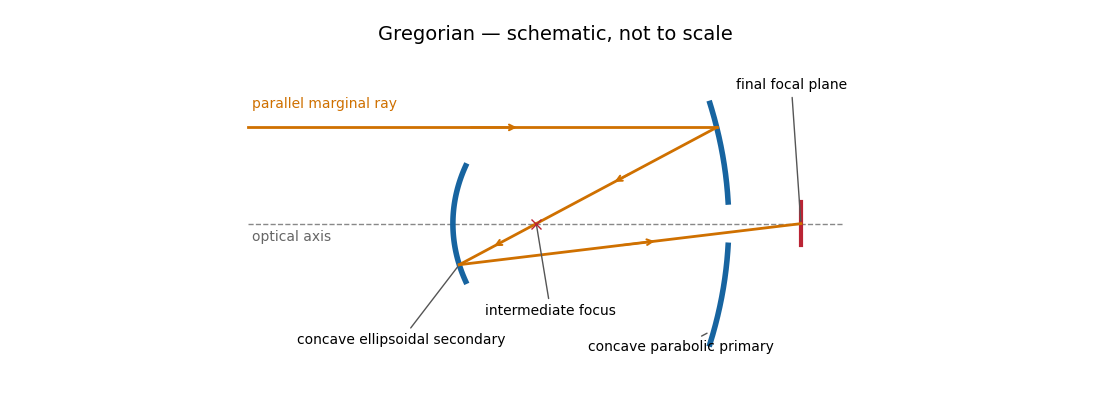


The real intermediate focus permits a field stop to reject unwanted light, and the two image inversions give an erect image. The rear focus is convenient and the effective focal length can be large. The secondary beyond prime focus makes the tube longer than the corresponding Cassegrain reflector, often with a larger secondary obstruction. The classical design retains off-axis coma, astigmatism and field curvature, and needs careful alignment.
Parabolic primary → real intermediate focus → concave ellipsoidal secondary → rear focus.
Articles by others on the same topic
There are currently no matching articles.