Use the gnomonic projection associated with an undistorted focal plane. Write and rotate the celestial Cartesian coordinate system so that the pointing meridian has longitude zero. The stellar direction and an orthonormal basis adapted to the optical axis areHere points east and points north. Intersect the ray with the plane . It gives , so the detector coordinates areThese equations also avoid spurious singularities caused by writing individual tangents or cotangents.
To put this gnomonic projection in the desired form, let and choose locally byThus . The denominator becomes , the numerator for becomes , and . ConsequentlyUse the local meridian chart , with chosen continuously near and at the image centre. A visible gnomonic projection requires , but this front-hemisphere condition alone does not select that meridian chart. A narrow field near a celestial pole can cross the opposite meridian; for such fields use the Cartesian expressions above and distinguish the oriented great circle parameter from ordinary declination. In particular, the small-field limit is and , with angles in radians. The factor is the shrinking angular distance per unit right ascension near the pole.
The great circle containing the pointing and celestial pole is the intersection of the unit sphere with the meridian plane . The orthogonal projection of onto that plane, normalized to unit length, isWithin the local meridian chart , its declination is therefore . Outside that chart, the same construction gives an oriented great circle parameter; the foot can lie on the opposite right-ascension half of the meridian, and need not be its ordinary declination.
To verify the right angle geometrically, the tangent to the great circle from toward is proportional to . Since , that tangent has only a component. The tangent from toward the pole, , lies in . Their orthogonality proves the claimed spherical right angle. Thus within the local meridian chart, is the declination of the perpendicular foot on the pointing meridian.
There are antipodal perpendicular feet on the complete great circle. On the local meridian chart, the telescope field selects the foot near the pointing; the cotangent equation alone determines only modulo . At a coincident foot or pole, the corresponding angle is understood by continuity rather than by a nonzero tangent vector.
A Newtonian reflector uses a concave primary generated by a parabola, followed by a flat secondary inclined at to the optical axis. Parallel marginal rays converge toward the primary focus; the secondary intercepts that converging beam and folds it sideways to an accessible focal plane.
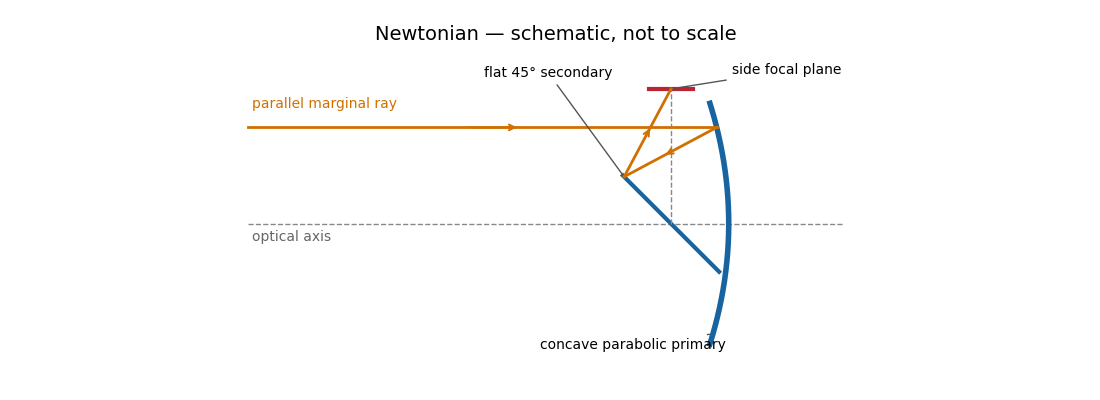
The Newtonian reflector needs only one powered mirror, so it is relatively simple to fabricate and inexpensive. A parabolic primary has no on-axis spherical aberration. Its principal wide-field limitation is coma, accompanied by field curvature and off-axis astigmatism. The diagonal and its supports obstruct the entrance pupil and introduce diffraction; the tube is long compared with a folded two-powered-mirror design, and heavy instruments at the side focus can be awkward to support. These comments also answer the unheaded design-comparison clause on the next PDF page.
Parabolic primary → flat diagonal → side focus.
In a classical Cassegrain reflector, a concave parabolic primary sends light toward an intermediate focus, but a convex hyperbolic secondary intercepts it before it reaches that focus. The secondary returns the beam through a central hole in the primary to a focal plane behind the primary. The two relevant foci of the secondary’s hyperbola are the primary’s would-be focus and the final focus.
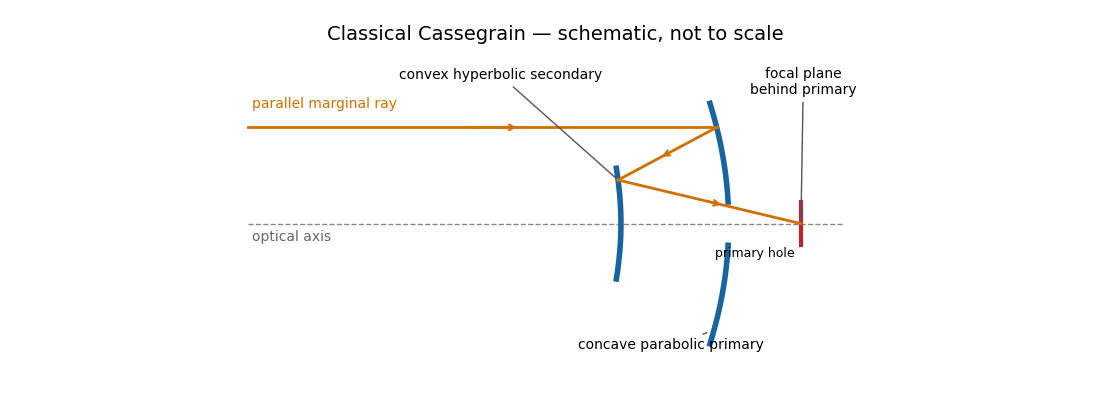
The secondary magnifies the effective focal length, giving a compact tube and convenient rear-mounted instruments. The classical conics correct on-axis spherical aberration, but not the off-axis coma, astigmatism or field curvature. There is secondary obscuration, diffraction from its supports, and sensitivity to mirror alignment. A long effective focal length is useful for a small angular image scale per detector pixel, but yields a small field for a fixed detector size.
Parabolic primary → convex hyperbolic secondary before prime focus → rear focus.
The Ritchey–Chrétien reflector follows the same folded path as a Cassegrain reflector, but both the concave primary and convex secondary are hyperbolic. Their conic constants and separation are chosen to cancel third-order spherical aberration and coma. The focal plane is behind the perforated primary.
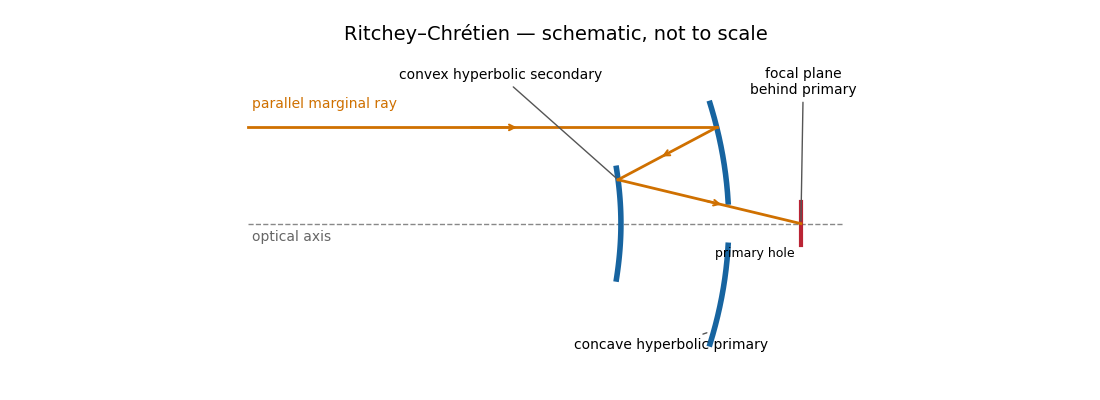
The absence of third-order coma gives a much more useful wide field than a classical Cassegrain reflector, making this design attractive for research imaging. It retains astigmatism and field curvature, so a large flat detector generally needs corrective optics; higher-order optical aberrations are not all removed. Both aspheric mirrors are more demanding to manufacture and align, and the usual secondary obstruction remains. The sketch illustrates the beam routing and mirror types; its conics are not an optimized aplanatic prescription.
Two hyperbolic mirrors give a compact system corrected for third-order spherical aberration and coma.
A classical Schmidt telescope combines a concave spherical primary with a thin aspheric corrector plate at its centre of curvature. The plate is also near the aperture stop. It supplies just the extra ray bending needed to cancel the mirror’s spherical aberration; rays then return toward an internal focus roughly halfway between the plate and primary. The native best-focus surface is curved, as indicated in red.
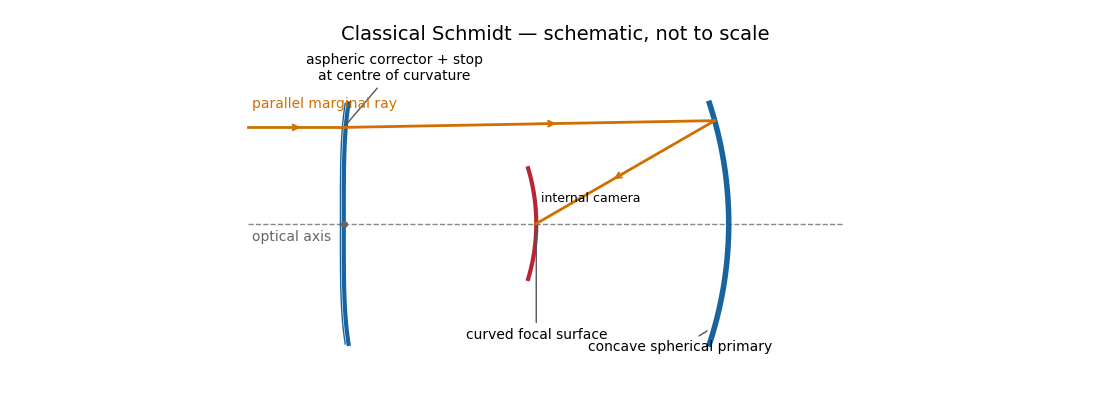
The spherical primary is easy to manufacture, and the stop at its centre of curvature gives a nearly symmetric optical geometry that suppresses coma and astigmatism over a large field. Fast Schmidt cameras are consequently excellent survey instruments. The costs are a long enclosed optical assembly, a large precision corrector, an internal camera that obstructs the beam, and a curved focal surface. A flat detector needs field flattening. The transmissive corrector introduces wavelength-dependent effects and transmission losses, unlike an entirely reflecting system.
Spherical primary + aspheric corrector at the centre of curvature → wide field on a curved internal focal surface.
A Gregorian telescope has a concave parabolic primary and a concave ellipsoidal secondary. Unlike the Cassegrain reflector, the secondary is beyond the primary focus: the rays cross that focus before reaching it. The two foci of the secondary’s ellipse are the intermediate focus and final rear focus, so the reflected rays return through the primary hole to the detector.
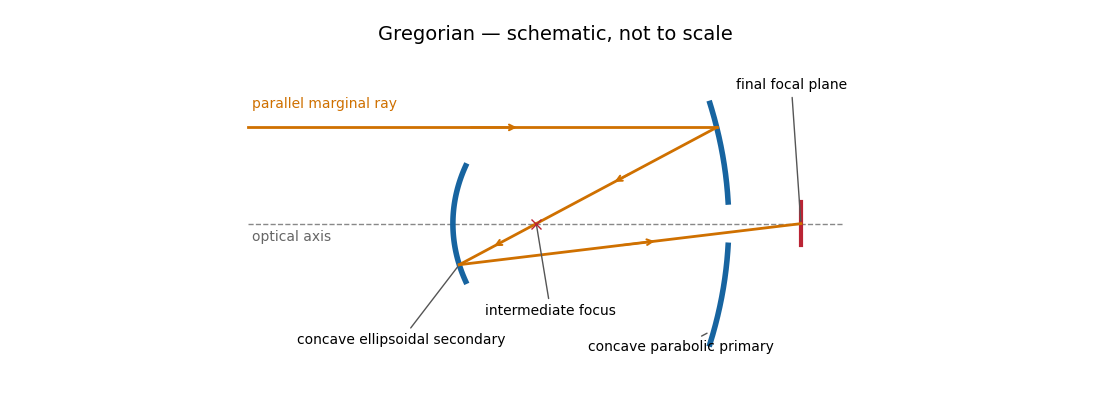


The real intermediate focus permits a field stop to reject unwanted light, and the two image inversions give an erect image. The rear focus is convenient and the effective focal length can be large. The secondary beyond prime focus makes the tube longer than the corresponding Cassegrain reflector, often with a larger secondary obstruction. The classical design retains off-axis coma, astigmatism and field curvature, and needs careful alignment.
Parabolic primary → real intermediate focus → concave ellipsoidal secondary → rear focus.
An ordinary passive primary must keep its optical figure while the direction of gravity relative to the mirror changes as the telescope tracks. A thin unsupported disk bends enough to introduce wavefront errors, degrading the point spread function. Increasing thickness strongly raises its resistance to bending.
For an isotropic elastic plate of thickness , Young's modulus and Poisson's ratio , the flexural rigidity is . Under its own weight the load per area scales as . With support spans of order the diameter , plate bending therefore givesNumerical coefficients depend on the support and boundary conditions. A larger greatly reduces gravitational sag, even though it adds weight. Near normal incidence a mirror displacement changes optical path length by approximately , so surface errors must be much smaller than the observing wavelength. Thickness provides passive stiffness needed to preserve the mirror figure.
The difficulty is an unfavorable engineering scaling, rather than a fundamental diameter cutoff. For the same passive support concept and fixed allowed sag, the elastic plate estimate gives . Consequentlywhere is the thermal diffusivity. Thus increasing diameter makes the casting, annealing, transport and support progressively harder, while its long thermal diffusion time prevents the mirror following the changing ambient temperature. Temperature gradients deform the surface; a warm mirror also creates local turbulence that worsens astronomical seeing. A thinner solid disk has a shorter thermal response but is too flexible without better support.
The quoted four-metre scale is a practical rule of thumb for the simple thick passive design, not an absolute physical impossibility. The official BTA description records a 6.05-metre, 42-tonne primary already operating well before this examination. Its existence rules out interpreting the stated number as a hard bound.
Mass, gravitational deformation and thermal response make straightforward thick-disk scaling impractical.
Three complementary approaches replace the simple thick solid disk:
- A thin meniscus on an active optics support distributes and adjusts forces to preserve the figure despite changing gravity and temperature. The Very Large Telescope has four 8.2-metre unit telescopes of this type; the ESO active-optics account describes their controlled mirror supports.
- A lightweight telescope mirror uses a honeycomb or ribbed backing: a deep structure retains stiffness without a massive solid interior and cools more readily. The Large Binocular Telescope uses two 8.4-metre primaries; its official history describes their honeycomb construction.
- A segmented mirror constructs the aperture from manageable pieces. Support actuators and mirror segment phasing control figure, piston and tilt. Each ten-metre Keck telescope uses 36 hexagonal segments, as recorded in the observatory’s telescope description.
“Operational” and “planned” here refer to the 2018 examination date. The next generation included the 39-metre Extremely Large Telescope with 798 segments, the thirty-metre Thirty Meter Telescope with 492 segments, and the Giant Magellan Telescope using seven 8.4-metre primary mirrors. These designs extend segmentation or lightweight casting with active control, rather than simply making a thicker slab. The specifications are documented by the 2017 ELT announcement, TMT optics design and GMT primary-mirror description. Adaptive optics is also needed to exploit the large apertures against atmospheric turbulence; it corrects faster disturbances than active optics.
Thin actively supported menisci, lightweight honeycomb mirrors, and phased segmented primaries enable larger apertures.
Articles by others on the same topic
There are currently no matching articles.