The telescope forms the sky image at the entrance slit. A collimator makes the transmitted beam parallel, a reflection diffraction grating disperses it, and a camera’s optical lens focuses each wavelength to a different detector position.
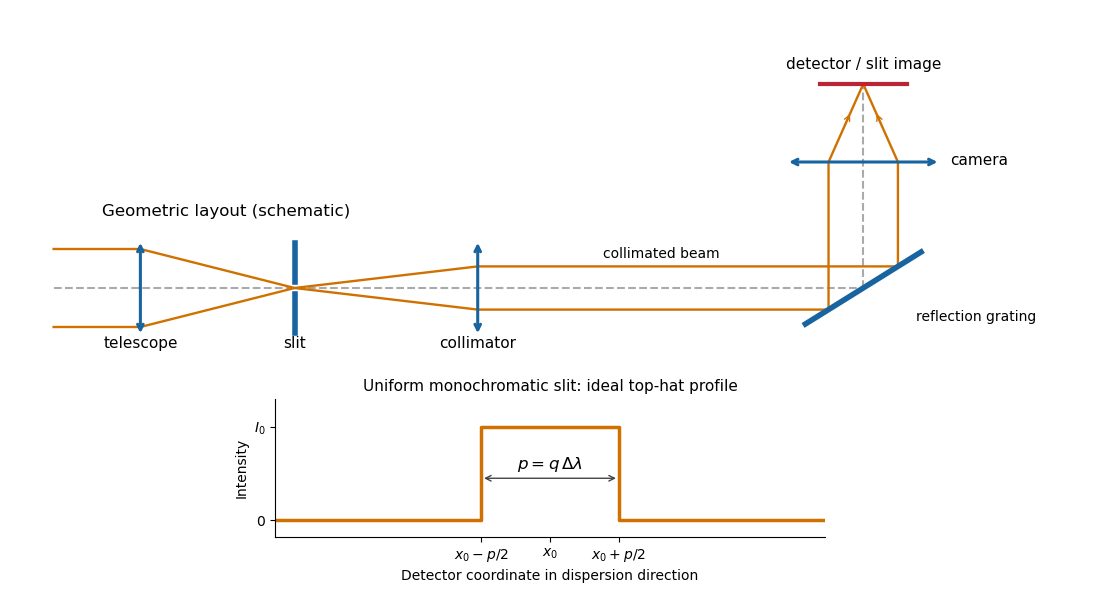
Reflection-grating spectrograph and slit-limited line profile
. Details. 
With a uniformly illuminated slit, ideal imaging and negligible slit diffraction, each monochromatic slit image has an approximately top-hat intensity profile of physical width . A small wavelength separation displaces two such images by , using the positive magnitude of grating dispersion. In the geometrical, slit-limited convention, resolution occurs when the displacement is of order the slit-image width. HenceHere is the slit’s apparent wavelength extent. A finite diffraction grating broadens the sharp edges; the top-hat sketch and the following identities presume slit-limited resolving power of a grating, rather than the regime where the grating’s own diffraction determines the line width. A precise resolution criterion for nonideal profiles can change order-unity factors.
Articles by others on the same topic
There are currently no matching articles.