With all momenta incoming and Fourier convention , differentiating the scalar contributes . The sole interaction vertex is thereforewhere enters on the scalar line; reversing the convention reverses the irrelevant overall sign. The free internal lines use the Dirac propagatorand the scalar Feynman propagator . Momentum is conserved at the vertex.
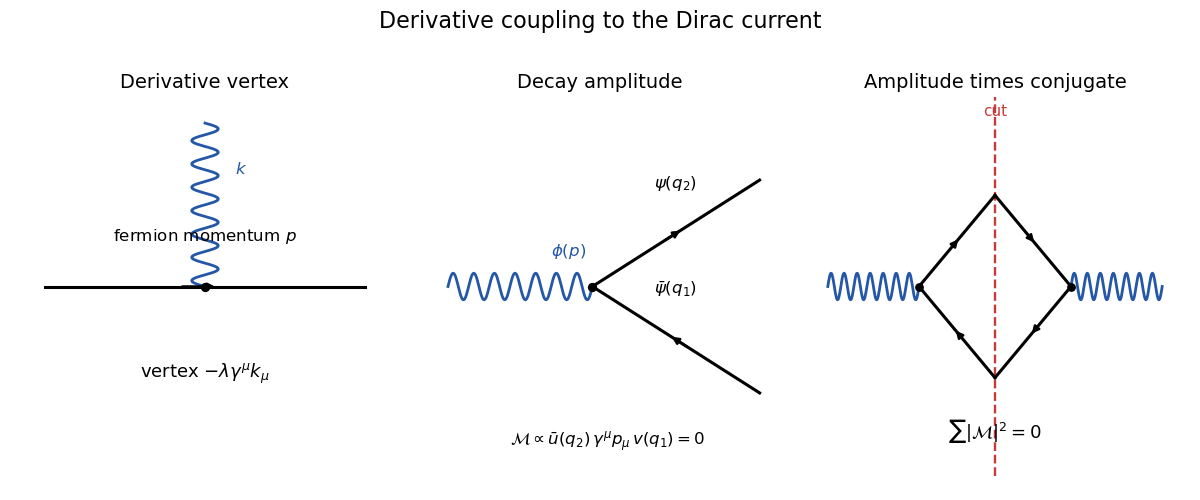

In four spacetime dimensions , , and . HenceThe coupling is an irrelevant coupling by power counting in quantum field theory, so it is a nonrenormalizable interaction that would ordinarily define only an effective theory with a cutoff. Here it is also a redundant operator: integration by parts gives up to a boundary term, and the Dirac current is conserved. This derivative coupling to a conserved current is removed exactly by the local phase redefinition .
The tree amplitude is, up to an overall convention-dependent sign,The Clifford algebra gives the momentum-space Dirac equation and its adjoint:ThereforeAlthough permits the relativistic two-body decay kinematically, the matrix element vanishes. Thus
Every scalar-fermion vertex contracts the scalar momentum with the Dirac current. Between on-shell external spinors,and the analogous particle-antiparticle identity also vanishes. Equivalently, the field redefinition in the previous part turns the theory into a free theory. Consequently every putative tree channel for has zero amplitude and
Articles by others on the same topic
There are currently no matching articles.