At a critical point, a local field operator has scaling dimension if under coarse-graining by . The coupling in has renormalization-group eigenvalueA perturbation is a relevant operator when , an irrelevant operator when , and a marginal operator when ; nonlinear terms in its renormalization-group beta function decide the fate of a marginal coupling. Irrelevant microscopic interactions decay under coarse-graining, so many distinct systems approach the same fixed point and share one universality class.
Near criticality the singular free energy density is of order one per correlation volume:The heat capacity contains two derivatives with respect to temperature, soConsequently the hyperscaling relation is
The critical two-point correlation function shows that the field has scaling dimensionIn the ordered phase the correlation length is the only diverging scale, so the order parameter scales asTherefore
The Gaussian fixed point isLinearizing there gives , so the mass term is relevant with eigenvalue . The coupling has no linear term and is classically marginal, ; for positive the term makes it marginally relevant in the infrared convention of the question. Since the inverse thermal eigenvalue is the correlation-length critical exponent,
Besides , the coupling beta function vanishes atThe mass fixed-point equation isso the root continuously connected to the origin isPerturbation theory requires , ensuring that the fixed-point coupling is small and the omitted higher powers are suppressed.
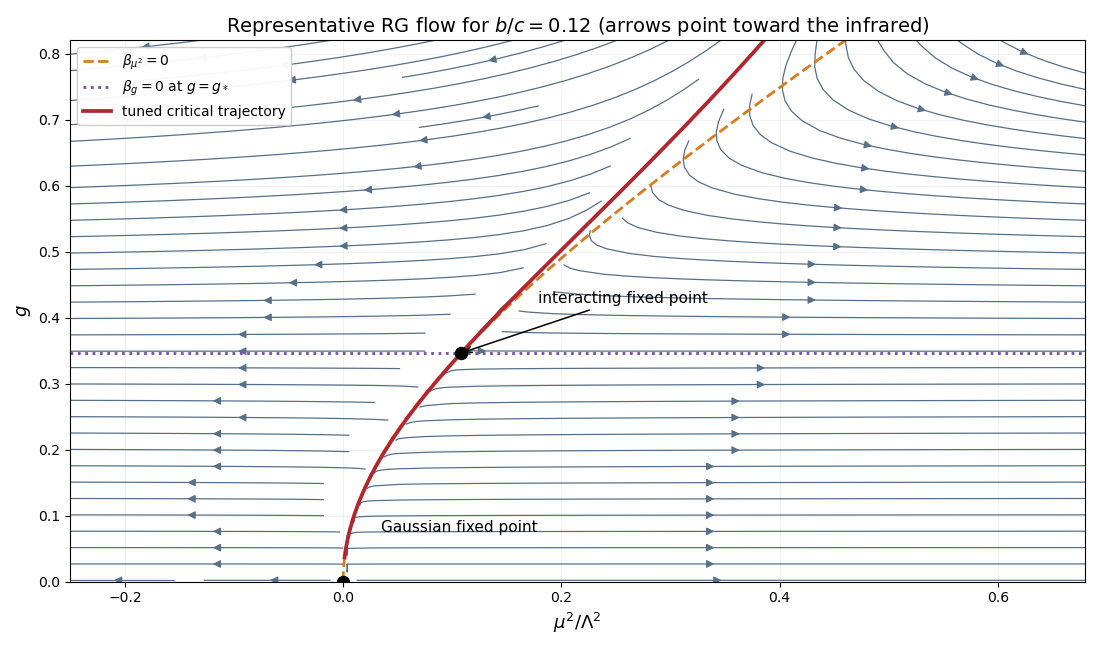
Renormalization-group flow near the Gaussian and interacting fixed points
. The arrows point toward the infrared. The Gaussian fixed point lies at the origin, the interacting fixed point lies at positive mass and coupling, and the red tuned critical trajectory connects their neighborhoods. Flows away from that trajectory leave along the relevant mass direction. Details.
For increasing infrared scale , positive flows upward toward and flows downward toward it. The mass direction remains relevant, so only the tuned critical trajectory reaches the interacting fixed point; trajectories on either side leave toward the two phases.
The relevant thermal eigenvalue is obtained from the stability matrix of a renormalization-group fixed point by differentiating the mass beta function:It follows that
Articles by others on the same topic
There are currently no matching articles.