A momentum-shell renormalization group step has three parts. First split the field into slow and fast Fourier modes, , and integrate over the shell . Second rescale , or equivalently , to restore the ultraviolet cutoff to . Third rescale the field so that the coefficient of returns to its chosen normalization. The resulting free energy has the same operator expansion but new couplings; iteration traces a renormalization-group flow in coupling space.
For the first step only, write and average over the fast modes of the Gaussian field theory. The cumulant expansion givesHereAt order , the connected contraction of two vertices gives the low-momentum two-point term. Since ,Expanding at small external momentum and matching yieldsThe first cumulant also produces a term linear in ; it is removed by fixing the one-point function, or equivalently by a field redefinition, and does not change the displayed one-particle-irreducible correlation function correction to the mass.
The leading vertex correction is order . Taking from each of three vertices, the connected Wick contractions form a triangle. There are eight contractions, so the third cumulant contributes times the triangle integral. At zero external momentum,For nonzero external momenta the three propagators carry the corresponding shifted loop momenta, with every internal line restricted to the fast shell.
Write and . The uniform Landau free energy isso stationarity requiresFor , the unique ground state is and the discrete symmetry is unbroken. If and , thenwhich breaks the first and leaves the second intact. This includes the case in which both masses are negative, because is then the more negative one. The remaining possible ordered case under the stated inequality is , for whichand only the second is broken. The Hessian matrix in each ordered state is positive because the uncondensed direction has squared mass , where is the condensed, more negative mass.
Near either continuous transition the nonzero order parameter is proportional to . Hence the mean-field critical exponents are
The lower critical dimension is the dimension at or below which fluctuations destroy the proposed finite-temperature ordered phase. Here the broken symmetry is discrete, so . In one dimension a domain wall interpolating between the two signs has finite energy, whereas its possible position gives an entropy growing as . Domain walls therefore occur with nonzero density at every positive temperature and split the system into domains of finite typical length. Thus there is no finite-temperature ordered phase in one dimension.
When , the free energy has continuous symmetry . Its ordered minima satisfyContinuous phase fluctuations make the lower critical dimension , in agreement with the Mermin-Wagner theorem. In two dimensions write the complex order parameter as . Neglecting the massive amplitude mode gives the Goldstone-mode effective free energyThe phase-difference variance isand thereforewithThus spin waves replace true long-range order by quasi-long-range order.
A vortex-antivortex pair of separation has the logarithmic energy . The number of pair separations below grows as , giving the coarse entropy . Thusand widely separated pairs become favorable at . Substituting the mean-field stiffness givessuggesting a Berezinskii–Kosterlitz–Thouless transition. The numerical location is only a bare-stiffness estimate: vortex-core fluctuations renormalize the stiffness near the transition.
At a critical point, a local field operator has scaling dimension if under coarse-graining by . The coupling in has renormalization-group eigenvalueA perturbation is a relevant operator when , an irrelevant operator when , and a marginal operator when ; nonlinear terms in its renormalization-group beta function decide the fate of a marginal coupling. Irrelevant microscopic interactions decay under coarse-graining, so many distinct systems approach the same fixed point and share one universality class.
Near criticality the singular free energy density is of order one per correlation volume:The heat capacity contains two derivatives with respect to temperature, soConsequently the hyperscaling relation is
The critical two-point correlation function shows that the field has scaling dimensionIn the ordered phase the correlation length is the only diverging scale, so the order parameter scales asTherefore
The Gaussian fixed point isLinearizing there gives , so the mass term is relevant with eigenvalue . The coupling has no linear term and is classically marginal, ; for positive the term makes it marginally relevant in the infrared convention of the question. Since the inverse thermal eigenvalue is the correlation-length critical exponent,
Besides , the coupling beta function vanishes atThe mass fixed-point equation isso the root continuously connected to the origin isPerturbation theory requires , ensuring that the fixed-point coupling is small and the omitted higher powers are suppressed.
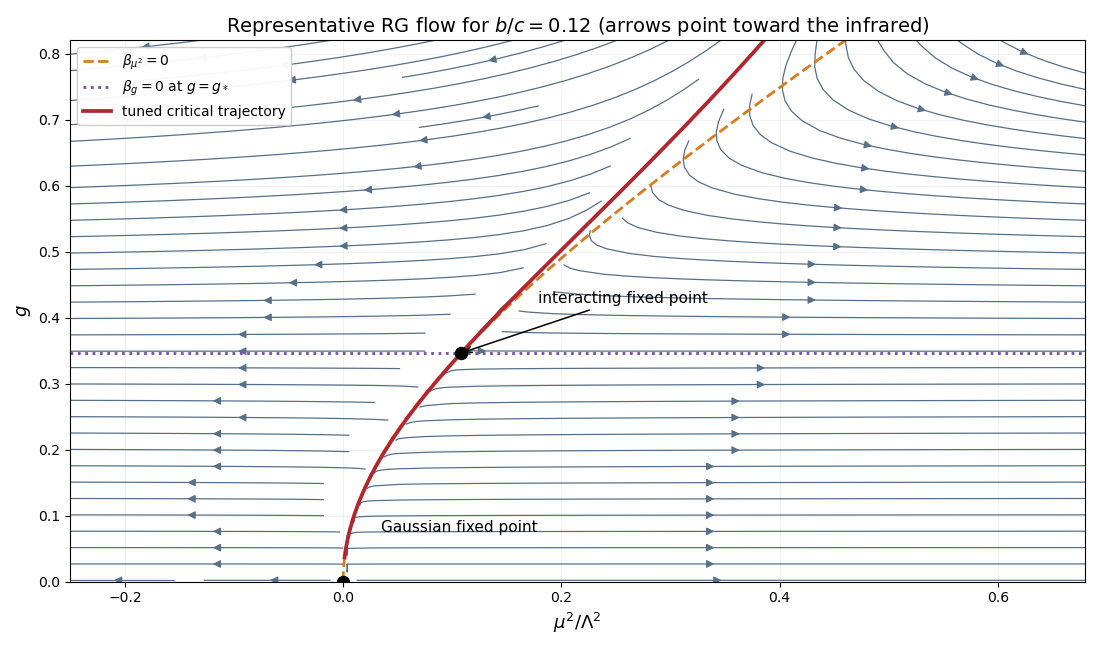
Renormalization-group flow near the Gaussian and interacting fixed points
. The arrows point toward the infrared. The Gaussian fixed point lies at the origin, the interacting fixed point lies at positive mass and coupling, and the red tuned critical trajectory connects their neighborhoods. Flows away from that trajectory leave along the relevant mass direction. Details.
For increasing infrared scale , positive flows upward toward and flows downward toward it. The mass direction remains relevant, so only the tuned critical trajectory reaches the interacting fixed point; trajectories on either side leave toward the two phases.
The relevant thermal eigenvalue is obtained from the stability matrix of a renormalization-group fixed point by differentiating the mass beta function:It follows that
Articles by others on the same topic
There are currently no matching articles.