For a scalar field with classical action , the Euclidean source convention used throughout this question givesThe generating functional produces correlation functions through functional derivatives. For example,More generally, each derivative brings down , so an -point function carries .
The classical action supplies the vertices and quadratic quantum field theory propagator in the path integral. The connected generating functional isand its first derivative is the source-dependent mean fieldThe quantum effective action is the Legendre transformwhere is eliminated in favor of . At vanishing source, stationary points of are the quantum equations of motion. This is the connected, or Schwinger, functional; a Wilsonian effective action instead integrates out modes above a momentum scale.
The perturbative expansion of contains arbitrary Feynman diagrams, including disconnected products. The linked-cluster theorem givesbecause the factorials from repeated connected components reproduce the exponential series. Therefore is the sum of connected Feynman diagrams.
The Legendre transform removes diagrams that disconnect upon cutting one internal line. Equivalently, every connected diagram is a tree whose vertices are exact one-particle-irreducible vertices and whose edges are exact propagators. Thusand its functional derivatives are the one-particle-irreducible correlation functions. Algebraically, differentiating the Legendre relations givesso an exact quantum field theory propagator joining two proper vertices is precisely the inverse Hessian matrix needed to reconstruct connected diagrams.
Change variables in the defining integral from the fluctuation to the total field, . Thenand henceIt follows nonperturbatively thatThus the same source corresponds at zero background to the mean field . Using the source-sign-compatible Legendre transform ,Renaming as gives the requested identity
Split the field into disjoint ranges of Fourier modes,The Wilsonian effective action is defined byWriting immediately givesQuadratic cross terms vanish because the momentum supports do not overlap. For ,where
When , the cubic contribution is absent andAlthough terms odd in occur for a fixed low field, the simultaneous transformation shows that integrating out the shell preserves the original discrete symmetry of the effective action.
Introduce the renormalization-group beta functions and field anomalous dimensionIndependence of physics from the arbitrary sliding scale gives the functional Callan-Symanzik equationup to the equivalent sign convention obtained by defining with a minus sign. For an operator of dimension containing fields, differentiating its coefficient shows the canonical and wave-function pieceswhere contains mixing among local field operators and genuine corrections at higher loop order. Thus , , and canonically produce relevant operators, marginal operators, and irrelevant operators, respectively, before anomalous corrections.
Applying four functional derivatives to the functional equation gives the homogeneous equation for the renormalized four-point one-particle-irreducible correlation function:If the opposite convention for is used, the last sign changes. The factor four counts the four external renormalized fields.
A continuum limit of a quantum field theory sends the ultraviolet cutoff to infinity while holding chosen physical masses and amplitudes fixed. In cutoff units this requires a diverging correlation length, so the bare couplings must be tuned onto the critical surface of an ultraviolet renormalization-group fixed point. Each relevant direction of a fixed point requires one coordinate fixed by measurement; predictivity requires only finitely many such directions, and irrelevant microscopic details disappear.
Several behaviors are possible. In an asymptotically free theory the trajectory approaches a Gaussian fixed point in the ultraviolet and interactions vanish logarithmically. In an asymptotically safe quantum field theory it approaches a non-Gaussian fixed point with finitely many relevant directions. A theory with a Landau pole may possess only a trivial quantum field theory as its continuum limit; retaining a nonzero interaction then requires a finite cutoff. Finally, if no ultraviolet-complete trajectory exists, the model remains an effective field theory valid only below a physical cutoff.
Repeated insertions of the fermion self-energy form a geometric Dyson resummation:The physical fermion mass is the pole mass: after analytic continuation, is determined by the zero of the exact inverse propagator at . Ifthen to all orders the pole obeyswith the signs fixed by the displayed Dyson convention.
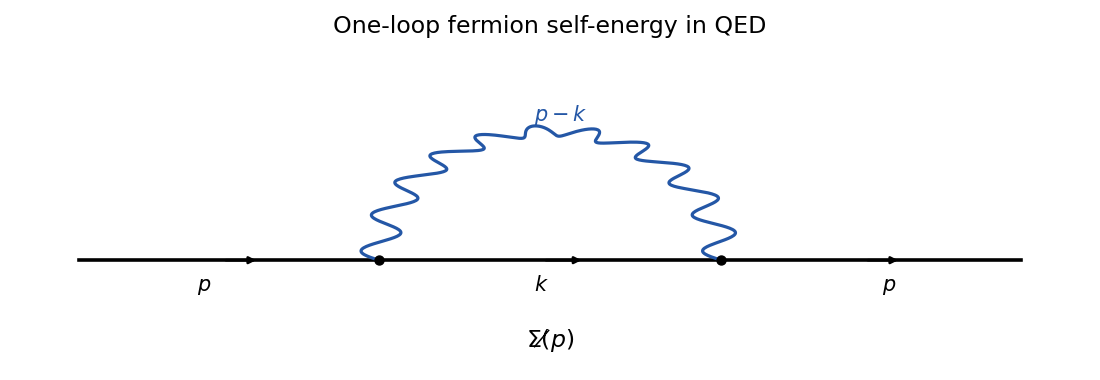
One-loop QED fermion self-energy
. An external fermion of momentum p emits an internal photon of momentum p minus k, propagates with loop momentum k, and reabsorbs the photon. Details.
The QED Feynman rules assign to the two vertices, the Feynman-gauge photon propagator contracts and and contributes , and the internal Dirac propagator is . Hence
The kinetic terms determine the engineering dimensions in dimensions:Requiring to have dimension givesThus the electric charge is dimensionless only in four dimensions. In dimensional regularization one writes the bare interaction with , where is dimensionless and the renormalization scale supplies the missing dimension.
Use a Feynman parameter with and . ThenThe identities for gamma matrices giveAfter the shift , the term odd in integrates to zero. The rotationally symmetric loop integral isConsequentlyThus
Restore the dimensional-regularization factor and defineUsing givesThe first term is the ultraviolet divergence. In the modified minimal subtraction scheme, subtraction of leavesOn the tree-level mass shell, and , so . The mass counterterm isThe pole condition therefore givesEvaluating the elementary parameter integral yields the equivalent expression
For a short Wilson line, a gauge transformation givesUse and . Keeping terms of order , including , givesSince the Lie bracket is encoded by the Lie algebra structure constants, , and thereforeThis is the infinitesimal form of the Wilson-line gauge transformation.
The variation found above uses the adjoint covariant derivative:For the Lorenz gauge functional ,The field-independent factor may be absorbed into normalization. The Grassmann Gaussian integral exponentiates the Faddeev-Popov determinant with anticommuting Faddeev-Popov ghost fields:A Gaussian average over the gauge condition supplies the covariant gauge-fixing term, so
The quadratic gauge-field action in momentum space isIn terms of the transverse projector of a vector field and longitudinal projector of a vector field,the operator is . Its inverse, the gauge-boson propagator, isTherefore and .
Without gauge fixing, every gauge orbit is integrated infinitely many times and the quadratic gauge-field operator has a zero mode in field theory for every pure-gauge direction. It therefore has no inverse and no propagator. A gauge condition selects one representative per orbit, up to global transformations and the possible nonperturbative Gribov ambiguity, and makes perturbative Gaussian integration well defined.
The anticommuting fields and represent the field-dependent Faddeev-Popov determinant. They are Lorentz-scalar Grassmann fields, appear only on internal lines, and contribute a minus sign for each closed ghost loop. Their diagrams cancel unphysical gauge-polarization contributions and are required for gauge-independent, unitary amplitudes in a non-Abelian covariant gauge.
For axial gauge, . Its Faddeev-Popov operator isOn the gauge slice , the second term vanishes. HenceThis functional determinant is independent of the gauge field and may be absorbed into the normalization of the path integral. Any introduced ghosts are free and decouple, so no ghost fields are needed in axial gauge.
Articles by others on the same topic
There are currently no matching articles.