Work on a beta plane with and constant depth . Assume a steady, small-Rossby number interior, negligible friction there, small sea-surface displacements, and negligible depth gradients. Taking the vertical curl of momentum givesThe constant-depth continuity equation gives . Neglecting relative-vorticity tendency and advection, and the interior dissipation, yields Sverdrup balance:Introduce the ocean transport streamfunction by , . Then . Here has units of acceleration, as in the given momentum equation; for a physical surface wind stress , it would be .
To obtain the circulation law, use the vector identity . Its gradient term and the sea-surface pressure gradient integrate to zero around a closed contour. ThusOn an impermeable island boundary, velocity is tangent to the coast, so pointwise. Consequently its circulation obeys
For the steady island problem, choose a counterclockwise contour that goes east from the southern tip to the basin's eastern wall, north along that wall, west to the northern tip, and south down the western coast of the island. It avoids the eastern-island and western-basin dissipative layers. In the leading momentum balance, . Integration by parts givesHere on the basin wall and on the island, with constant latitude on the two connecting legs. Equating this integral to the wind forcing gives the Godfrey island rule
For the square island, , , and its west coast is . Both horizontal contour legs have length . With ,soThe sign convention makes positive northward. For it is southward. The total transport includes the island's thin eastern boundary current: omitting that current would leave a latitude-dependent interior transport rather than this constant passage transport.
To quantify the island's effect on the western boundary current, compare interior streamfunctions west of the island. In its latitude band, the inviscid solution isWithout an island it would be . Since the western basin wall has zero streamfunction, the difference in its required northward boundary-current transport isThus the island changes the current's strength by redistributing transport across its latitude band. For a square contained in the central positive-cosine band, it weakens the northward current near and strengthens it near the island's northern and southern edges. The change averages to zero over ; its local sign follows the formula for other island sizes.
Take for definiteness and define . Thermal-wind balance gives , and the lower boundary condition fixes . The basic interior quasi-geostrophic potential vorticity has no gradient, so a boundary-supported normal mode has zero interior potential-vorticity perturbation. Its vertical equation isDecay upward selects .
The buoyancy perturbation is . At a rigid boundary , linearized material conservation of buoyancy givesAt , this is , where for . The Eady edge wave therefore hasIt is an exponentially trapped boundary-buoyancy wave, not a vertically propagating interior mode. The formula for extends to , where the perturbation is stationary.
For the two-region problem, absence of a density jump at the common material interface requires continuity of buoyancy:Thus its basic slope is . For a nondegenerate stratification contrast, its variation over horizontal scale is , which is small in the usual quasi-geostrophic approximation with Burgers number of order one. The matching conditions can therefore be applied at the constant reference level to leading order. An exceptionally small stratification contrast would require checking this flat-interface ordering separately.
Pressure and normal velocity must be continuous because there is no membrane or singular interfacial force. Since base buoyancy is continuous, expanding pressure continuity at the displaced interface gives simply . The base horizontal velocity is also continuous there; call it . Decay away from the interface then givesLinearized buoyancy conservation in each region givesMatching normal velocity gives : the common slope correction to normal velocity cancels because pressure continuity also makes the horizontal velocity perturbation continuous. HenceThe quasi-geostrophic wave at a stratification interface has intrinsic phase velocityAs with and the shears bounded, the lower region becomes effectively rigid andrecovering the upper-fluid Eady edge wave. The matching calculation describes regular interface-supported modes; arbitrary interior potential-vorticity initial disturbances can additionally be advected by the shear.
Let , , and . The hydrostatic and thermal equations combine to giveTaking the vertical curl of the horizontal momentum equations to leading quasi-geostrophic order givesThe log-pressure coordinate continuity equation gives . Substitute . In commuting the vertical derivative with , the extra term is . Therefore the log-pressure quasi-geostrophic potential vorticity equation is
The required small parameters have distinct roles. The Rossby number makes inertial acceleration small relative to the leading geostrophic balance. The parameter lets that leading balance use a single while retaining the beta effect in the slower vorticity evolution. Finally, and the thermal equation imply . Density-weighted continuity has vertical derivative scale , where , so . The vertical-advection consistency criterion for log-pressure quasi-geostrophy is thusIt also controls the omitted vertical-advection ratio . Small Rossby number alone would not ensure small ageostrophic flow for every choice of stratification and vertical scales.
For constant , linearization about rest givesPutting replaces the vertical operator by . Consequently the Rossby wave in a log-pressure atmosphere has
If or , then . Boundedness excludes the growing solution and uniquely selects . If , boundedness excludes the linear-in- solution, leaving ; this is the zero-vertical-wavenumber threshold.
If , both oscillatory solutions are bounded. Boundedness alone does not give a unique propagating solution. With forcing at the bottom and no incident wave from above, impose an upward radiation condition. Sincepositive has upward group velocity. The outgoing solution is . The physical streamfunction includes the prescribed density-weighting factor; it is the amplitude that must remain bounded.
Thus the strict range for vertically propagating waves isAt , the unforced steady interior equation requires , so a nonzero bottom streamfunction cannot have a time-independent solution of this ideal rest-state problem without additional dynamics.
Assume , , and use complex normal mode amplitudes. The zonal momentum and continuity equations giveWhen , solving these two linear equations gives
For , a nonzero solution requires and . The remaining momentum equation gives . Only the positive sign decays at both infinities, so the equatorial Kelvin wave isIts phase and group velocities are both eastward with speed .
For nonzero meridional velocity, substitute the eliminated amplitudes into . The result isSet . The decaying Hermite polynomial modes have , up to normalization, and their eigenvalue gives the equatorial shallow-water dispersion relation
For , the quadratic in factors asThe admissible Yanai wave root is . With , substitution and cancellation giveThese expressions satisfy the original equations even at the isolated point where the two algebraic roots coincide and the earlier elimination formula has a zero denominator. The other root is not an independent admissible branch: its generic singular reconstruction fails the trapping conditions.
In the zonal momentum equation, the acceleration term is , the Coriolis term is , and the pressure term is . When , acceleration is small and the leading balance is between Coriolis acceleration and the pressure gradient. When , acceleration balances pressure and the Coriolis term is small; the branch tends to an eastward gravity wave.
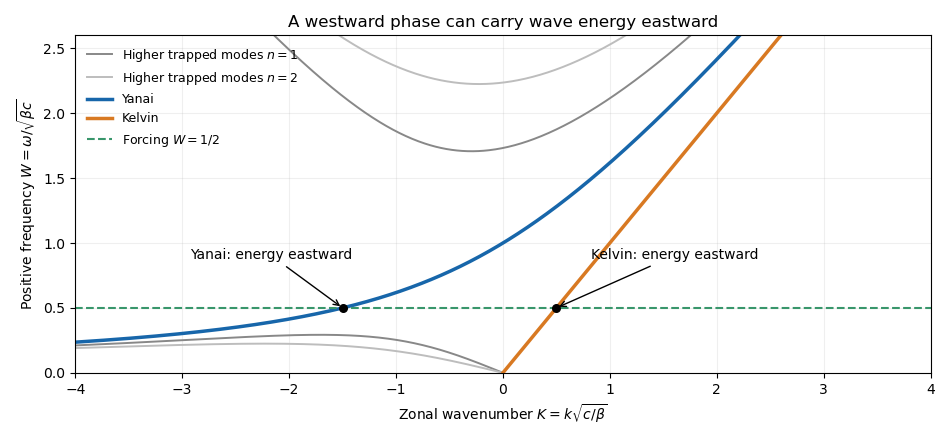
For , the fixed-frequency zonal roots areThe radicand is nonnegative exactly when satisfies . This gives the frequency gap for higher equatorial wave modes:
For the forcing frequency , we have . Already the low-frequency upper bound is , and that bound decreases with , while the high-frequency bound increases. Hence no mode propagates. The available real-wavenumber branches areFor the equatorial Kelvin wave, . For the Yanai wave, differentiating givesThus both propagating responses are detected east of the localized forcing, provided it has nonzero projection onto their meridional structures. The Yanai phase travels westward at this frequency, but its wave packet and energy travel eastward. Higher modes contribute only an evanescent response near the forcing.

Articles by others on the same topic
There are currently no matching articles.