The first term is the local viscous force per unit length from resistive-force theory. With unit tangent vector , the drag tensor gives , where is velocity relative to the fluid.
The second term is the bending force of an inextensible filament. Varying its energy gives bulk force density . The final term, , is the force density from filament tension; is the Lagrange multiplier enforcing . At low Reynolds number, these forces balance without a filament acceleration term.
With mass, length, and time dimensions , the coefficients haveThus the drag coefficients have the dimensions of dynamic viscosity, the filament bending modulus has dimensions force times length squared, and tension has dimensions force.
In the small-slope Monge representation, , , and the leading transverse velocity is . With no imposed axial prestress, the induced filament tension is second order in transverse amplitude, so its transverse contribution is higher order. The transverse component of force balance reduces to the small-slope elastohydrodynamic filament equationAn externally imposed zeroth-order tension would instead add .
For the transverse motion, the off-diagonal part of the resistive-force theory tensor gives axial propulsive force density to second order. Its integral isSubstitute the bending equation and integrate by parts:The boundary expression for transverse filament thrust is thereforeOnly endpoint slope, bending moment, and shear enter this expression. Exact inextensibility also generates second-order longitudinal material motion; if that motion is retained in instantaneous total axial drag, it adds . For a periodic deformation with fixed axial base position, that additional term has zero cycle average. Thus the displayed formula is the transverse propulsive contribution and also gives the cycle-averaged propulsive force.
A periodic displacement with angular frequency has . Balancing this viscous forcing with bending over length gives . Thus the elastohydrodynamic penetration length and sperm number areSince , the fourth root has dimensions length, as required.
With , , and , the bending equation becomesThe defining balance cancels both coefficients, giving . A large sperm number means that the periodically forced response decays before reaching the distant end.
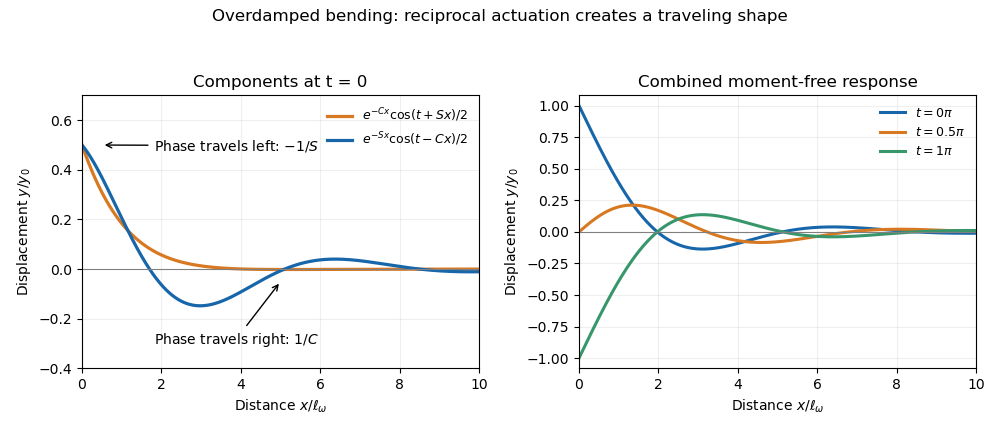
For the long filament, take the time-periodic solution of the dimensionless bending equation, after transients have decayed. Write . Then , so the spatial exponents satisfy . Define and . The two roots with negative real part are and ; the other roots violate decay at infinity.
Hence . The driven displacement gives , while the zero bending moment gives . Since , . The oscillatory bending of a moment-free semi-infinite filament isHolding each wave phase constant gives its dimensionless phase velocity:The first travels toward the actuator and attenuates over length ; the second travels away and attenuates over the longer length . These are spatially damped phase patterns in an overdamped bending equation, not two undamped inertial beam waves. Their combination satisfies both displacement and zero-moment conditions at the driven end.

Articles by others on the same topic
There are currently no matching articles.