For thin lenses in contact, optical powers add. At the two reference wavelengths, the lensmaker's equation gives total powerAn achromatic lens has . Subtracting and solving for the curvature-factor ratio yieldsOpposite curvature-weighted powers compensate the two materials' optical dispersion.
At the intermediate reference wavelength, the lensmaker's equation gives . Therefore the curvature-factor ratio from the previous part impliesand henceThe last equality uses the Abbe number definition and expresses the achromatic doublet power balance in terms of component focal lengths.
Write and . The achromatic doublet power balance isSolving these two linear equations gives and . Taking reciprocals gives the required focal lengths:The design requires distinct Abbe numbers; identical relative dispersion cannot yield a nonzero total achromatic power from this two-element thin model.
is the Abbe number, a measure of inverse relative optical dispersion. Ordinary crown glasses have comparatively large and lower refractive index, while ordinary flint glasses have smaller and often higher index. The Abbe diagram below spans typical optical-glass values; the shaded family ranges are schematic, and the marked examples are catalogue data. Modern glass compositions broaden and overlap the simple crown/flint picture.
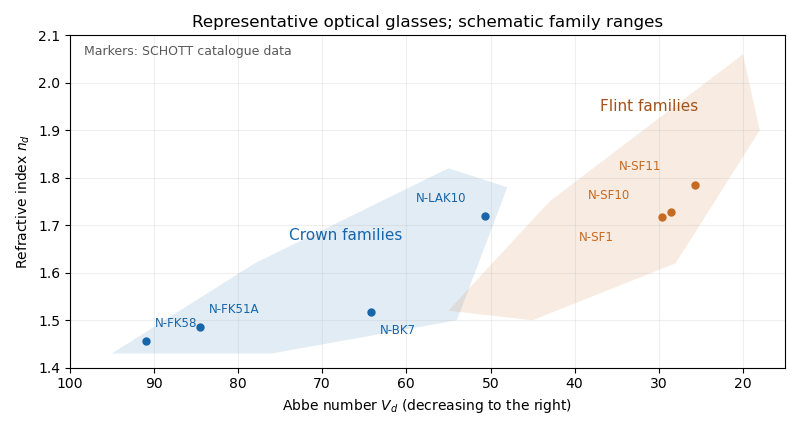

For a positive doublet with , the preceding formulas require and : a converging crown glass element and a diverging flint glass element. Their dispersion corrections cancel, while their net optical power is positive. A small difference in Abbe numbers requires large opposing component powers, which makes the design harder to correct for other optical aberrations.
Articles by others on the same topic
There are currently no matching articles.