The inner cylinder is . With and , this becomes , so away from the touching pointAt this boundary the outward radial vector from the cylinder center is , so the counterclockwise unit tangent is . Since and , the no-slip boundary condition givesFor a streamfunction in polar coordinates, no penetration through a stationary material curve makes constant along that curve. Both cylinders touch at the origin, so continuity forces their constants to agree. Since adding a constant does not alter velocity, choose their common value as .
The outer circle obeys , and henceIts counterclockwise tangent is again . Its angular velocity is and radius is , so its signed tangential speed is . The boundary conditions areThe first follows both from impermeability and from the common streamfunction value forced by the contact point.
With , the stated biharmonic stream function for planar Stokes flow isRequiring it to vanish at and givesThus and . Writing yieldsUsing and , differentiation shows that equals on the inner boundary and on the outer boundary. Both wall conditions hold precisely whenThis is the Stokes flow between touching counter-rotating cylinders.
At an interior stagnation point, . The first equation isSince inside the fluid, . AlsoOn the preceding locus the bracket is nonzero, so . ThereforeFor , in the interior, and its nested nonzero level curves are closed recirculating streamlines around this unique stagnation point.
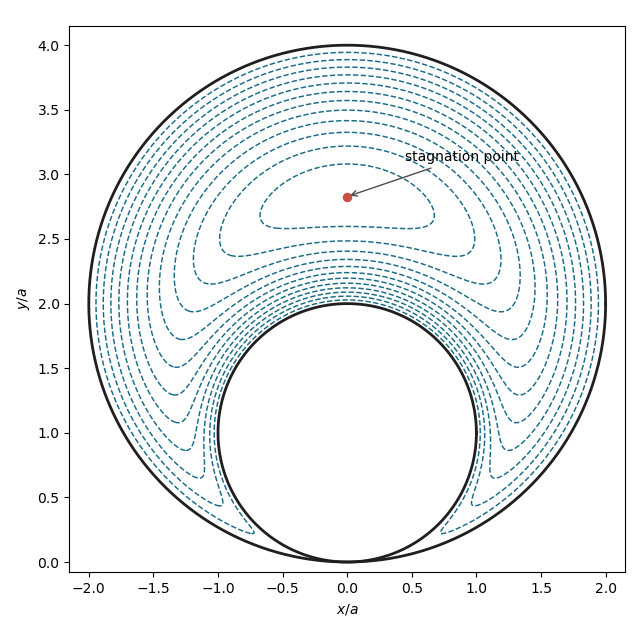
Streamlines around two touching cylinders
. Articles by others on the same topic
There are currently no matching articles.