Put the star at the origin, take along the line of sight toward the observer, and let point North in the plane of the sky. The direction is then anticlockwise from North. Draw the ascending node on the sky plane at position angle , tilt the circular Kepler orbit through the orbital inclination about that nodal line, and place the planet an angle along the orbit from the ascending node. The direction of increasing must cross the sky plane toward at .
A convenient orthonormal basis in the orbital plane isHere points along the nodal line and fixes the required sense of motion. The planet lies at ; this relation also specifies all the labels required in the sketch.
Resolving into the sky coordinates givesIn particular, at the orbital nodes, and at , so that node is indeed the ascending node.
The projected separation isRotating the projected coordinates through gives components along the nodal line and perpendicular to it. The position angle is therefore most safely written with the quadrant-preserving functionor, wherever the corresponding tangent is finite,
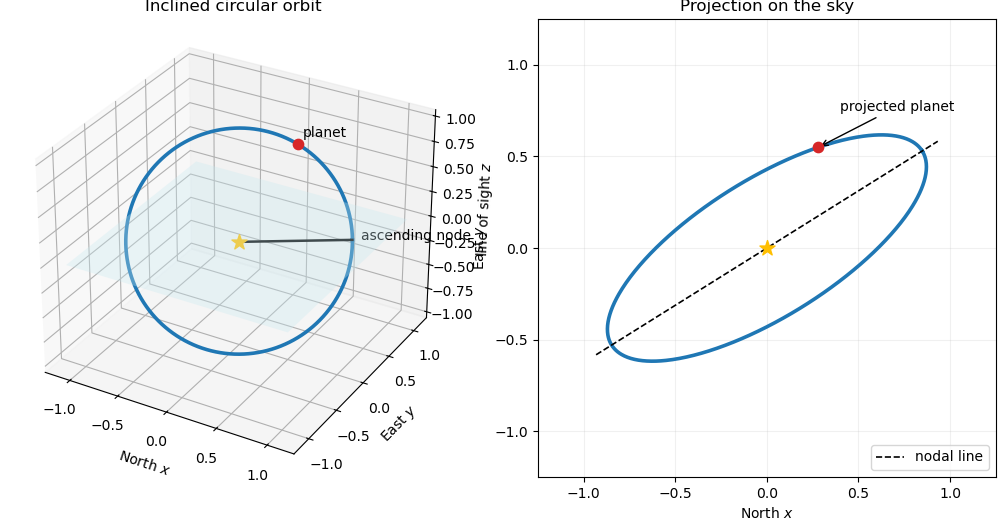

For the nearly edge-on orbit with , the small-angle approximation gives . HenceAlso,Thus, on a branch where and with separation measured in units of ,as stated. The absolute value is required when denotes the nonnegative separation over the whole orbit.
The oriented normal vectors to the planet and dust-belt planes areTheir inner product is the cosine of the mutual inclination, soIf , this reduces to ; equal inclinations then give . If both planes are face-on, it likewise gives , independently of their undefined nodal longitudes. Reversing an observationally unidentified ascending node by produces the familiar orbital-plane orientation degeneracy for an axisymmetric belt.
Let . From part (iii), and . The tangent addition formula therefore givesor, without singular coordinate tangents,For with , smooth choice of the angular branch gives
Coplanarity requires both and , up to the orbital-plane orientation degeneracy. Under that hypothesis the measured planet angle must obeyFor a nearly edge-on belt this offset is small except close to the projected crossings where . Measurements at several orbital phases can therefore test the entire projected ellipse: a systematic offset from the predicted relation implies a nonzero mutual inclination. A single projected location generally cannot establish coplanarity because , the front-back branch, and the nodal orientation can be degenerate.
An exterior misaligned planet exerts an orbit-averaged secular torque on each belt orbit. In the hierarchical limit , its leading quadrupole approximation drives nodal precession about the planet's orbital angular-momentum axis at a rate of orderup to a coefficient of order unity. Because this rate varies across a radially extended belt, differential nodal precession winds an initially flat belt into a warp and eventually a vertically thick, phase-mixed structure. Collisions can damp the free inclinations and make material approach a forced or Laplace plane; at sufficiently large mutual inclination, coupled eccentricity-inclination evolution such as the Kozai–Lidov mechanism may also become important.
Articles by others on the same topic
There are currently no matching articles.