In one standard Schwinger-Keldysh propagator convention, suppressing the momentum delta function,The two bulk-to-boundary propagators to the late-time insertion areInterchanging every and gives the equivalent opposite contour-label convention. Direct differentiation of the supplied Bunch-Davies vacuum mode gives
Each differentiated external propagator contributes , the differentiated internal propagator contributes , and the two vertices contribute . The common factor is thereforeThe ordered time integral needed on either same contour branch isWriting and integrating the polynomial exponential givesThe two time orderings have and respectively . Combining the and contour signs and complex conjugates yieldsThus and
For opposite contour branches the two vertex integrals factorize. Sincetheir product contributes . The two assignments and then giveConsequently
A late-time connected four-point function of a scale-invariant field in three spatial dimensions, after removing its momentum-conserving delta function, must obeyIn both contributions, scales as and every energy-denominator term scales as . Hence the complete -channel primordial trispectrum scales as , as required by scale invariance.
The inverse 3+1 decomposition of spacetime metric givesThe first term is the squared derivative along the hypersurface normal and the second is the spatial-gradient contribution.
At fixed and , varying the shift givesandIntegration by parts in the gravitational term turns the variation of into the spatial divergence of . Since the shift has no time derivative, its Euler-Lagrange equation is the ADM momentum constraint for a P(X, phi) scalar field
In flat gauge in cosmology, the supplied expressions implyto first order. The last two terms cancel after taking , so the geometric part of the momentum constraint is . Its matter part isThereforeand, after discarding a spatially homogeneous lapse mode,
For the homogeneous background, . The second Friedmann equation givesDividing by shows that the coefficient found above is
Substitution of and conversion to conformal time turn the interaction intoTreat and as constant at leading slow-roll order and use the massless de Sitter modeFor , the in-in formalism time integral at a vertex with leg undifferentiated is proportional toSumming the three choices of undifferentiated leg gives the primordial bispectrumThe sign follows from the interaction sign displayed in the question and at this order.
Liouville transport of the phase-space density along the particle trajectories givesUsing the equations of motion produces the Collisionless dark-matter Vlasov equation
Integrating the Collisionless dark-matter Vlasov equation over momentum makes the force term a vanishing momentum-space boundary term. Since , the zeroth moment isMultiplying by before integrating gives the first moment. Decompose the second velocity moment asusing the velocity-dispersion tensor of collisionless matter. Combining the result with the continuity equation givesThe single-stream pressureless-fluid equations follow when .
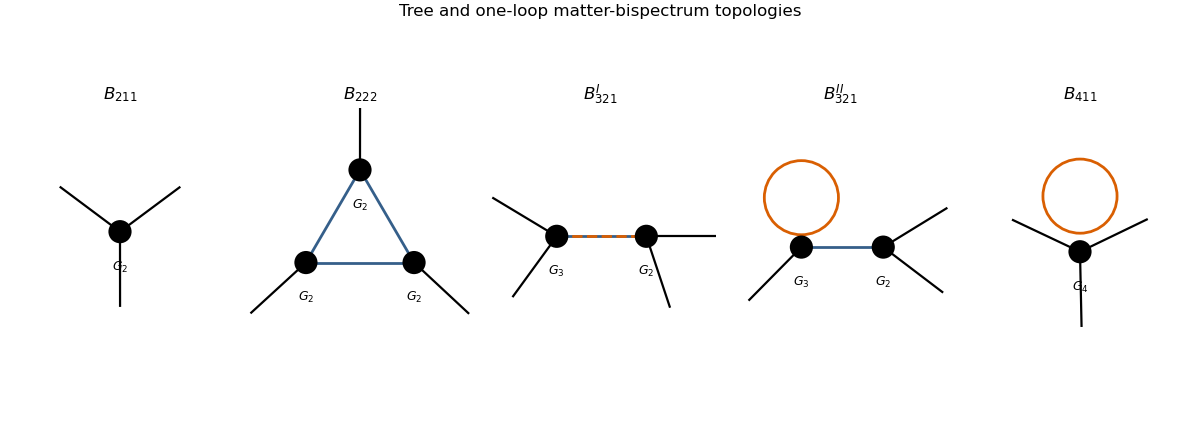
Write a filled vertex with incoming linear fields for the th-order peculiar-velocity divergence. Gaussian initial conditions require every linear field to be paired. Through sixth order in the linear density there are exactly five connected topologies: the tree diagram and the one-loop triangle , vertex-correction diagram , propagator-correction diagram , and four-leg diagram . These are the five diagrams of the one-loop matter bispectrum.
Define the standard perturbation theory velocity kernel bywhere and . For , one representative external labelling of the tree contribution isThe four one-loop representatives areThe full answer adds the distinct permutations of the external labels; the question asks for only one labelling of each topology.

The ultraviolet part of the one-loop matter power spectrum is renormalized by the leading effective field theory of large-scale structure operator proportional to . The analogous velocity-divergence counterterm iswhere the time dependence and the nonlinear reference scale may be absorbed into the renormalized coefficient . In the bispectrum it suppliesand permutations, with momentum shape on the corrected leg. This cancels the local ultraviolet dependence of .
Write and setwith first order. The photon on-shell condition isUsing and retaining linear terms gives . Hence
Divide the time component of the geodesic equation by and use . To first order, . Substitution of the supplied Christoffel symbols makes the background terms cancel the derivative of . The derivatives of the lapse and shift also combine, leavingThus the comoving photon energy is conserved in the unperturbed spacetime and changes through the gradient of the scalar gravitational source.
The collisionless equation states that is constant along a photon geodesic:At linear order . The last term is second order because the background distribution is isotropic. Inserting the stated temperature parametrization into this Free-streaming photon Boltzmann equation and using the energy equation givesFor a Fourier mode, with , this is
The integrating factor for the Fourier-space transport equation is . Therefore the line-of-sight solution for free-streaming photons between an initial time and observation at isThe first term freely streams the initial angular distribution; the integral accumulates the lapse and shift source along the unperturbed photon path.
Articles by others on the same topic
There are currently no matching articles.