The original double integral covers the triangle . By Fubini's theorem, after reversing the order, runs from to and from to . Since a continuous function is integrable on this bounded region,For the square pyramid, a horizontal section at height is a square of side : each vertex moves linearly from the base towards . Hence its cross-sectional area is , and its volume is . To use the identity just proved, choose :
Start with the solid between the elliptic paraboloid and the upper plane . Its projection is the disksince their vertical separation is . The second lower bound, , removes the part between the elliptic paraboloid and this lower plane whereverCall this second disk . Its centre is distance from the centre of , andbecause . Thus lies wholly inside . In particular the lower plane never exceeds the upper plane on , so the subtraction describes exactly the requested solid.
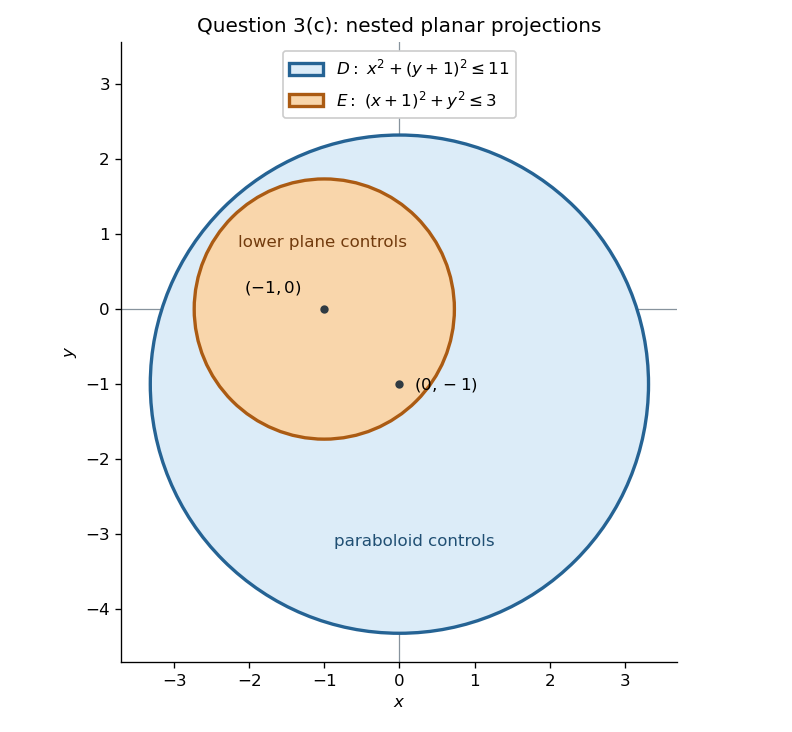

The nested-disk subtraction for paraboloid volumes therefore gives a difference of two double integrals:Translate polar coordinates to the centre of each disk. A general integral of this form isUsing and gives
Articles by others on the same topic
There are currently no matching articles.