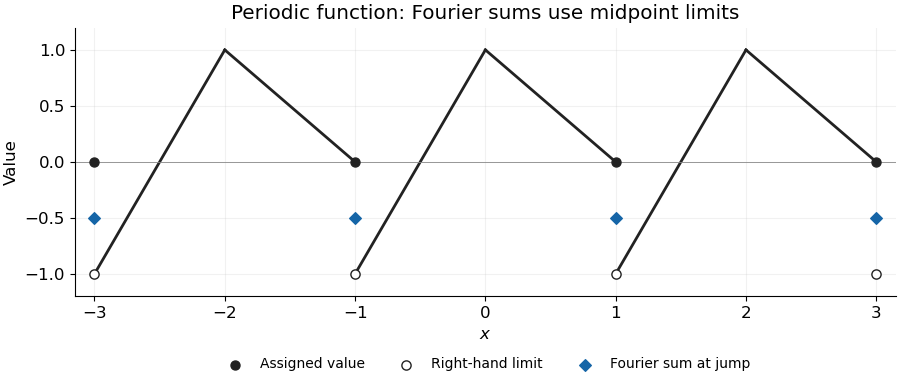
The graph repeats every two units: it rises linearly from the right-hand limit at an odd integer to value one at the next even integer, then falls linearly to value zero at the next odd integer. The defined value at each odd integer is zero, while its right-hand limit is minus one.
The Dirichlet convergence theorem for Fourier series gives the midpoint of the two one-sided limits at a jump. Hence, on the requested interval, the Fourier sum differs from precisely atAt every other point it equals ; in particular it equals one at the continuous corners with even integer coordinates.

For period two, write . Direct integration gives . For , and , soThus the Fourier series isIt converges to the values specified in part a. Changing the assigned values at the jumps would not change these integral coefficients.
At , the Fourier sum is , and only the odd cosine coefficients contribute. Therefore , givingAt , the sum is . All nonzero cosine terms vanish, and the sine terms have alternating signs over odd indices. Thus , soThis is the Leibniz formula for π obtained from the same Fourier series.
Articles by others on the same topic
There are currently no matching articles.