Solutions to all six questions and all optional parts. The surface-volume formula in Question 2(b) requires an appropriate enclosing surface and orientation. The symmetry claim in Question 6(a), as printed, also needs the coefficient to be even in ; a counterexample to the unrestricted claim is given.
Use the change of variables , . Its Jacobian determinant in the first quadrant is , and the inverse is uniquely determined byBoth are positive for , so the transformation is one-to-one on the region. It becomes the rectangle , . The integrand is , and . Thus
Green's theorem for a positively oriented simple closed planar curve statesHere . The trapezium has parallel sides of lengths two and one, separated by height one, so its area is . ThereforeEvery congruent trapezium gives the same answer when its boundary is traversed anticlockwise, since the scalar curl is constant and geometric congruence preserves area. Reversing the traversal would instead reverse the sign.
A parametrization of the cylindrical patch isThe last range uses the planes and . The surface area element is . HenceIncluding or excluding the boundary curves does not change the surface area.
For a bounded region with piecewise smooth boundary and a continuously differentiable vector field on a neighborhood of its closure, the divergence theorem sayswhere is the outward unit normal vector. The left side integrates divergence over the volume; the right side is the outward flux.
Apply the divergence theorem to . The product rule givesbecause the two gradient inner products cancel. Also . ThusThis is Green's second identity, under the usual regularity assumptions permitting these derivatives and boundary integrals.
Take in Green's second identity. Since , , on the unit sphere, and there,The final term vanishes by the divergence theorem, because it equals . ThereforeWe assume sufficient boundary regularity for the stated boundary values and integrals, or use the corresponding trace/limit formulation. This is the equality of volume and surface averages for a harmonic function, since the unit ball and sphere have volume and area .
Parametrize the surface of revolution byAn oriented vector surface area element isUse the vector field , whose divergence is one. If this parametrization has the outward orientation on an enclosing surface, the divergence theorem givesThe second equality is integration by parts, using the endpoint values. For example this outward convention applies when the positive- branch lies above the negative- branch, for .
The stated regularity and endpoint conditions alone do not guarantee an embedded enclosing surface: branches can cross or coincide. Without an appropriate orientation assumption the flux formula is an algebraic signed volume. If “inside” is defined as the region between the two graph branches for each radius, its nonnegative geometric volume is insteadThis explicitly handles a reversal or change in the order of the two branches.
For , the positive- branch is above the negative one, so the orientation in part i is outward. ConsequentlyThe integral follows from .
If two solutions exist, their difference satisfies inside and on the boundary. Suppose has a positive value. Continuity on the closed ball gives a positive maximum at an interior point, where the Hessian matrix is negative semidefinite and hence . But the equation gives , a contradiction. A negative minimum similarly contradicts .
Thus , proving uniqueness by the maximum principle for the modified Helmholtz equation. Here a classical solution is understood to be inside and continuous up to the boundary; mere first differentiability would not define the displayed Laplacian classically. With enough boundary regularity, the alternative Green's first identity proof is .
The curl is . For the upward orientation of the paraboloid, the vector surface area element is . Therefore Stokes theorem givesThe upward normal gives the prescribed anticlockwise boundary orientation viewed from above.
Take the boundary pieces in the orderOn the circular arc , use for . Then and , so its line integral is zero.
On , use , , with decreasing from two to zero. Since and , , giving four. On , use , , with increasing from zero to two. Again , giving minus four. The total is , agreeing with Stokes theorem.
Write , so . The Cartesian curl isThe last component is zero because both differentiated terms are . ThusThe condition excludes the cylindrical-axis coordinate singularity.
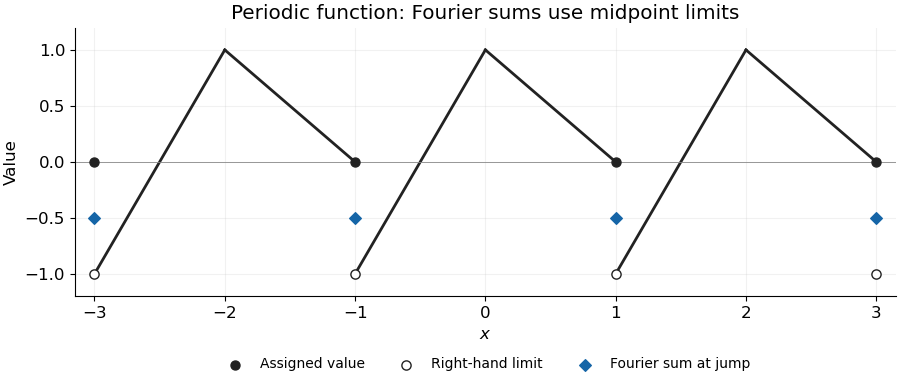
The graph repeats every two units: it rises linearly from the right-hand limit at an odd integer to value one at the next even integer, then falls linearly to value zero at the next odd integer. The defined value at each odd integer is zero, while its right-hand limit is minus one.
The Dirichlet convergence theorem for Fourier series gives the midpoint of the two one-sided limits at a jump. Hence, on the requested interval, the Fourier sum differs from precisely atAt every other point it equals ; in particular it equals one at the continuous corners with even integer coordinates.

For period two, write . Direct integration gives . For , and , soThus the Fourier series isIt converges to the values specified in part a. Changing the assigned values at the jumps would not change these integral coefficients.
At , the Fourier sum is , and only the odd cosine coefficients contribute. Therefore , givingAt , the sum is . All nonzero cosine terms vanish, and the sine terms have alternating signs over odd indices. Thus , soThis is the Leibniz formula for π obtained from the same Fourier series.
For and , D'Alembert's formula for the wave equation on the full real line isFor the specified initial data, define the cumulative initial-velocity integralThen . The initial velocity jumps at , so the resulting solution is interpreted piecewise classically, or as a weak wave-equation solution across the corresponding characteristic curves.
At , the interval of integration has half-width . Evaluating the cumulative integral in part a gives the even functionIt has value at zero and maxima at , then falls to zero at the two wavefronts.
At , the integration interval first moves through positive arguments, then crosses zero, and finally contains all of . The result isThe final plateau is the integral of the entire initial velocity profile divided by .
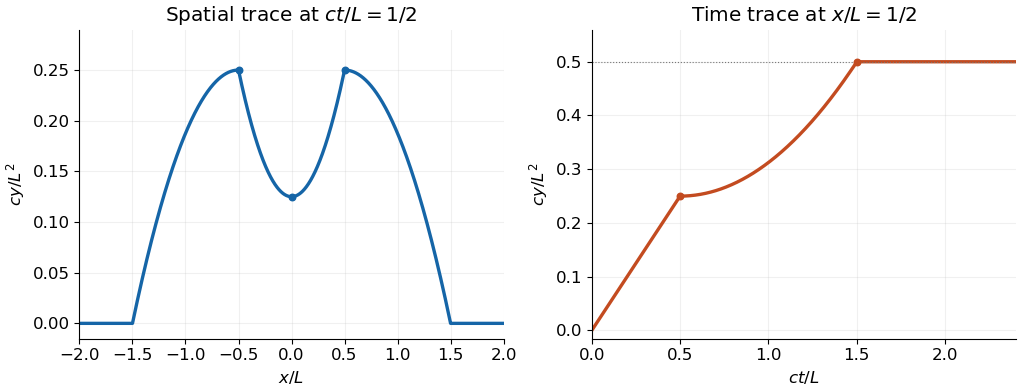
Two traces of the D'Alembert solution for the compactly supported initial velocity
. The spatial profile has two peaks at half the initial support radius. The time trace at that location eventually reaches a constant plateau. Axes use dimensionless variables; plotted curves use . Details.
The multivariable chain rule gives and . Substitution into the differential equation yieldsThe coordinate transformation is invertible exactly when .
Eliminate the two pure second derivatives by taking to be the roots of . They are distinct real numbers exactly whenThus the required function is . The mixed coefficient becomes , so the transformed equation is . Integrating once in each coordinate giveswith arbitrary sufficiently smooth functions . This is the characteristic form of a strictly hyperbolic partial differential equation.
For uniqueness, subtract two solutions and call their difference . It has zero boundary and initial data, with . Its squared L2 norm obeys the energy estimateThe boundary term vanishes and . A nonnegative quantity starting at zero must stay zero, proving uniqueness in the usual classical or corresponding energy class.
The printed evenness claim for is false for an arbitrary coefficient . Take and . The strong maximum principle makes the solution positive in the interior for . If it were even, and would both be even. Subtracting the equation at and would give , impossible for .
With the additional assumption , the intended argument is valid. For , reflection solves the same equation with the same initial and boundary data. Uniqueness then proves . If , initial and boundary values disagree at the two time-zero corners; the initial condition is understood in the interior or in the L2 norm limit.
With , the chain rule gives . ThusSeparation of variables gives the eigenfunctions with time factors . The Fourier sine coefficients of the initial constant areOnly odd modes survive, soReturning to , , henceFor every the exponential coefficients give uniform convergence of the differentiated series on later-time compact sets, verifying the PDE and boundary conditions. As , the solution tends to at every interior point and in L2 norm, while remaining zero at the endpoints. The expression is visibly even in , consistent with the corrected symmetry argument for .
Articles by others on the same topic
There are currently no matching articles.