Solutions cover all seven questions: Section A, Questions 1–4, and Section B, Questions 5–7, including every optional question. The module label is I for Mathematics and Mathematics and Philosophy, and M1 for Mathematics and Computer Science; the formal paper code is A10138W1. In Question 2(b), is understood, as required by .
Write as an matrix and as an matrix, with rows . The rule for matrix multiplication givesEvery row of is therefore a linear combination of rows of . Taking linear spans gives
When is an invertible matrix, . Apply i first to and then to :Thus the two row spaces are equal. In particular, invertible left matrix multiplication preserves row rank.
For any matrix and compatible invertible matrix , the linear map maps onto : a linear combination of rows of is sent to the same linear combination of rows of . Its inverse function is , so these row spaces have equal dimensions. Hence right matrix multiplication by also preserves row rank.
If , ii now givesThis proves the required matrix similarity invariant without needing to assume equality of row rank and column rank.
For the given real matrix , direct matrix multiplication gives the eigenvectorsPut these eigenvectors into the columns ofSince , is an invertible matrix. The three column identities give , soIn particular, the matrix similarity is established by an explicit change-of-basis matrix.
Write and . Because is a diagonal matrix,Thus exactly when for every . The three eigenvalues are distinct, so every off-diagonal entry of must be zero; diagonal entries are unrestricted. Consequently the centralizer of a diagonal matrix here isEvery displayed matrix indeed commutes with , since diagonal matrices multiply entry by entry on the diagonal.
Matrix similarity transports commuting operators: with ,By ii, all such matrices are thereforeFor completeness, matrix multiplication givesThe parameterization is injective, since matrix multiplication by and recovers the parameter diagonal matrix. Thus there are infinitely many choices. Already the distinct scalar matrices , , give an infinite family.
The rank-nullity theorem for a linear map , with a finite-dimensional vector space over a field , isHere the nullity is the dimension of the kernel of a linear map, and the rank of a linear map is the dimension of its image of a linear map.
Define the linear functional by . The given hyperplane is . Choose with . For any , the vector whose only nonzero coordinate is satisfies . Hence is surjective and has rank of a linear map equal to .
Applying the rank-nullity theorem to this particular linear map givesThe nonzero-coefficient hypothesis is essential: if all were zero, the kernel of a linear map would instead be all of .
Over the finite field , a basis of the hyperplane has vectors by ii. Each vector on the hyperplane has a unique expression as a linear combination of that basis, and each coefficient has possibilities. ThusEquivalently, choose freely all coordinates except , where , and solve uniquely for . For this counts just the zero vector, consistently with .
The transpose is a linear map, so is a linear map on the -dimensional vector space . Let denote a matrix unit. The answer depends on the characteristic of a field.
If , then means . Such skew-symmetric matrices have zero diagonal, and their entries above the diagonal can be chosen freely. A basis of the kernel of a linear map is for , giving nullity . The image of a linear map consists of all symmetric matrices: is symmetric, and every symmetric matrix is . Its basis comprises and for , giving rank of a linear map .
If , then , so consists of all symmetric matrices, with dimension . Every is symmetric with zero diagonal, and every symmetric zero-diagonal matrix arises by taking for and all other entries zero. The image of a linear map therefore has basis for , and dimension . This is the symmetrization map in characteristic two.
In both cases the rank-nullity theorem is verified explicitly:
The monomials form a basis of : they span every polynomial of degree of a polynomial at most , and equality of polynomials forces equality of every coefficient, proving linear independence. ThereforeThe zero polynomial is included in even though its degree of a polynomial need not be assigned an ordinary nonnegative value.
Suppose, for a contradiction, that and have no common root of a polynomial. Since the polynomial ring has no zero divisors and , the relation with not both zero forces both and to be nonzero.
By the fundamental theorem of algebra, writewhere the are distinct. For each , . The equality implies that divides . The multiplicity of a root in polynomial multiplication is the sum of its multiplicities in the factors: factor out the largest powers of and note that the two remaining factors have nonzero values at . Since , must contain .
Thus has at least roots of a polynomial counted with multiplicity of a root, so . This contradicts . ConsequentlyCounting multiplicity of a root is necessary: counting only distinct roots of a polynomial would miss repeated factors.
Use the linear mapIt is well defined because , and it is a linear map by distributivity of polynomial multiplication. If for a nonzero pair, ii would give a common root of a polynomial of and . The hypothesis therefore implies , so is injective.
By i, the domain and codomain both have dimension : a basis of the domain is for , and a basis of the codomain is . The stated finite-dimensional result makes surjective. In particular has a preimage, proving the degree bound in polynomial Bézout's identity:Indeed, injectivity also proves uniqueness of this pair under the stated degree of a polynomial bounds.
Put . Taking all coefficients zero puts the zero vector in . If , lie in and , thenThus is closed under vector addition and scalar multiplication, contains the zero vector, and is therefore a linear subspace of . This is precisely why the linear span is a linear subspace.
Suppose . If , thencontrary to the hypothesis. Hence . The assumed linear independence of then gives . Therefore are linearly independent. Adding a vector outside the previous linear span creates no nontrivial relation.
Write . Since , necessarily . Rearranging givesAll generators of therefore belong to , proving one set inclusion. Conversely, all belong to the linear subspace , proving the other set inclusion. ThusThis linear span exchange does not require linear independence of the original vectors.
For , its image of a linear map is exactly . Consequently is surjective if and only if are a spanning set for .
If the vectors are linearly independent and , then , so for all . Hence is injective. Conversely, if is injective, any relation says and thus , proving linear independence.
Combining both equivalences givesA basis is therefore exactly a choice of vectors giving existence and uniqueness of coordinates, expressed by a bijection.
Take any finite selection of distinct indices and a relationThe coordinate at on the left is exactly , while the zero vector has coordinate zero. Hence for each . Every finite subset of is therefore linearly independent, which is the definition of linear independence for an infinite set. Thus is linearly independent in the vector space of finitely supported sequences.
Every is a finitely supported sequence, so for a finite set of indices ,Thus is a spanning set. If contained , the displayed expression would give a nontrivial relationamong the distinct vectors of the finite subset of : the coefficient of is . This contradicts the linear independence of . It also covers , whose singleton is not linearly independent. Hence . In particular, is both a basis and a maximal linearly independent subset of .
The hypothesis implies , since the zero vector is a scalar multiple of every vector. SetSince is not a scalar multiple of , . Positive definiteness and bilinearity of the real inner product giveMultiplying by and taking square roots proves the strict Cauchy-Schwarz inequalitySince every real number satisfies , this proves, in particular,The argument derives the required inequality directly from the inner product axioms.
The two-vector Gram matrix isThe upper bound follows because the subtracted square is nonnegative. If either vector is zero, the determinant is zero. Otherwise apply the non-strict version of the calculation in i: with gives . ThereforeEquality on the left holds exactly when the two vectors are linearly dependent; equality on the right holds exactly when they are orthogonal. The Gram determinant measures the squared area of their parallelogram: in the nonzero case, , the square of base times perpendicular height.
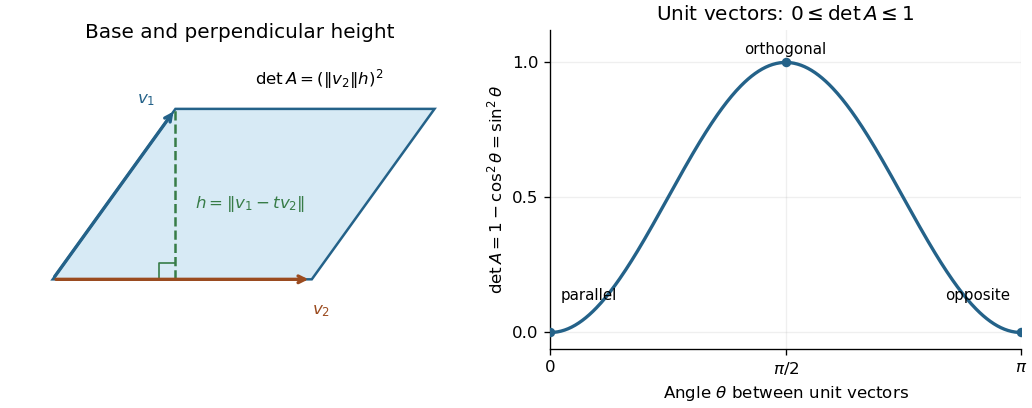
The Gram determinant as squared parallelogram area, and its dependence on the angle between unit vectors
. Details. 
Bilinearity of the real inner product gives, for the specified linear combinations,The last equality is the entrywise rule for matrix multiplication, with the transpose of the column vector .
Symmetry of the real inner product gives . Moreover, i with shows thatso the Gram matrix is a positive semidefinite matrix. To also check reality of every eigenvalue, allow a nonzero vector with . Since is a real symmetric matrix,Here is the conjugate transpose, and cancels the imaginary part. Thusbecause . This proves both that every eigenvalue is real and that it is nonnegative.
By the spectral theorem for real symmetric matrices, there is an orthogonal matrix such thatFor clarity, the diagonalization can also be justified recursively. The characteristic polynomial has a complex root of a polynomial by the fundamental theorem of algebra. By ii its eigenvalue is real; taking a nonzero real or imaginary part of an associated eigenvector in gives a real eigenvector, which can be normalized. Its orthogonal complement is invariant, because . Restriction to this linear subspace is again symmetric, and induction on dimension gives an orthonormal basis of eigenvectors.
All by ii. The permitted invariance of determinant and matrix trace under change of basis, applied to the diagonal matrix, yields
If every , then each diagonal entry of the Gram matrix is , so its matrix trace is . Using iii and the permitted arithmetic-geometric mean inequality,The bound is attained by any orthonormal family, whose Gram matrix is the identity matrix.
The function composition of two bijections is a bijection, with inverse function . Thus function composition is a binary operation on . It is associative, since both and send to .
The identity function is a bijection and satisfies . Every bijection has an inverse function , itself a bijection, satisfying . These verify all group axioms, so is a group, the symmetric group of .
For a singleton , the symmetric group contains only the identity function. For a two-element set, it contains the identity function and the transposition exchanging the two elements; the latter squares to the identity function. In both cases all elements commute, so the group is Abelian.
If contains three distinct elements , define the transpositions and , fixing every other element of . They are bijections, even when is infinite. With function composition read from right to left,Thus they do not commute, so the symmetric group is not Abelian. Since is nonempty, this proves
For each , left translation in a group is a bijection, with inverse function . Thus belongs to . For , associativity of the group operation givesHence is a group homomorphism. If , evaluation at the identity element gives . ThereforeThis is the left regular representation used in Cayley's theorem.
Suppose . Choose with , using the given right inverse element property. Multiply the idempotent relation on the right by . By associativity and the given right identity element property,Thus the only idempotent element of a semigroup is . This argument uses no cancellation and does not assume a left identity element.
Suppose . Using only associativity and the given right identity element property,Thus is an idempotent element of a semigroup. By i it equals , provingNo left identity element or cancellation law is needed for this deduction.
For any , choose with . By ii, as well. Associativity and the right identity element property now giveThus is also a left identity element. The given binary operation is closed on and associative, is a two-sided identity element, and each has the two-sided inverse element . All group axioms hold, so is a group. This is the one-sided group axioms criterion.
An injective function from a finite set to itself is surjective: its image of a function contains as many distinct elements as the entire set, so it cannot omit one. Thus every element of is a bijection, and conversely every bijection is injective. HenceIt is a group under function composition by i.
The shift , , is injective, so . It is not surjective: the least natural number is missing from its image of a function, whether starts at zero or one. For every , the image of a function of is contained in the image of a function of , so .
The identity function belongs to and is its identity element under function composition; any group structure using that operation would have this same identity element. Since has no right inverse element, is not a group under function composition. It is a monoid, since injectivity is preserved by function composition.
Each left coset is nonempty, since it contains , and every lies in its own left coset. Suppose and intersect, say with . ThenSince is a subgroup, , and . The reversed relation gives . Thus any two left cosets are either equal or disjoint, and together they cover . Therefore is a partition of a set . No finiteness or normal subgroup assumption is needed.
For and , defineIf then , so this function is well defined. Its inverse function is , since successive left translation in a group by and cancels. ThusIn particular every left coset has the same cardinality as .
Let the finite set contain distinct left cosets. By i, they form a disjoint partition of a set , and by ii each has elements. If is also finite, counting this finite disjoint set union givesThus is a finite group. This is the counting argument behind Lagrange's theorem.
Fix . The integer powers of a group element satisfyFor nonnegative integers these rules follow by associativity and counting factors; negative integers are handled by , and opposite signs by cancellation of adjacent inverse elements. All factors are powers of the same element, so no abelian group assumption is involved.
It follows that is a group homomorphism from the additive group of integers to , andThe homomorphism uses ordinary addition on ; composition of the power functions corresponds to ordinary multiplication of exponents.
Suppose an arbitrary binary operation makes a group and makes a left group action on . For any group action, each acting element induces a bijection: the function induced by its inverse element is its inverse function.
In particular, the acting element whose underlying integer is must induce a bijection . But its power function isa constant function. This is injective only when all elements of equal . ThereforeThis proves the power-map group action obstruction for every possible ; it never assumes that is ordinary integer multiplication, or that the integer is the acting identity element.
If , choose ordinary addition on , giving the additive group of integers. Every power function is the unique identity function on the singleton , so the group action axioms hold:Thus ordinary addition supplies the required group operation on . Together with ii, existence is equivalent to being the trivial group.
Articles were limited to the first 100 out of 450 total.
Articles by others on the same topic
There are currently no matching articles.