The Fourier cosine series converges to the continuous even -periodic extension. If represents modulo , its value isIt has value zero at , rises linearly with distance from these points until height , and then stays flat until the next descending ramp. Thus the sketch on has minima at , and plateaux centred at the odd multiples of . Its large partial sums round the corners and closely follow the whole graph.
The Fourier sine series converges, away from the odd multiples of , to the odd -periodic extensionAt every odd multiple of its value is zero, the midpoint of the jump from to . At even multiples of it passes continuously through zero. Thus on every interval it has a negative plateau, a rising linear segment through , and a positive plateau. The jump size is .
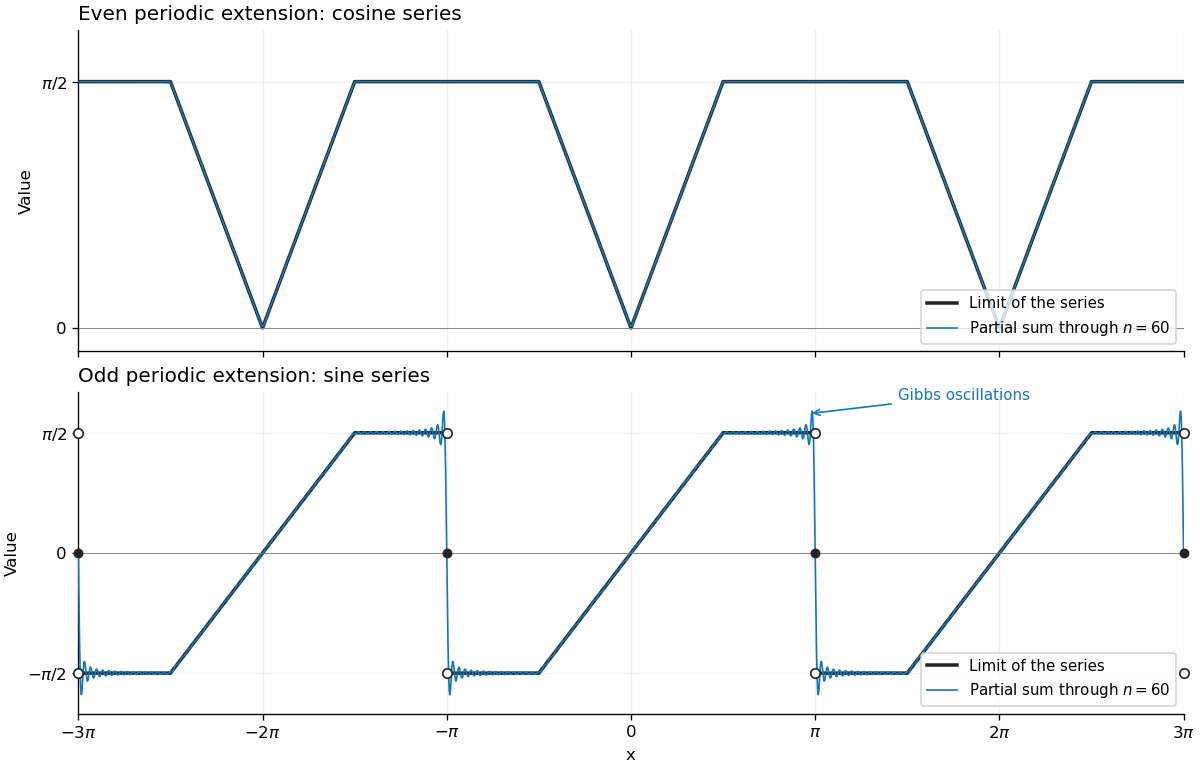
Periodic limits and 60-term Fourier partial sums
. Details. 
The blue curves are the partial sums through . The open endpoint circles and filled zero dots in the lower panel distinguish the one-sided limits from the value of the Fourier sine series at each jump. Near these jumps the partial sums exhibit the Gibbs phenomenon: the oscillations become concentrated in narrower regions as the number of terms grows, while their limiting overshoot remains about times the jump, here about .
Articles by others on the same topic
There are currently no matching articles.