For the Fourier cosine series, first take the even extension on , and then its -periodic extension. Evenness eliminates the sine terms. With the constant term written as , the Fourier coefficients and series areFor the Fourier sine series, take the odd extension for and for , and extend with period . Values assigned at isolated endpoints do not change the Fourier coefficients. Oddness eliminates the constant and cosine terms, leavingBoth formulas follow by orthogonality on and the parity of the extensions.
Using the usual piecewise smooth interpretation of the derivative hypothesis, Dirichlet's theorem on Fourier series gives the average of the two one-sided limits of the appropriate periodic extension. The even extension is continuous at and at the identified endpoints , so the Fourier cosine series converges toFor the odd extension, the one-sided limits at zero are and , while at the periodic one-sided limits are and . Hence the Fourier sine series converges toAt an endpoint this equals precisely when is zero there. One can also see the zero endpoint values directly: every partial sum consists of sines that vanish at both endpoints.
Put . The constant Fourier coefficient isFor , integration by parts givesThe terms cancel. ThusThis Fourier cosine series has when is divisible by four, when , and when is odd.
The Fourier cosine series converges to the continuous even -periodic extension. If represents modulo , its value isIt has value zero at , rises linearly with distance from these points until height , and then stays flat until the next descending ramp. Thus the sketch on has minima at , and plateaux centred at the odd multiples of . Its large partial sums round the corners and closely follow the whole graph.
The Fourier sine series converges, away from the odd multiples of , to the odd -periodic extensionAt every odd multiple of its value is zero, the midpoint of the jump from to . At even multiples of it passes continuously through zero. Thus on every interval it has a negative plateau, a rising linear segment through , and a positive plateau. The jump size is .
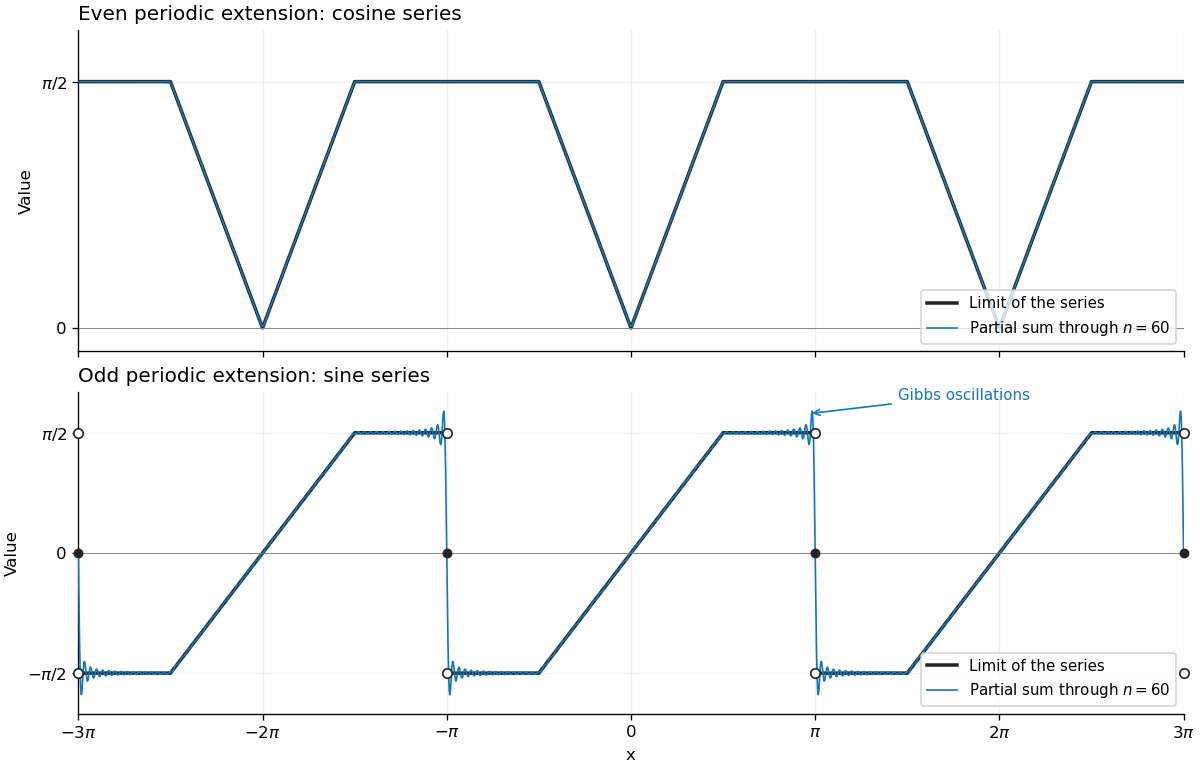
Periodic limits and 60-term Fourier partial sums
. Details. 
The blue curves are the partial sums through . The open endpoint circles and filled zero dots in the lower panel distinguish the one-sided limits from the value of the Fourier sine series at each jump. Near these jumps the partial sums exhibit the Gibbs phenomenon: the oscillations become concentrated in narrower regions as the number of terms grows, while their limiting overshoot remains about times the jump, here about .
The truncated Fourier cosine series gives the better approximation over the whole closed interval. Its Fourier coefficients obey , so absolute convergence and the tail boundgive uniform convergence. The even periodic extension is continuous; its slope changes only cause corners.
By contrast . The odd periodic extension has a jump at , giving slower coefficient decay and the Gibbs phenomenon near that endpoint. Every truncated Fourier sine series satisfies , soIt therefore cannot converge uniformly to on , although it converges at every point of . This comparison concerns approximation across the interval; it does not assert that the cosine truncation has smaller error at every individual interior point for every .
Articles by others on the same topic
There are currently no matching articles.