The relation rearranges to , so the diagonals and have the same midpoint. Equivalently and : each pair of opposite sides has the same displacement vector. Thus the given quadrilateral is a parallelogram. The identities also describe degenerate configurations if coincident or collinear vertices are allowed.
Multiply numerator and denominator by the complex conjugate of . For this givesThus its real part and imaginary part are respectively
Multiplying by gives . The sixth roots of unity do not solve the original equation, since substituting either gives three. The other four do, because the extra factor is nonzero. HenceTheir real parts are and their imaginary parts are , giving the four corners in the left Argand diagram below.
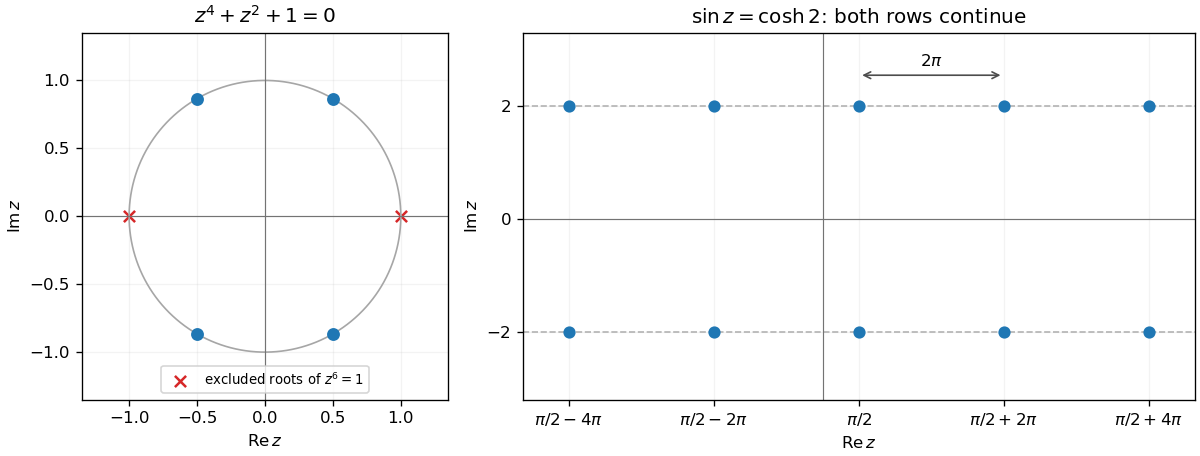

Writing and comparing real parts and imaginary parts gives and . A real solution is impossible since . Thus , and positivity forces . Consequently and , givingThe right Argand diagram in the preceding figure shows representative points on the lines ; each row continues with spacing .
Articles by others on the same topic
There are currently no matching articles.