The first field is , so direct curl calculation givesIt is not conservative because its curl is nonzero. The second is a radial gradient field:The scalar expression is a smooth function and single-valued on all of space, so is a conservative vector field. Its potential of a conservative vector field is . Parts (a) and (b) check path dependence directly.
Parametrize the segment by , , so . For the first field, and its dot product with the tangent is one. ThereforeFor the second field, use the fundamental theorem for line integrals. The endpoints both have , so their potential values agree andDirectly, its parameter integrand is , which changes sign under and integrates to zero.
The shorter circular arc lies in the - plane and can be written , . The first field is , whose dot product with is one. HenceThe second field is radial while the circular tangent is perpendicular to the radius, so . Thus the first field gives different values, and , along the two paths, whereas the conservative second field gives the same endpoint difference.
As a check using Stokes theorem, the arc followed by the reversed segment encloses area in the plane. The constant curl has upward component two, giving circulation , exactly the difference above.
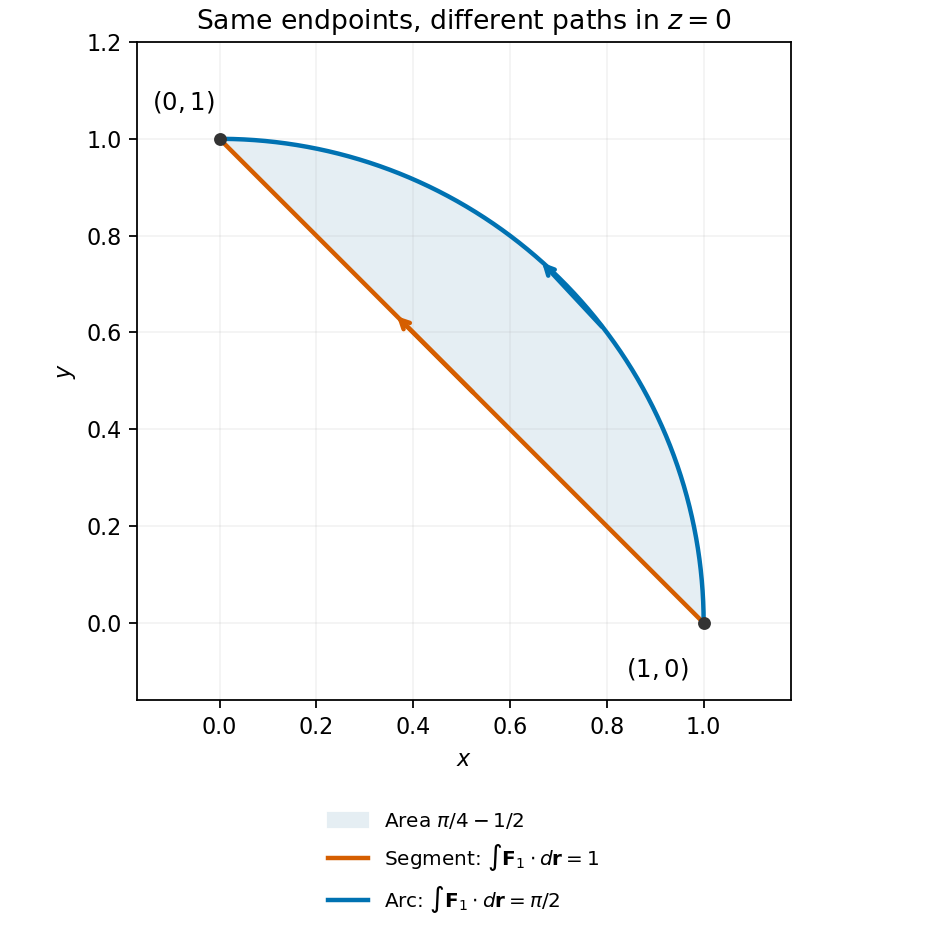
Straight and circular paths with the same endpoints, enclosing the area responsible for their circulation difference
. Details. 
Articles by others on the same topic
There are currently no matching articles.