The dot product is , while the Euclidean norms are and . Thus the angle in the stated range isThe positive cosine shows that it is an acute angle.
The integrand is an even function, since both and are odd functions. Using integration by parts,The endpoint cosine terms vanish, leaving the sine contribution.
The first partial derivatives factor asBoth vanish at the origin, verifying that it is a stationary point. Since , every stationary point has ; the first equation then gives . Thus one requested additional point is ; the other is .
The characteristic polynomial isIts roots give the two eigenvaluesTheir sum is zero, agreeing with the trace of the matrix.
Multiply numerator and denominator by the complex conjugate :The real part and imaginary part are therefore
Put . The values , , and give the Taylor expansionThe factorial in the quadratic term accounts for its coefficient .
For this separable differential equation, away from , separation gives , or on a connected interval. The initial condition gives , henceThe maximal interval containing on which this solves the printed differential equation is . Although the linear formula extends through one, the right-hand side there is and the original equation is undefined. The equilibrium solution , lost if one divides by , does not satisfy the initial condition.
For independent fair dice, the probability of avoiding one on each die is . ThereforeThe complement of an event gives
The product rule and chain rule give . At zero the slope is zero and the curve passes through . Consequently the tangent line is
Differentiate the three components with respect to their matching Cartesian coordinates:The term contributes nothing to the derivative because it is independent of .
In plane polar coordinates, is distance from the origin and is the angle from positive toward positive . The conversion to Cartesian coordinates isConversely , with the angular coordinate undefined at the origin.
Multiplying the polar equation by its denominator gives . Squaring and using yieldsTake . Completing the square givesThe standard ellipse equation is consequentlywhose centre is . Squaring has introduced no unwanted branch: on this ellipse the minimum of is , so follows with the correct positive sign.
Read the squared semiaxis lengths from the denominators in the standard equation obtained in (b). With the positive choice of there,Since , the horizontal semiaxis is the larger. Thus these are the semi-major and semi-minor axes, respectively.
Differentiate the sum of kinetic energy and potential energy using the dot product product rule:The equations of motion make the bracket zero. Hence the mechanical energy is constant in time. The central restoring force can exchange kinetic and potential energy but supplies no change in their sum.
Set . Each coordinate satisfies the harmonic oscillator equation, so the general solution isThe four initial data give , , and . ThusThis is the position component of the isotropic harmonic oscillator flow. Substitution also gives the constant energy .
The stated condition is equivalent to . Therefore the solution from (b) obeysFor nonzero initial data this is a circle centred at the origin with radius . The sign of chooses its direction of traversal. If , the same algebra gives only the stationary origin, a degenerate radius-zero case rather than a genuine circular orbit.
As printed, the function is undefined at the origin. For , its gradient isThe scalar prefactor is positive, and , so this gradient never vanishes. Thus there are no stationary points on the stated domain. Its infimum is three, approached as , but that value is not attained there.
If the intended definition includes the natural extension , that extension has a unique strict global minimum at the origin, with value three. Indeed, off zero, and proves differentiability at zero with zero gradient. More strongly, subtracting three gives the radial Gaussian flat function: every derivative of that difference vanishes at the origin. The vanishing Hessian matrix does not turn this minimum into an inflection point. These are two different domain interpretations; the extension must be stated rather than silently inserted.
Write , where . Because this hyperbolic function has strictly positive derivative , stationary points under an increasing outer function have the same positions and types for and . For ,The first equation requires or . If , the second gives . If , it gives . These are all the nonzero stationary points. At the origin, , so its gradient is ; the origin is not stationary.
At the Hessian matrix of is , and at it is . At and its Hessian matrices are respectively and . ThereforeThe extrema are local: is unbounded above and below on the full plane.
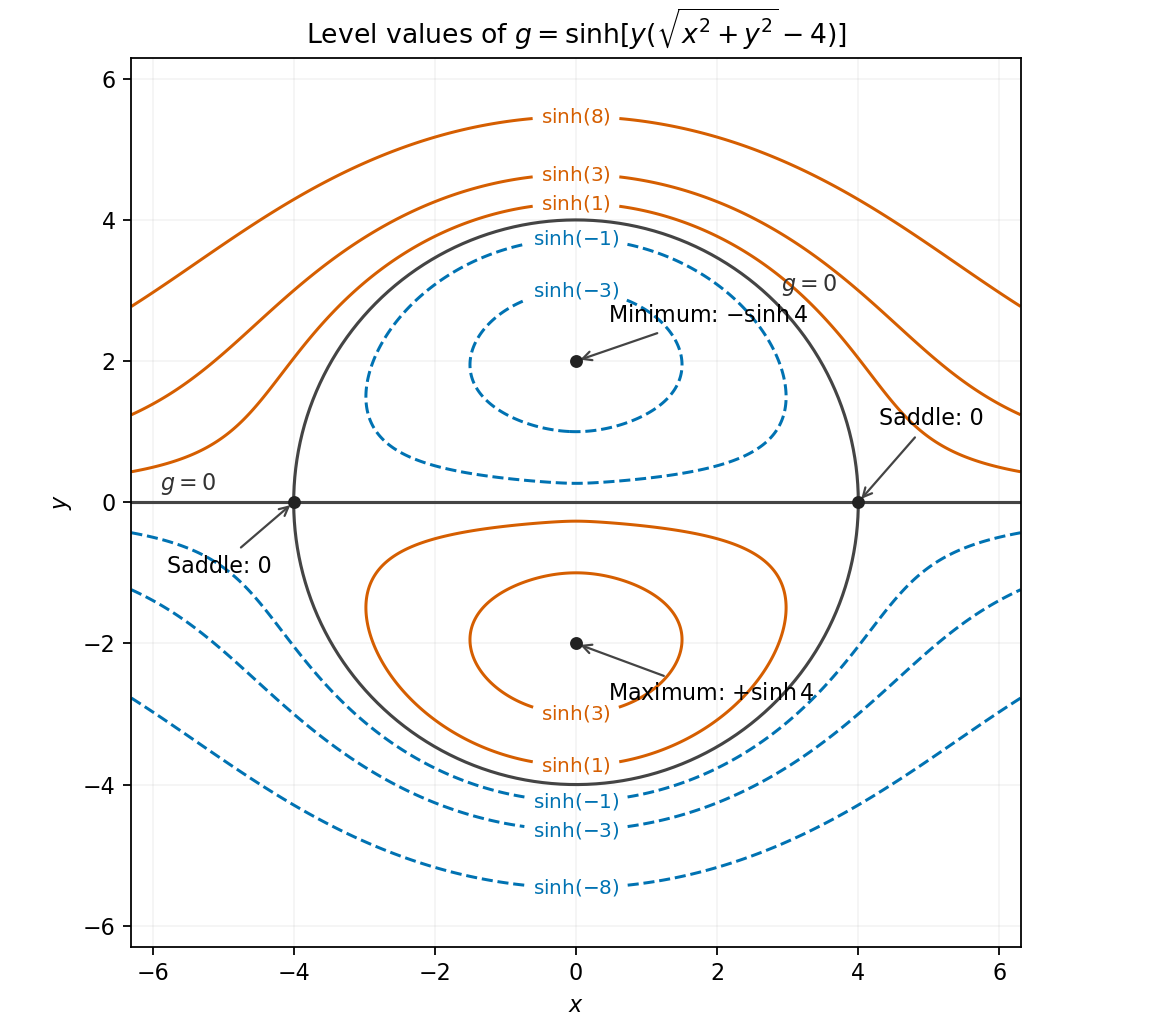
For the level curve geometry, a level is . In particular, the zero level curve is the union of the entire axis and the circle , crossing at the two saddle points. Inside the circle, above the axis and below it; outside, these signs reverse. Levels between and zero have closed loops around the upper minimum as well as unbounded lower-half-plane components. Reflection across the axis reverses the sign and gives the loops about the lower maximum. At the two extremal heights, the corresponding closed loop shrinks to its extremum. These features determine the sketch.

Let be the unscaled matrix. Expansion along its third row givesScaling a three-by-three matrix by scales its determinant by . Therefore
The three columns of are , , and . Each has squared Euclidean norm eight. Their pairwise dot products areHence , so . Thus is an orthogonal matrix, with . The determinant from (i) places it in the determinant-one component.
The transpose rule gives . If is orthogonal, , and the identity becomesMultiplying on the left by yields . This is precisely the defining condition for an antisymmetric matrix.
The inverse appearing in the assumption requires . Taking determinants of giveswhere the minus sign comes from the odd matrix order. Multiplying by gives . Since is real, the second factor is positive. Thus and is a singular matrix. This is the singularity forced by an odd-dimensional transpose-inverse identity, with the roles of the two matrix letters exchanged.
Use the real Fourier series convention . The function is an even function, so . For noninteger real ,For , the product-to-sum identity givesThus the Fourier series of a noninteger-frequency cosine isIts Fourier coefficients are , giving absolute convergence and uniform convergence. The periodic function is continuous at its joins because the two endpoint cosine values coincide, so the Dirichlet-Jordan convergence theorem gives this value at every point.
The first field is , so direct curl calculation givesIt is not conservative because its curl is nonzero. The second is a radial gradient field:The scalar expression is a smooth function and single-valued on all of space, so is a conservative vector field. Its potential of a conservative vector field is . Parts (a) and (b) check path dependence directly.
Parametrize the segment by , , so . For the first field, and its dot product with the tangent is one. ThereforeFor the second field, use the fundamental theorem for line integrals. The endpoints both have , so their potential values agree andDirectly, its parameter integrand is , which changes sign under and integrates to zero.
The shorter circular arc lies in the - plane and can be written , . The first field is , whose dot product with is one. HenceThe second field is radial while the circular tangent is perpendicular to the radius, so . Thus the first field gives different values, and , along the two paths, whereas the conservative second field gives the same endpoint difference.
As a check using Stokes theorem, the arc followed by the reversed segment encloses area in the plane. The constant curl has upward component two, giving circulation , exactly the difference above.
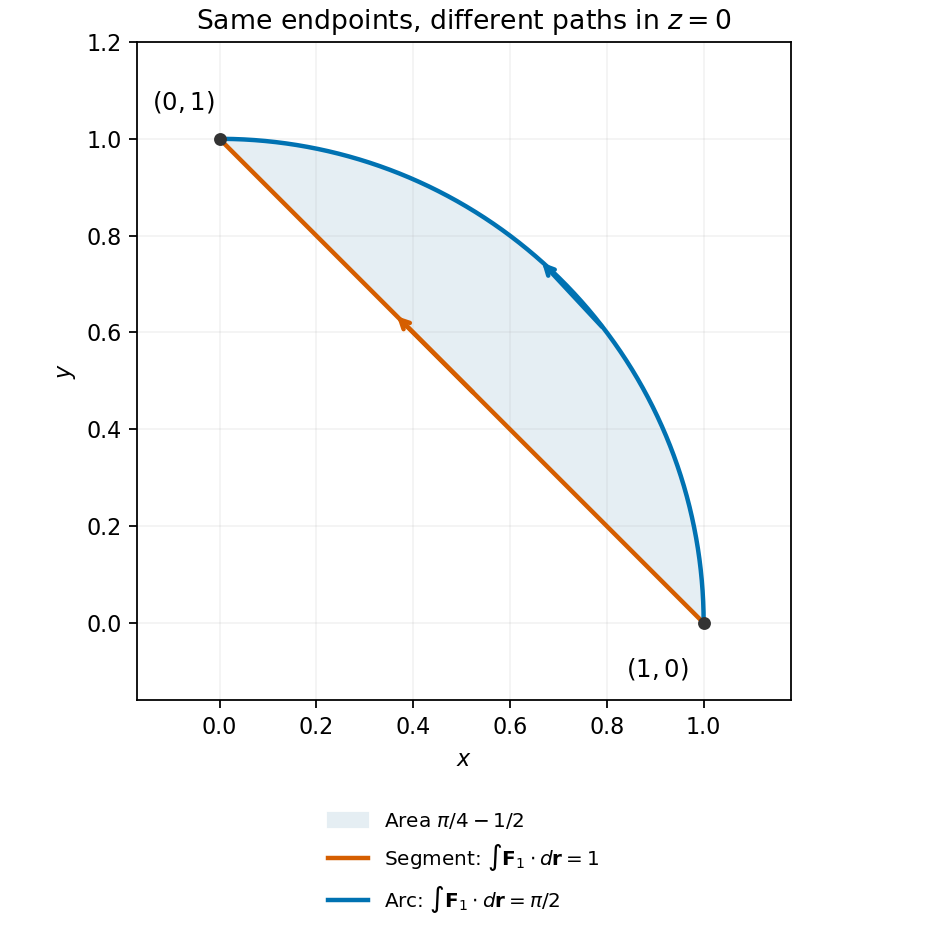
Straight and circular paths with the same endpoints, enclosing the area responsible for their circulation difference
. Details. 
The law of total probability weights each jar's red fraction by its selection probability:The large difference in jar sizes does not change their equal selection probabilities; pooling their contents would describe a different experiment.
By Bayes' theorem,The denominator sums red outcomes from both possible jar choices, as calculated in (i).
Every seven-element subset of the hundred individually identifiable tiles is equally likely. Choose three of the thirty-four vowels and four of the sixty-four consonants; the favourable draw has no blank tiles. ThusThis is a multivariate hypergeometric distribution count, including the implicit factor for blanks. Dividing by instead would incorrectly condition on having drawn no blanks.
Put and . Decompose the marginal as , where . It follows thatBoth bounds are attainable: choose none or all of the mass outside to belong to . More explicitly, the four joint cell masses can be , all nonnegative. This is the first case of sharp bounds from binary conditional probabilities.
For the usual conditional-probability ratio, the given requires . If , the two bounds coincide at . If , the conditional is undefined as a ratio, although its formal joint-model bounds reduce to .
Write , and . The law of total probability gives , a convex combination of the two fixed conditional values. HenceThese are the closed sharp bounds in the usual mixture-model interpretation, obtained by allowing to range from zero to one. The joint masses realize every such mixture.
There is an endpoint qualification if both conditionals must literally be defined by ratios: then . If , the marginal lies strictly between them, so the stated endpoints are an infimum and supremum rather than achieved extrema. If , every allowed mixture has exactly that common value. This is the second case of sharp bounds from binary conditional probabilities.
Split the integrand into its three coordinate contributions. Each integrates independently over the rectangular box:For example, the last factor is . No spherical or cylindrical Jacobian is needed for this Cartesian integral.
The region is the triangle . Reversing the integration order makes the inner integral elementary:The integrand is continuous on this compact triangle, so Fubini theorem justifies exchanging the order.
In cylindrical coordinates, the two surfaces meet when , giving and . The solid has , , and . With volume element ,The upper-minus-lower height is nonnegative throughout that radial interval.
Fix the total area at . Apply Lagrange multipliers to with constraint . The two derivative equations areSince , the second gives . Substitution in the first gives . The constraint then yields . ThereforeFor completeness, eliminating makes on . Its derivative changes from positive to negative at the calculated radius and its volume tends to zero at both domain endpoints. Thus this stationary cylinder is indeed the maximum. It is the fixed-area case of optimal aspect ratios of closed cylinders.
Divide the objective area by , which does not change its maximizer, and use with constraint . The Lagrange multiplier equations areAt a nondegenerate cylinder , the second gives . Eliminating it gives . Hence satisfies . Select its positive root:This is the sphere-inscribed case of optimal aspect ratios of closed cylinders. One may check maximality from : its derivative has the sign of , so it changes from positive to negative at the selected root.
In the physicists' Hermite polynomial convention, begin by differentiating the Gaussian function:The defining prefactor then givesThe derivative-based definition uses nonnegative integers; negative orders are not part of this polynomial definition.
Let , so . Differentiate this identity times, for . By the Leibniz rule, only the first two derivatives of the linear factor can contribute:Rearranging provesThe case is the starting identity , treated separately without introducing a negative derivative order.
Differentiate the product in the definition of . Using the identity in (b),The last expression is , soAlso separately. This is the Hermite polynomial derivative recurrence in the physicists' normalization.
Articles by others on the same topic
There are currently no matching articles.