In the real Fourier series convention for period ,where the Fourier coefficients areThese formulas apply to integrable periodic functions. Writing equality at each point requires appropriate convergence hypotheses; the periodic solution sought below is smooth, so its series causes no such difficulty.
Differentiate the Fourier series term by term and collect cosine and sine terms. Substitution into the equation givesFor a smooth periodic solution, differentiation of the series is justified. Alternatively, multiply the differential equation by each trigonometric mode and integrate by parts; periodicity cancels the boundary terms and gives the same coefficient constraints without first differentiating an infinite sum.
Fourier orthogonality isolates a coefficient. Multiplication by and integration over annihilates the constant, all cosine terms and all sine terms except the one with , whose squared integral is . Thus the corresponding coefficients on the two sides must agree for each positive integer .
Multiplication by works in the same way, while integration against the constant mode extracts . This is the uniqueness of the Fourier coefficients; it does not follow from comparing a few point values of the series.
The constant coefficient is . For every the two mode equations arewhere is the Kronecker delta. The first equation gives , so the second becomes . HenceNo other modes survive. This is the single-frequency case of the Fourier solution of a first-order equation with periodic forcing.
Using the sine addition formula, combine the surviving modes:It has amplitude and a phase delay . The full general solution would add , but this exponential is periodic only for , so the displayed periodic solution is unique.
The curve starts at and initially rises. It crosses zero at and , attains its maximum at and minimum at , then returns to . These follow either from the shifted sine form or from .
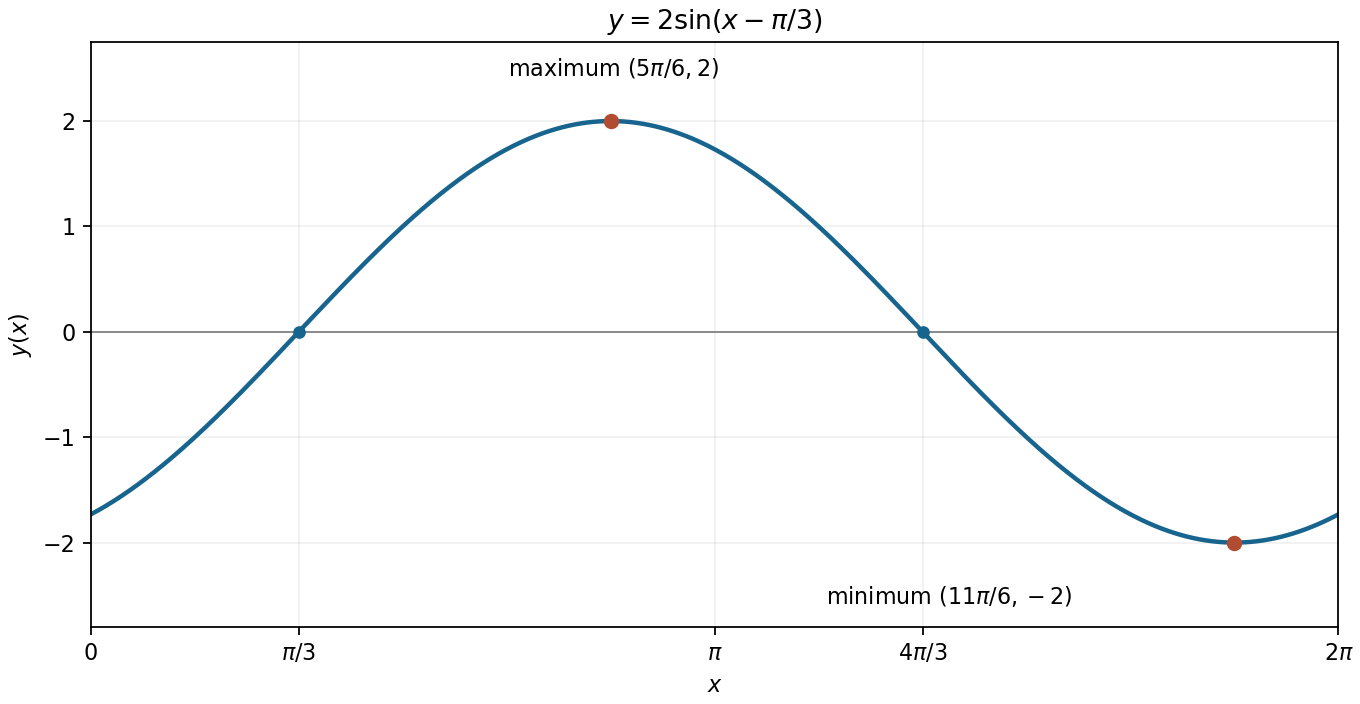
The unique periodic sinusoidal response, with its maximum, minimum and zero crossings
. Details. 
In the convention with constant term , Parseval's identity isOnly the first harmonic contributes here, so
Articles by others on the same topic
There are currently no matching articles.