Set , so . This integration by substitution givesThe antiderivative is taken on either interval separated by . Differentiating verifies the sign and factor .
Differentiating the hyperbolic cosine with the chain rule gives . For real , , so the only zero of the derivative is , namely . ThusSince , this stationary point is the global minimum.
For , logarithmic differentiation givesSince , the derivative vanishes precisely when . HenceThe derivative is positive before and negative after , so this is a global maximum on the given positive domain.
The distance from the origin is . The direction angle, measured counterclockwise from the positive horizontal axis, is modulo . Thus the path is an Archimedean spiral, turning clockwise through two complete revolutions as its radius decreases linearly from to zero.
It starts at , reaches at , crosses at , returns to the positive vertical axis at when , and ends at the origin when . These crossings fix both the scale and direction of the sketch.
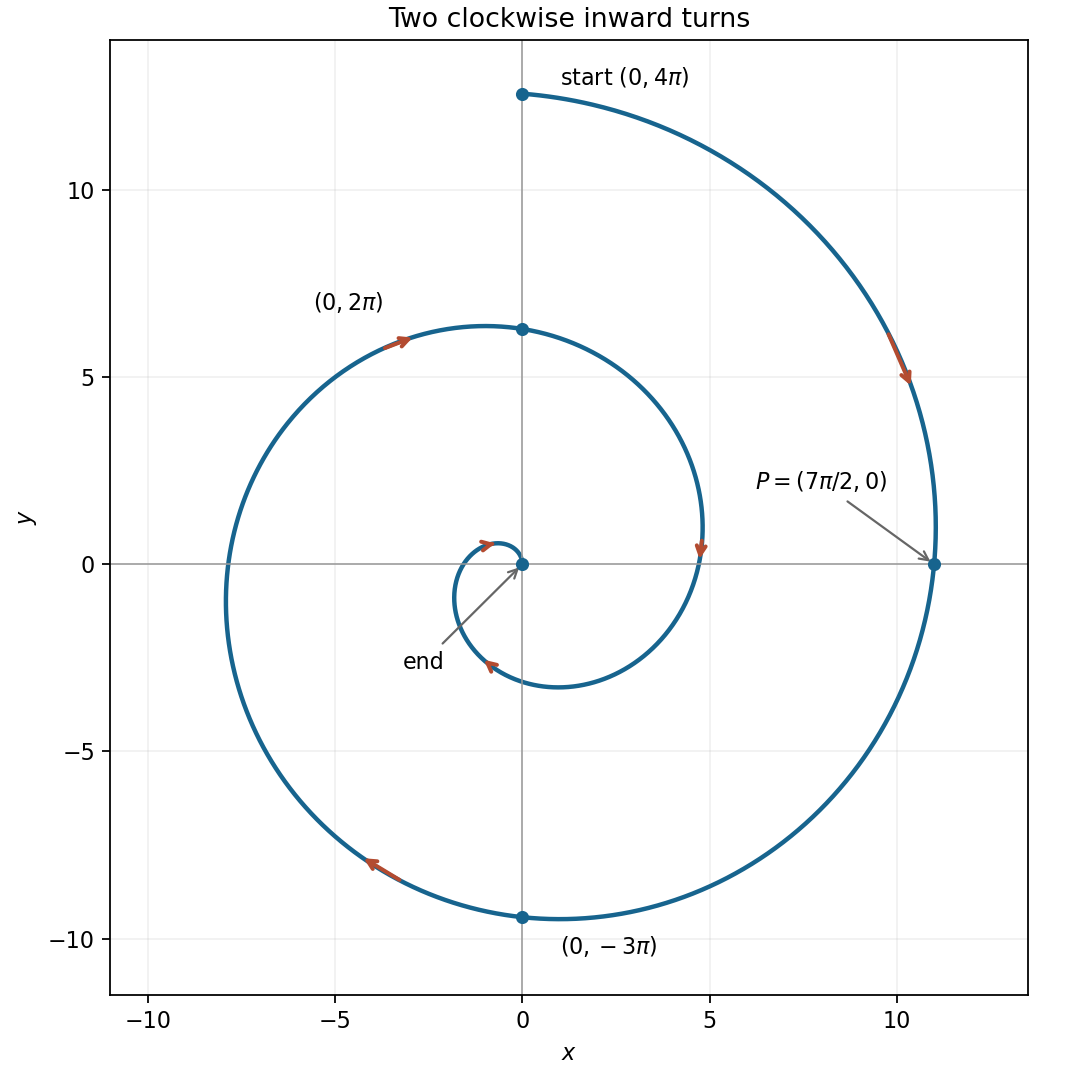

At the stated point, the radial distance is , so and . Differentiate the parametric curve:At , these are and . Since , the tangent line has finite slope
Let the equilateral triangle have side length . Its altitude is , and its incircle has radius : the centre lies on a median, one third of the altitude above the base. The area of the triangle is , while the circle has area . ThereforeThe side length cancels, as required for a dimensionless ratio between similar configurations.
Put and move all terms to one side. The polynomial factors asThe root yields the already supplied . In the stated interval, gives , while gives . Thus all the other solutions areThere are no endpoint solutions because is not one of the three roots.
For negative real , the angle lies strictly between and . On that interval, has exactly the two solutions and . Dividing by and applying the natural logarithm yieldsBoth values are negative, and the restriction excludes all further periodic sine branches.
The integrand is a continuous function, so the fundamental theorem of calculus differentiates the upper limit directly:No explicit antiderivative is needed.
Change the summation index to . Then runs from to . Each term for cancels its partner , and the zero term contributes nothing. The sole unpaired term is , so
The cubic Taylor polynomial about isIf has a continuous fourth derivative near , Taylor's theorem gives equal to this polynomial plus . With continuous derivatives only through third order, the corresponding remainder is . An equality with an infinite Taylor series would require additional convergence information, rather than just the existence of these four terms.
Factor out and use the binomial series with exponent :Thus the expansion through cubic order isThe coefficients of and vanish because the function is an even function. The underlying binomial expansion converges for .
Near zero the logarithm's argument is positive, so . Use the Maclaurin series of the natural logarithm:The local calculation uses for the real logarithm; the power series converges for .
Use inside the exponential series:The two cubic contributions cancel, leavingThus the coefficient of is zero, even though the function itself is not an even function.
Write for the mean in minutes. An exponential distribution with that mean has rate , so its probability density function isThe density has units of inverse minutes, ensuring that its integral is a dimensionless probability.
Take on the horizontal axis and on the vertical axis, both nonnegative. There is no interruption when the noise occurs after the scheduled ending, namely . This is the part of the first quadrant above the diagonal . Equality has probability zero, so assigning the boundary either way does not affect the calculation.
The same original diagram below also marks the region used in part (e); its lower boundary offset is an illustrative positive choice of .
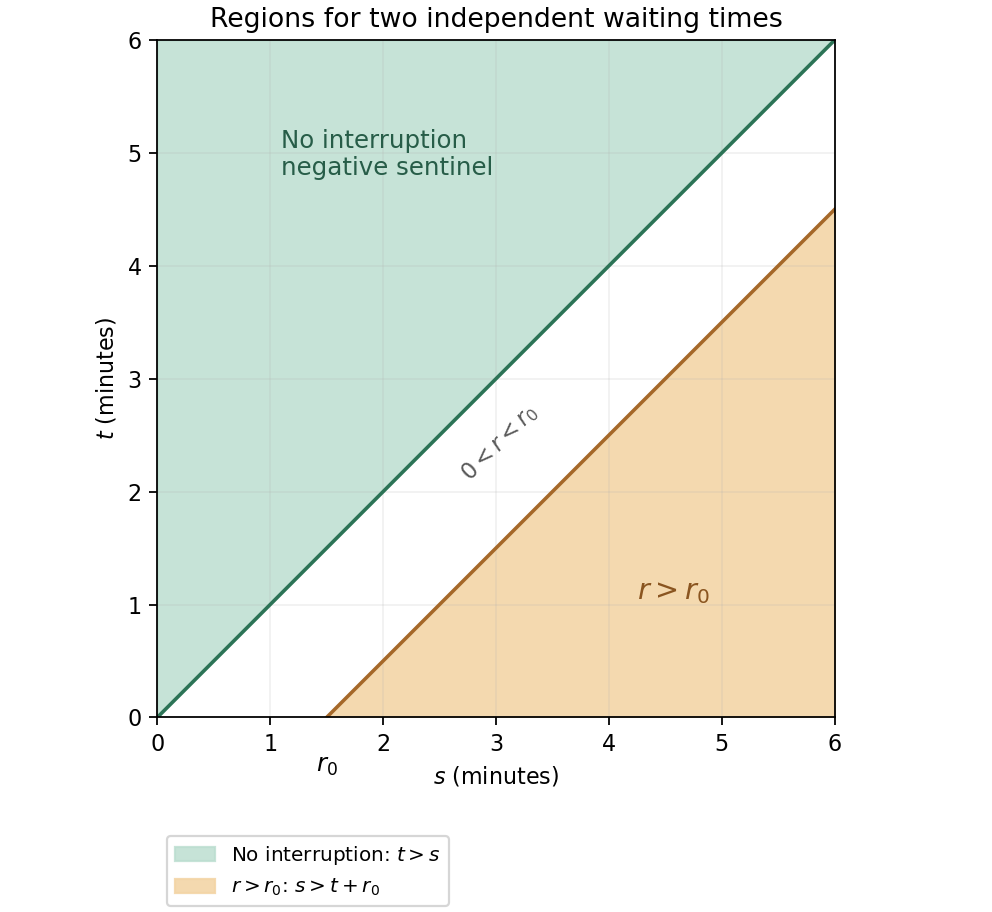
The no-interruption region above the diagonal and the region of positive remaining time exceeding a chosen threshold
. Details. 
For a small rectangle of side lengths , independence makes its probability approximately . Thus the joint probability density function is the productAdding the probabilities of disjoint small rectangles covering a region of integration, and taking their sizes to zero, gives the double integral of this product over that region. Without independence, the two marginal distributions alone would not determine the joint probability density function.
Integrate over the region :ThereforeThis is also the two-clock case of competing exponential clocks. A larger mean time to noise increases this probability, while a larger mean service length decreases it.
On interrupted outcomes, ; on the other outcomes the sentinel value is negative and cannot exceed . ConsequentlyOn the diagram in part (b), this is the first-quadrant region below , starting at the horizontal intercept . It lies strictly inside the interruption region .
Use the lower limit for the inner integral:HenceThe prefactor is the probability that interruption occurs; the remaining exponential is its conditional positive tail. This is the positive difference of independent exponential waiting times. The exponent is dimensionless because both and are measured in minutes.
As , the exponential factor tends to zero, so . Requiring an arbitrarily large amount of remaining time must have vanishing probability for this finite-mean distribution.
When , the prefactor is . Therefore as . The clocks then have identical independent continuous laws, so either is equally likely to finish first. A tie has probability zero. The limit is the interruption probability, rather than one, because non-interrupted outcomes retain the negative sentinel value.
The time already elapsed since the noise is minutes. Conditional on a particular noise time and on still being in progress, memorylessness of the exponential distribution givesThis law does not depend on . Averaging over the conditional distribution of therefore leaves the same remaining-time law. HenceThe elapsed minutes are not subtracted from the original mean; the exponential residual lifetime has the same mean after any elapsed duration.
For the two-by-two matrix, take the product of the diagonal entries minus the product of the off-diagonal entries:In particular, is an invertible matrix.
Interchange the diagonal entries, negate the off-diagonal entries, and divide by the nonzero determinant. The matrix inverse isMultiplication by gives the identity matrix, since each diagonal product sum is and each off-diagonal product sum is zero.
The characteristic polynomial isFor , the eigenvector equation reduces to ; for , it reduces to . Choose the following unit vectors consistently for the remaining parts:Each eigenspace consists of all scalar multiples of its displayed vector, including zero; an eigenvector itself must be nonzero.
The chosen eigenvectors have dot productThey are therefore orthogonal, and their unit lengths make them an orthonormal eigenbasis. This agrees with the spectral theorem for real symmetric matrices, since is real symmetric and its two eigenvalues are distinct.
Multiply the quadratic form out directly:Thus , and . Both eigenvalues are positive, so this is a positive-definite quadratic form; its positive unit level set is an ellipse. The next part exhibits its principal axes explicitly.
Let for the normalized eigenvectors already chosen. Then , , and orthogonal diagonalization givesThe ellipse has semi-axis lengths and along and , respectively. Rescale and to obtain the unit circle . Since ,The identity checks the rescaling directly. Swapping or reversing eigenvectors gives other valid coordinate matrices; the displayed one follows the explicit choices in part (a).
In the real Fourier series convention for period ,where the Fourier coefficients areThese formulas apply to integrable periodic functions. Writing equality at each point requires appropriate convergence hypotheses; the periodic solution sought below is smooth, so its series causes no such difficulty.
Differentiate the Fourier series term by term and collect cosine and sine terms. Substitution into the equation givesFor a smooth periodic solution, differentiation of the series is justified. Alternatively, multiply the differential equation by each trigonometric mode and integrate by parts; periodicity cancels the boundary terms and gives the same coefficient constraints without first differentiating an infinite sum.
Fourier orthogonality isolates a coefficient. Multiplication by and integration over annihilates the constant, all cosine terms and all sine terms except the one with , whose squared integral is . Thus the corresponding coefficients on the two sides must agree for each positive integer .
Multiplication by works in the same way, while integration against the constant mode extracts . This is the uniqueness of the Fourier coefficients; it does not follow from comparing a few point values of the series.
The constant coefficient is . For every the two mode equations arewhere is the Kronecker delta. The first equation gives , so the second becomes . HenceNo other modes survive. This is the single-frequency case of the Fourier solution of a first-order equation with periodic forcing.
Using the sine addition formula, combine the surviving modes:It has amplitude and a phase delay . The full general solution would add , but this exponential is periodic only for , so the displayed periodic solution is unique.
The curve starts at and initially rises. It crosses zero at and , attains its maximum at and minimum at , then returns to . These follow either from the shifted sine form or from .
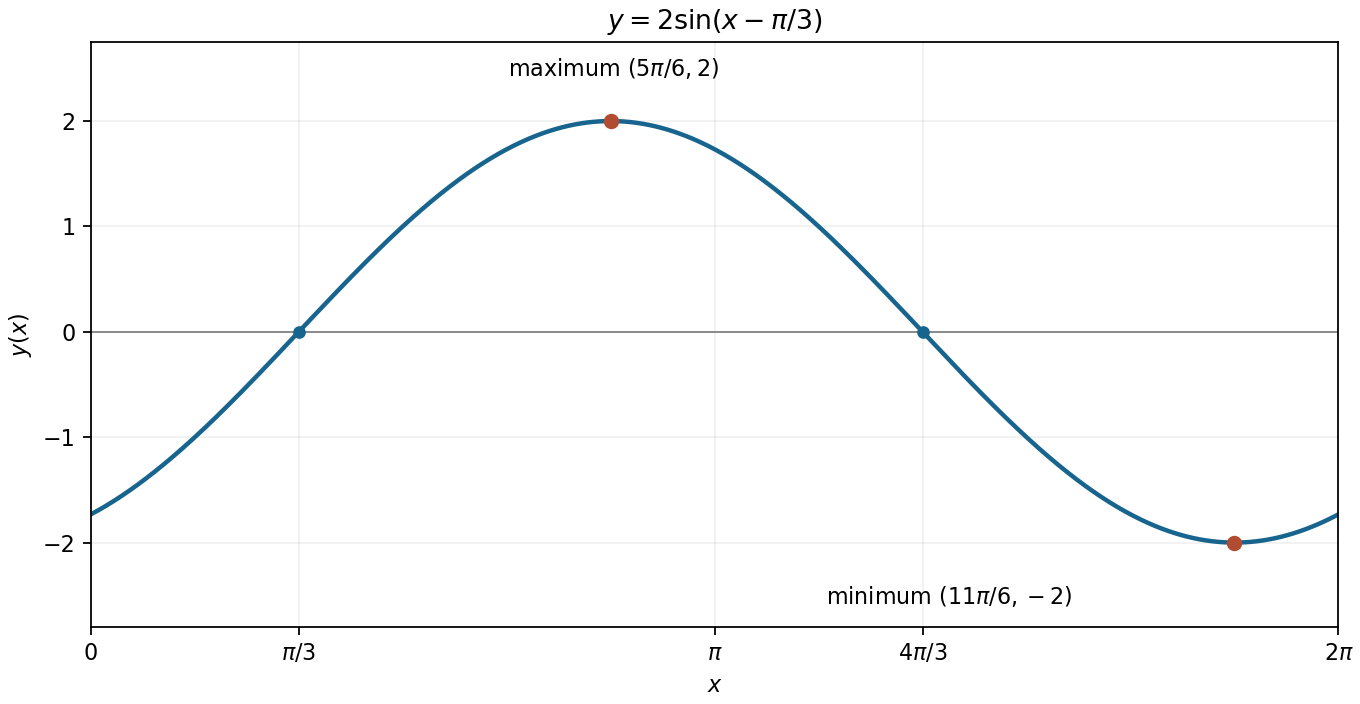
The unique periodic sinusoidal response, with its maximum, minimum and zero crossings
. Details. 
In the convention with constant term , Parseval's identity isOnly the first harmonic contributes here, so
Square the two-term form and integrate directly:The first two integrals are each before their prefactors, while the cross term is zero because its integrand is . Thus the result is again , agreeing with Parseval's identity.
The vector triple product identity givesIt is the requested linear combination of and . The notation in this question denotes the three-dimensional cross product.
Expand the same double cross product in two ways. First expanding with as the inner cross product givesAlternatively, use with to getEquating these expressions and moving every term to one side provesThis four-vector scalar triple product identity is valid without assuming that any three of the four vectors are independent.
At an intersection, the two position vectors agree, so . The scalar triple product with is thereforesince a determinant with repeated columns vanishes. Geometrically the displacement of the two anchor points must lie in the same plane as the two line directions.
This is a necessary condition. If are not parallel, it is also sufficient, because their span is exactly the plane perpendicular to . For parallel directions the triple product vanishes automatically, even for distinct lines, so the condition alone cannot guarantee intersection.
Articles were limited to the first 100 out of 252 total.
Articles by others on the same topic
There are currently no matching articles.