Set for this part. In the interval the special points are . Elsewhere is a composition of smooth functions.
At zero, and therefore . Its assigned value is zero, so the function is continuous and differentiable there, with .
At either tangent pole , the bounded sine oscillates without a limit. For an explicit check at , let and . Both approach from below, but the function values are respectively and . Negating these sequences gives the same obstruction at . Assigning the value zero at the poles cannot repair either limit.
Thus is discontinuous and nondifferentiable exactly at , and is smooth elsewhere in the specified interval.
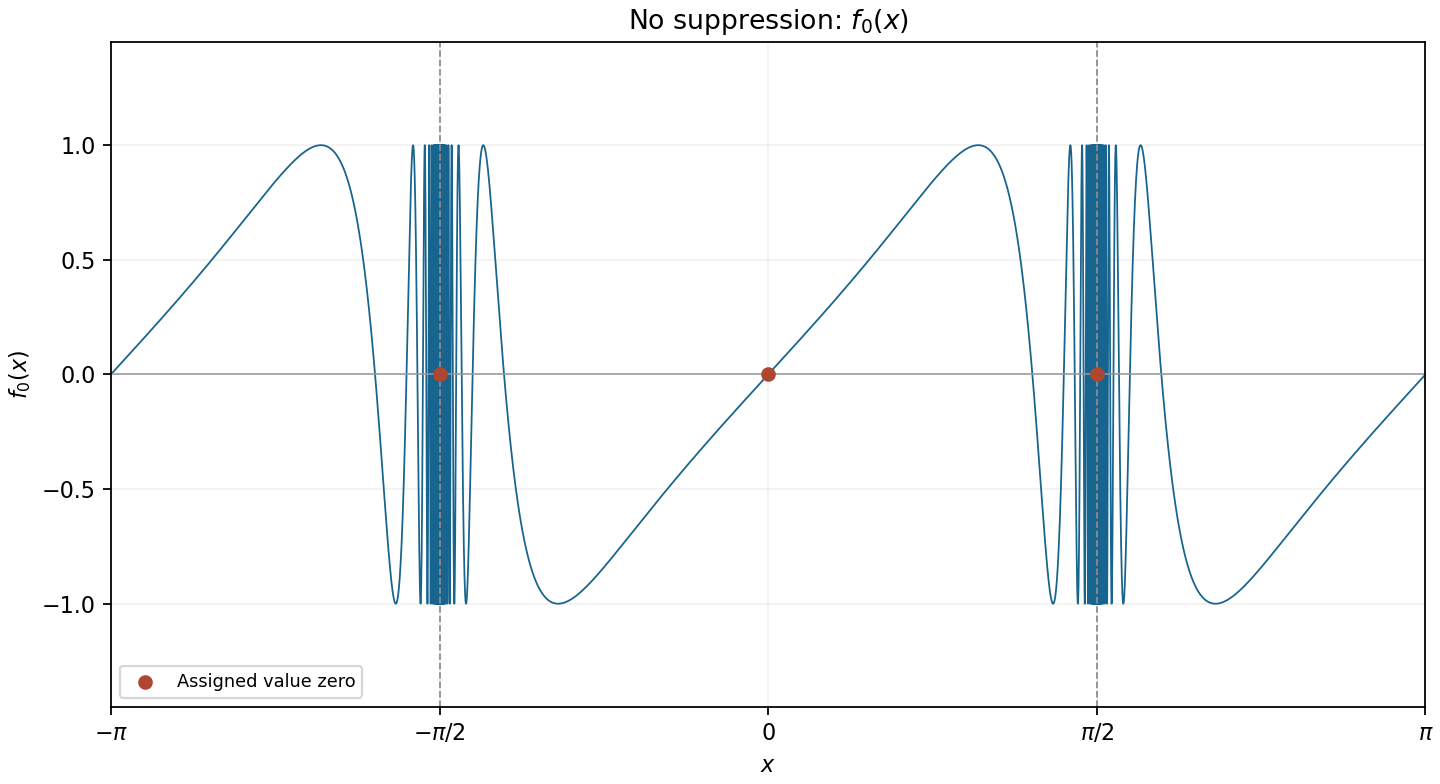
Undamped tangent-phase oscillations with assigned zero values at both poles and an ordinary differentiable crossing at zero
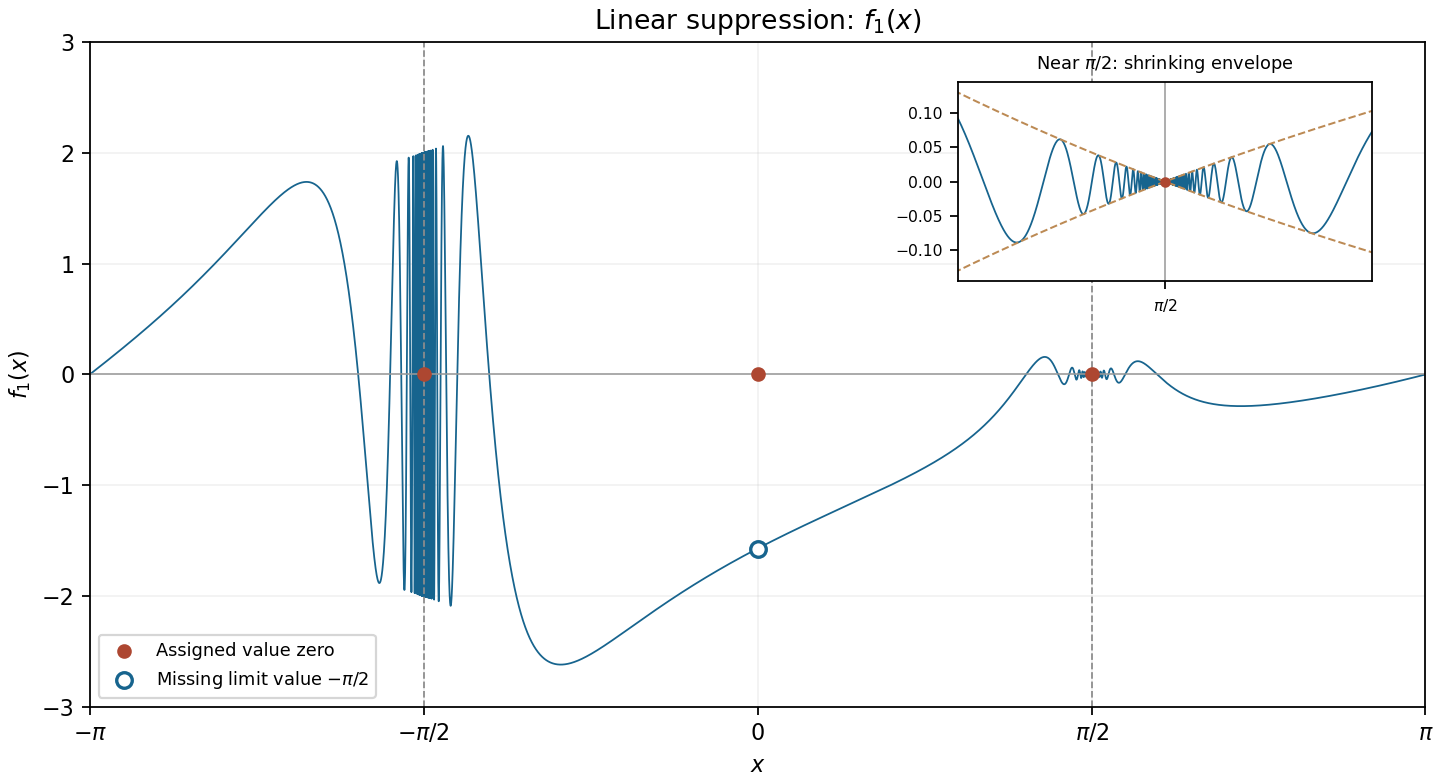
. Details. At , the prefactor tends to , so the nonvanishing amplitude leaves the oscillatory discontinuity intact. At zero, use to obtainThe limit is , whereas the assigned value is zero. This is a removable discontinuity, not a continuous crossing.
At , write . The estimateproves continuity at the assigned zero. But its difference quotient isThe sequences from part (i) make this approach and , so the derivative does not exist. This illustrates the distinct continuity and differentiability thresholds for a damped oscillation.
Therefore the discontinuities are and ; the nondifferentiability points are . The function is smooth elsewhere.
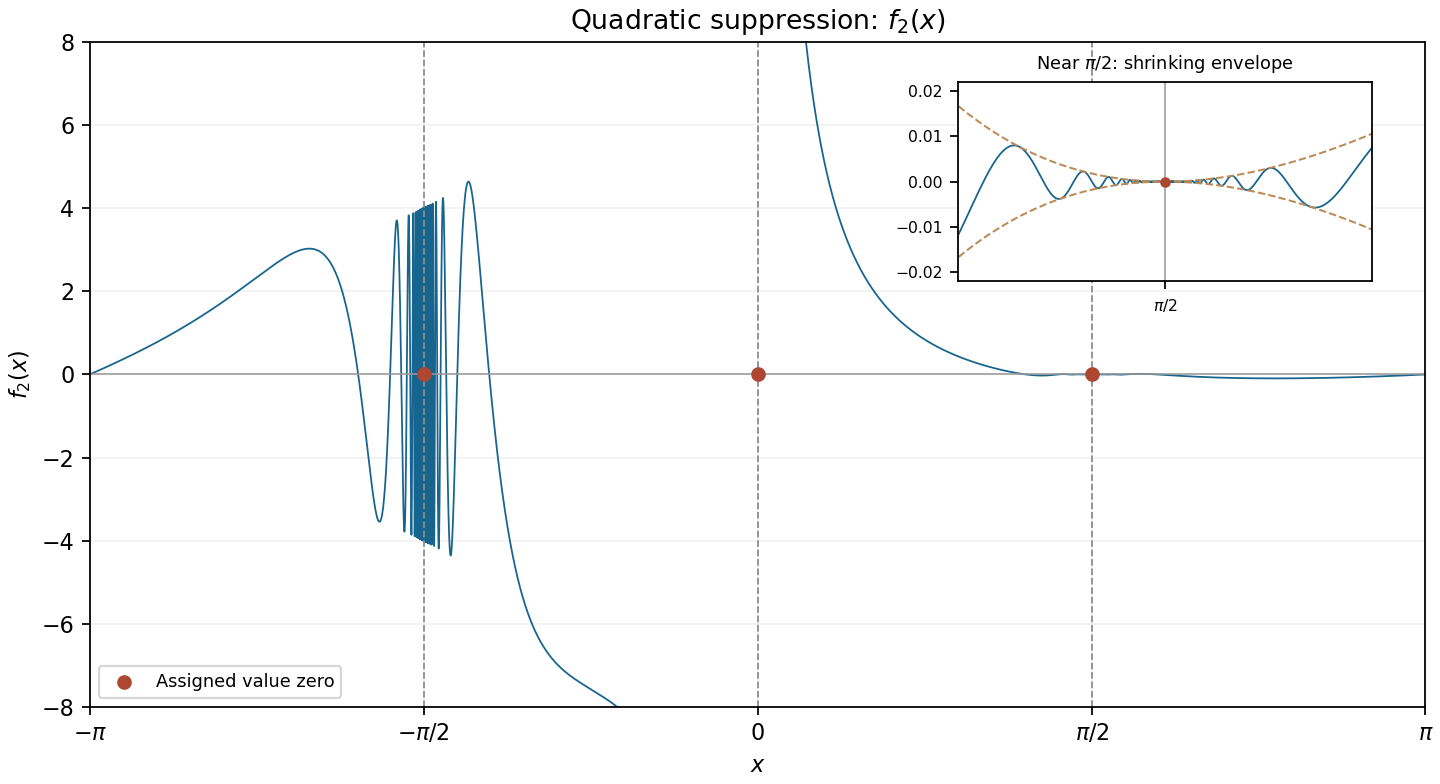
At , the squared prefactor tends to , so the oscillatory discontinuity again remains. Near zero,It is unbounded near zero, despite its assigned zero value there, so it is neither continuous nor differentiable at zero.
At , put . ThenThus is continuous and differentiable at , with . After translating the point to zero, the estimate shows how quadratic damping restores differentiability at the origin. The only discontinuities and nondifferentiability points are and ; the function is smooth away from these two points and . At , its derivative exists but is not continuous.
Indeed, for near , put . Then . Here and , so the derivative retains oscillations. Existence of the derivative at a point does not require continuity of nearby derivatives.


Articles by others on the same topic
There are currently no matching articles.