Use outward normal vectors to the two faces. The cross productspoint away from the opposite vertices, since and . Their Euclidean norms are and , and their dot product is . The interior dihedral angle of a convex polyhedron is supplementary to the outward-normal angle, soThis also equals the cosine of the acute angle between the unoriented face planes. The outward-normal angle itself has cosine ; keeping that distinction avoids a sign ambiguity.
For the triangular face, take the cross product of two edges and divide by two:The origin lies on the opposite side from this normal, since . Thus this is already the outward vector area, withThe vector areas of a closed polyhedron sum to zero, so the sum for the remaining three faces is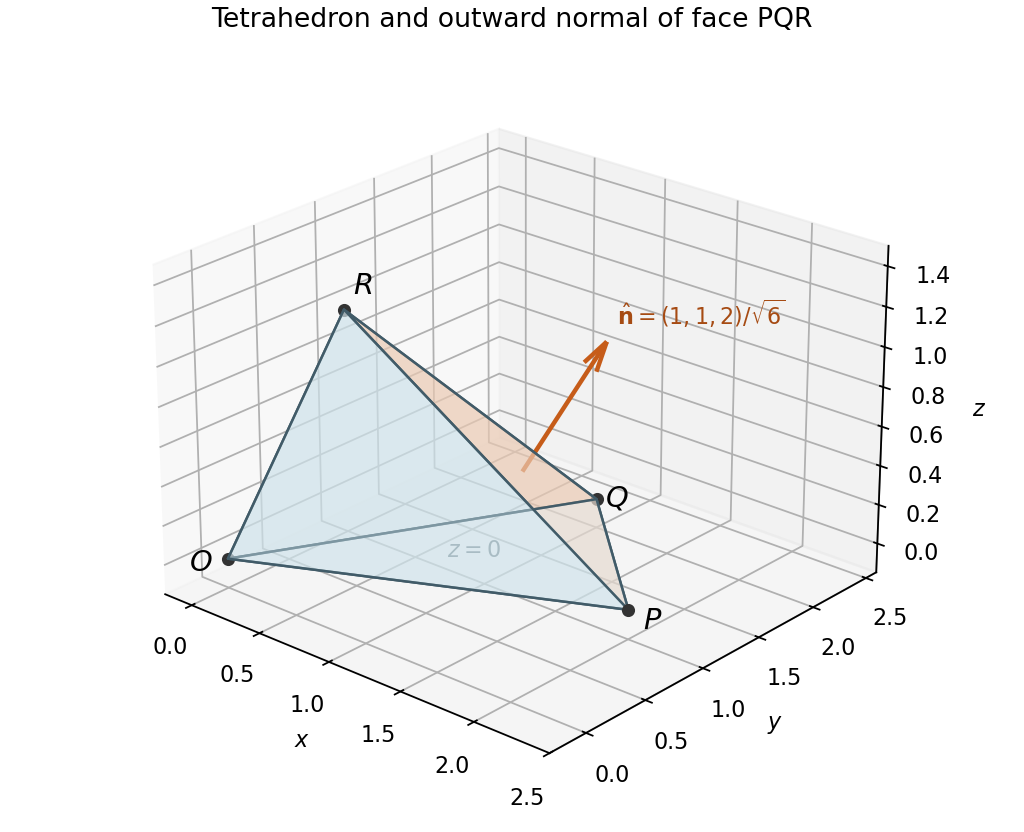
Figure 1.
Tetrahedron with its highlighted face PQR and outward unit normal
. Details. 
The normal from (ii) gives the plane equation . The distance from a point to a plane is the absolute value of the normalized plane equation at that point. At the origin this givesFor a geometric check, the perpendicular foot is , parallel to the normal and satisfying the plane equation. Its Euclidean norm is the same distance.
Articles by others on the same topic
There are currently no matching articles.