The tangent has poles at and , so these are vertical asymptotes of . The zeros on the given interval are . Near zero, , so the graph starts with a horizontal tangent line.
Each of its three branches is increasing. Indeedand the numerator starts at zero with derivative , so it is positive for . The first branch rises from zero to , the middle branch rises from through to , and the last rises from to .
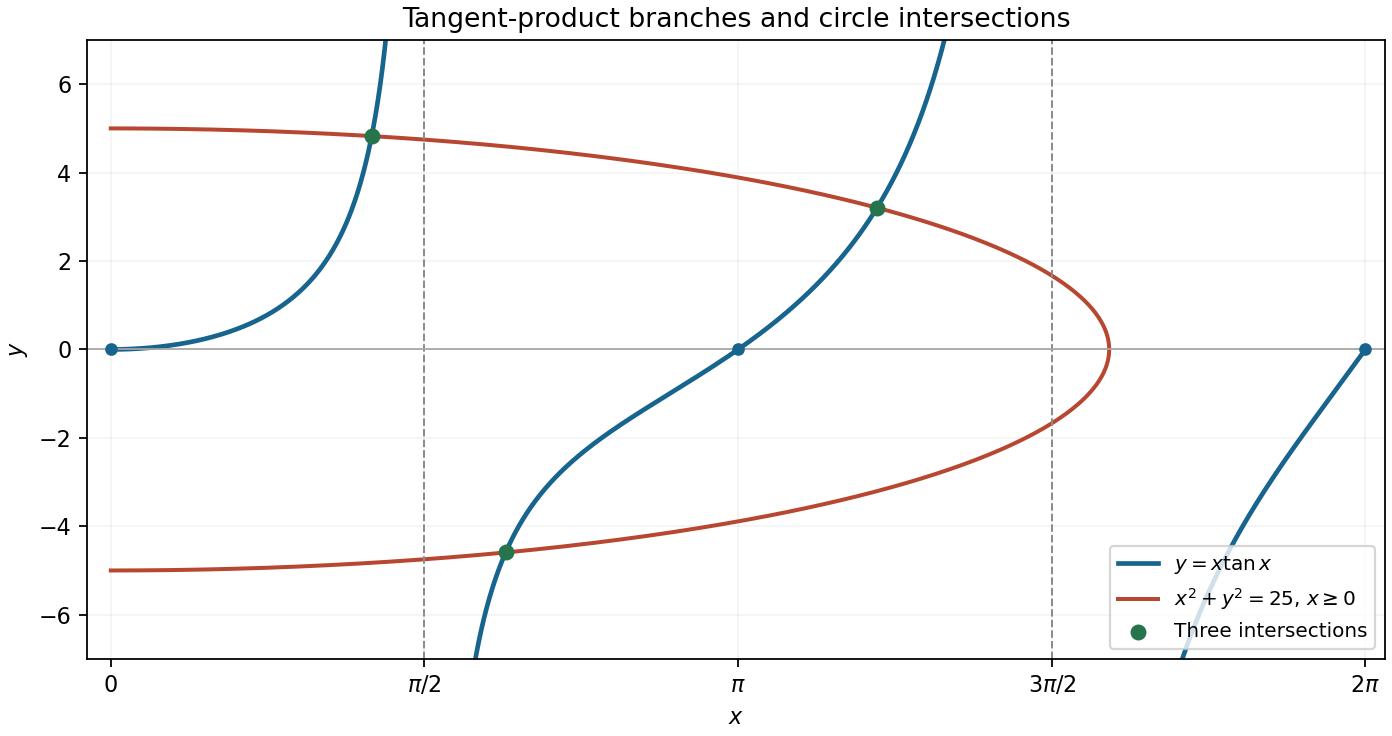
The three increasing tangent-product branches and their intersections with the right half of the circle
. Details. 
Articles by others on the same topic
There are currently no matching articles.