Use implicit differentiation, treating as a function of :Where , this is . At the two points where , the ellipse has vertical tangent lines rather than a finite slope.
At an intersection, , so . Substitution into either parabola givesThe resulting linear equation for has only one solution, so this is the unique intersection.
The two derivatives are and . At the intersection their slopes are and , so their direction vectors and have zero dot product. Thus the tangent lines are perpendicular and their angle is
Multiply the separable differential equation by : . The left side is , hence . ThereforeThe real general solution is taken on any connected interval where the logarithm's argument is positive.
At , the point on the parabola is and the tangent line has slope . The normal line to a plane curve therefore has slope . Its equation isThus the requested results are
The tangent has poles at and , so these are vertical asymptotes of . The zeros on the given interval are . Near zero, , so the graph starts with a horizontal tangent line.
Each of its three branches is increasing. Indeedand the numerator starts at zero with derivative , so it is positive for . The first branch rises from zero to , the middle branch rises from through to , and the last rises from to .
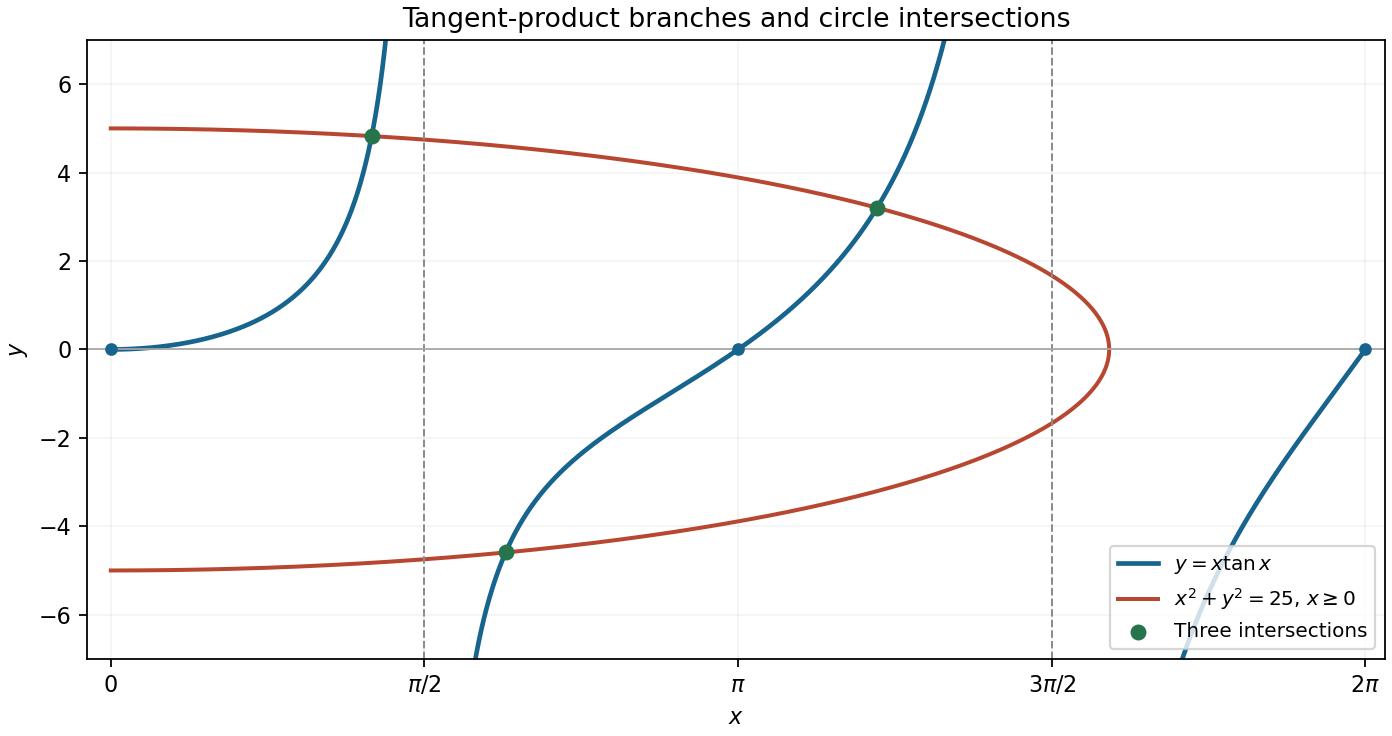
The three increasing tangent-product branches and their intersections with the right half of the circle
. Details. On , is strictly increasing from a negative value to a positive value, giving one root. On , the equation is . This function is strictly convex, positive at the two interval ends and negative at , giving exactly two roots.
There are none on the remaining possible interval . Put ; then , soHence the number of simultaneous real solutions is , as marked in the preceding graph.
For , set , . This integration by substitution givesThis case is treated separately because the denominator in part (a) vanishes.
Write the partial fraction decomposition as . After multiplying through, . Setting gives , and setting gives , so
Let in centimetres and take in seconds. The constant rate gives . By the Pythagorean theorem, the diagonal length isfor times when the side length is nonnegative. No initial value of is specified, so it must remain as a parameter. Choosing the time origin when gives the special convention .
Differentiate before substituting the instantaneous side length. The related rates equation isAt the stated dimensions and rate,The diagonal grows more slowly than the changing side, since .
The parabola opens upward, with its minimum at and zeros at . The quartic graph is symmetric about the vertical axis, has its flat maximum at , and also has zeros at .
Their intersections solve , so the only real intersections are and . Between them, is the upper curve and the lower curve.
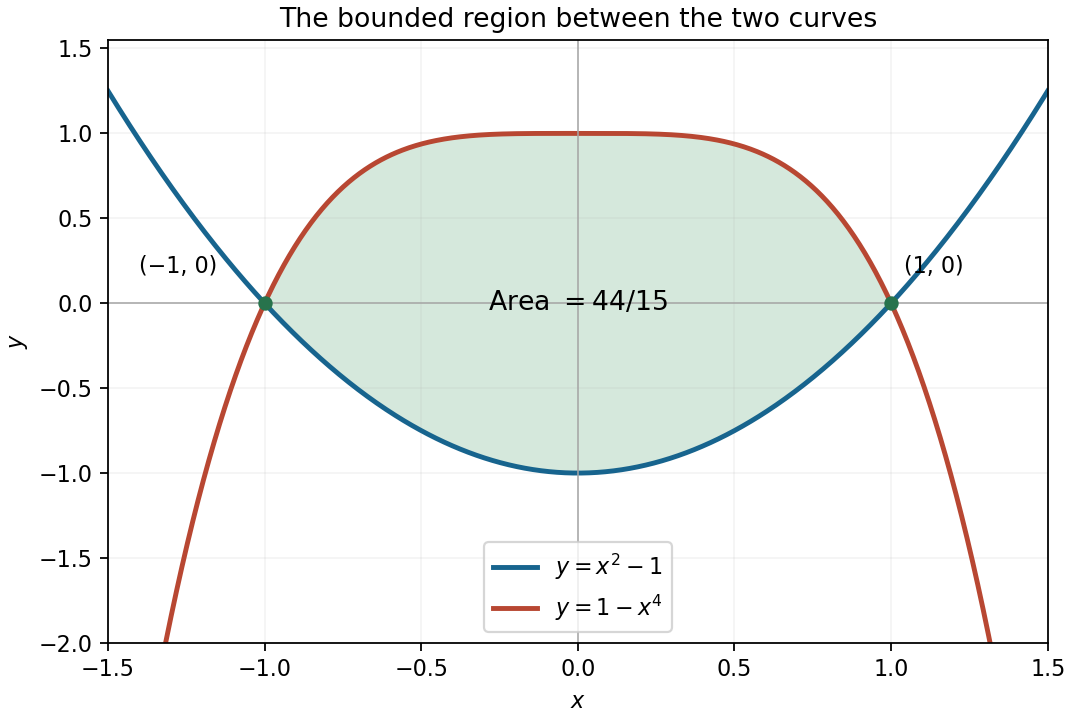
The parabola, the inverted quartic, and the finite region between their intersections
. Details. Subtract the lower curve from the upper curve on the intersection interval. The definite integral isThe result is in square coordinate units.
Collect the coefficients of the three unknowns in rows. The linear system has matrix formThe next two parts solve this same system by the two requested methods.
Use Gaussian elimination on the augmented matrix. First take and , then :By back substitution, the last row gives , the second gives and hence , and the first gives . ThusThe right-hand side has been transformed in every row operation, preserving the solution set.
Choose Cramer's rule, the permitted alternative to finding an inverse. The determinant isReplacing each column by the right-hand side givesConsequentlyThe nonzero determinant also proves uniqueness.
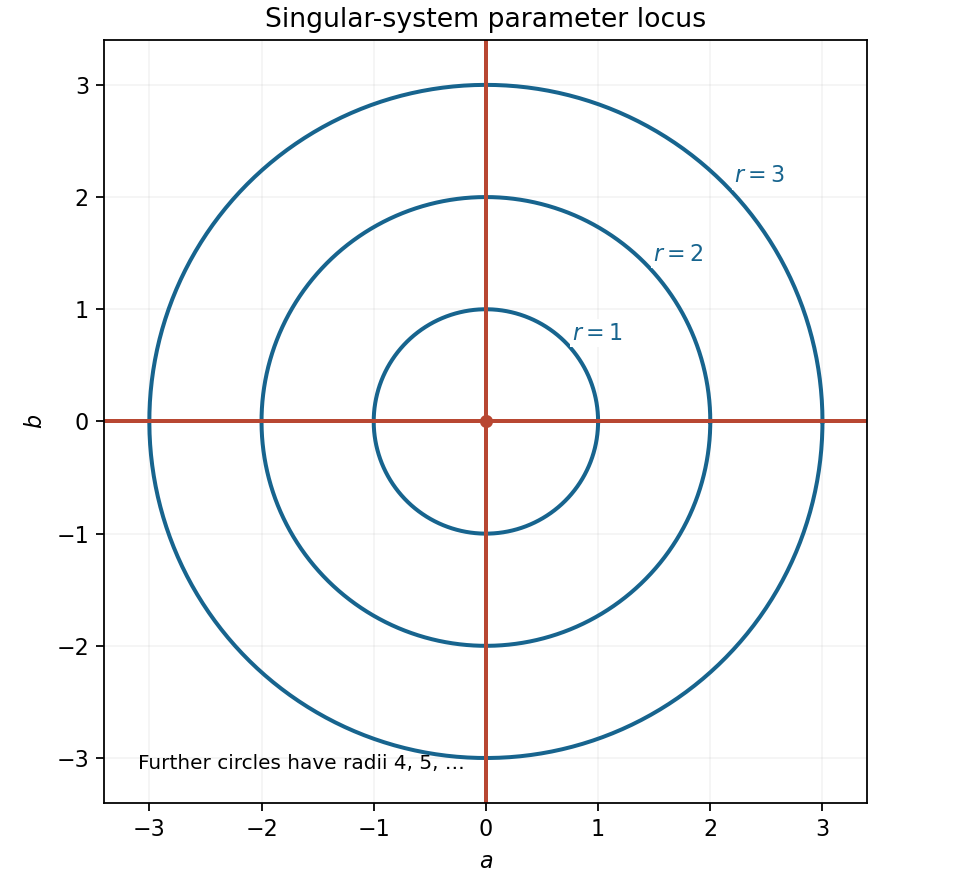
The square roots simplify to the absolute values and . Put . A nontrivial solution of the homogeneous linear system exists exactly when its coefficient matrix is singular:The second factor vanishes precisely when , or , giving both coordinate axes. The first factor vanishes when is a nonnegative integer. Hence the complete locus isThese are the two axes together with concentric circles of positive integer radii. The zero-radius case is the origin, already included on the axes; at that point both equations vanish and any nonzero pair works.
The original PDF asks for cube roots of . Their complex modulus is , and their arguments are , . Converting to Cartesian form givesCubing any one gives the positive real number .
Real coefficients imply that the conjugate is also a polynomial root. Write the remaining root as . ThenThe coefficient of in this product is . That coefficient is zero in the specified polynomial, so . Hence the two other roots areAs a check, the full polynomial is , corresponding to , and .
Rewrite the complex position as . Differentiating gives the complex velocity and accelerationFor real , . Their requested magnitudes are thereforeThere is no pole for real time. The magnitude is the Euclidean length of the two Cartesian components, not the modulus of either component separately.
For the first-order linear ordinary differential equation, an integrating factor isMultiplication converts the left side to a derivative:Integrating gives . The initial value fixes , so
On a branch with , the given derivative is nonzero wherever the original equation is defined, so use inverse-function linearization of a first-order equation and regard as a function of :The integrating factor givesThus the nonzero solutions are given implicitly byEach branch must also retain ; at those excluded points the original right-hand side is undefined and the inverse graph cannot represent a regular . Differentiating the implicit equation gives , equal to the required quotient wherever these restrictions hold.
The additional solution , on any interval avoiding , was lost when dividing by and must be included. It is not defined through the point in the original equation.
For , the Bernoulli differential equation becomes linear under . Multiplying the equation by givesOn an interval with , the integrating factor is , henceTherefore the complete set of solution branches isThe original equation requires ; each nonzero branch additionally requires . The zero solution is restored explicitly because the reciprocal substitution excludes it.
If either vector is zero, both sides vanish. Otherwise let be the angle between them. The magnitudes of the cross product and dot product are described bySquaring and using proves Lagrange's identity:
Assume the two line-defining points are distinct. Put and . The triangle formed by the three points has area . The same area is half the base length times the perpendicular height from the third point to the line. Hence the distance from a point to a line in three dimensions isThis remains valid when the nearest point lies outside the segment, since the base line is infinite. If all three points are collinear, the numerator and distance are both zero.
Use as an anchor. Two directions in the required plane areTheir cross product is , so a normal vector is . The Cartesian equation of a plane isDirect substitution verifies all three given points. The independent direction vectors ensure the plane is uniquely determined.
The axis intercepts of the plane areUse two edge vectors from :The triangle area is half this cross product magnitude:
In cylindrical coordinates, and , so . Thus the circular elliptic paraboloid has equationAt height , the rim radius is .
For , parametrize the curved surface by , with and . The magnitude of the cross product of its coordinate tangents gives the area element of a surface:Integrating givesThis is the curved surface area, not the area of a lid across the horizontal opening. The expression tends to zero at and has dimensions of area. The volume and centroid of a parabolic cup use the same geometry.
The liquid occupies and . A horizontal slice is a disk of area . Integrating these areas givesEquivalently, the triple integral is , including the cylindrical Jacobian determinant factor .
For positive constant mass density , reflection symmetry makes the horizontal coordinates of the centre of mass zero. The total mass and the vertical first moment areTheir ratio givesThis is the centre of the liquid volume, rather than of the curved wall. The density cancels because it is uniform; the larger disks near the top place the centre above half-height.
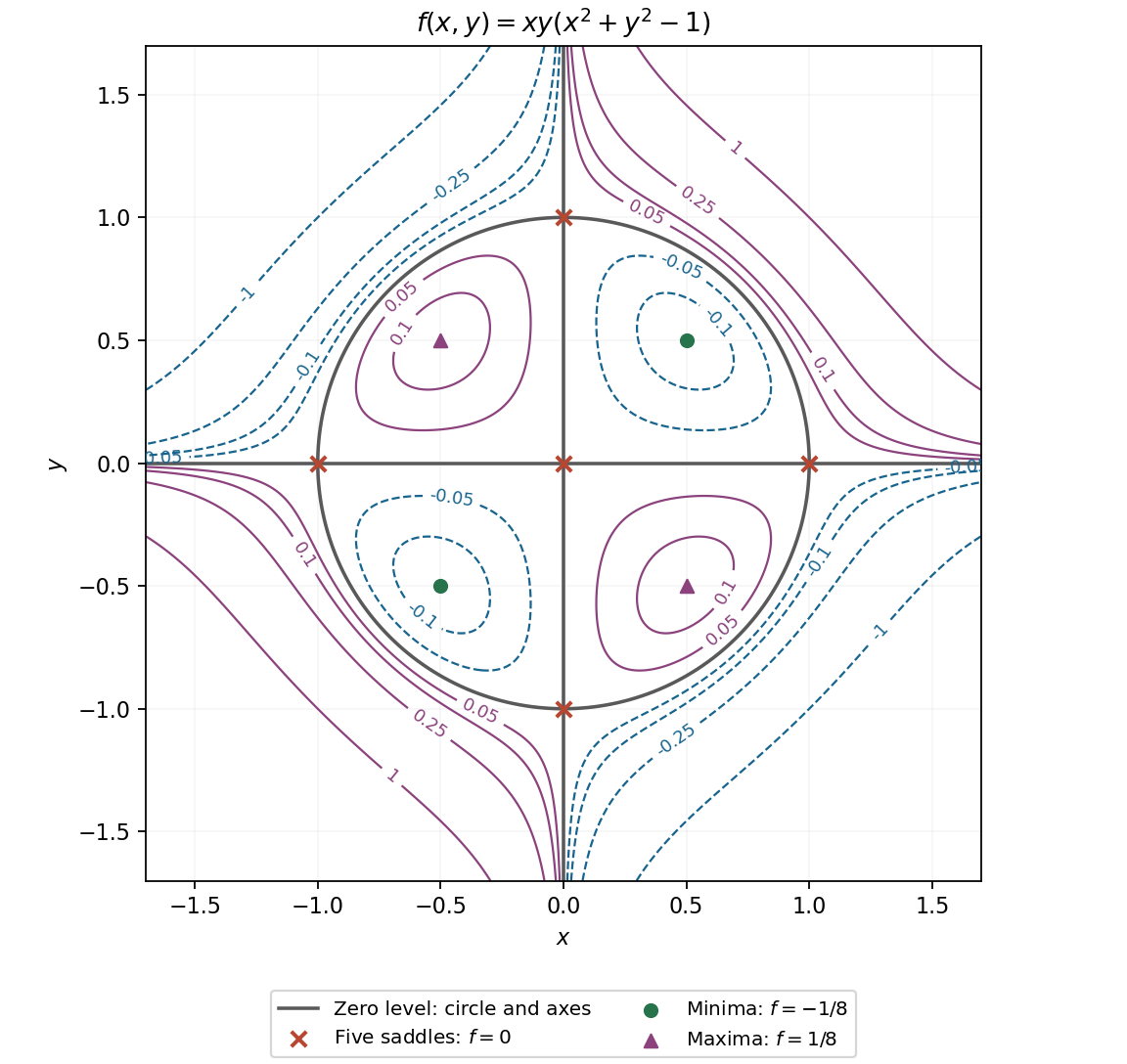
The gradient factors asIf a coordinate is zero, the solutions are , and . With both coordinates nonzero, subtracting the two bracket equations gives , hence . These give four more stationary points.
The Hessian matrix has equal diagonal entries and off-diagonal entry . At the origin its eigenvalues are , and at the four nonzero axis points they are , so all five are saddles. At the two same-sign interior points the eigenvalues are , while at the opposite-sign points they are . ThereforeThe extrema are not global, since the quartic takes arbitrarily large positive and negative values along suitable rays.
For the contour sketch, the zero level is exactly the two axes together with the unit circle. Inside the circle, is negative in the first and third quadrants and positive in the other two; outside, those signs reverse. Small negative levels contain closed loops around the two minima as well as unbounded branches in the second and fourth quadrants. Small positive levels similarly contain two loops around the maxima and unbounded branches in the first and third quadrants. The closed loops shrink to the extrema at levels , and disappear beyond those levels. This is the unit-scale quartic surface with axes and a circle as its zero set.


For a classical solution take twice differentiable, so that the second derivatives exist. Direct use of the chain rule giveswith the two profile arguments as specified. Thus .
To prove generality, introduce characteristic coordinates , , whose Jacobian determinant is . For the differential operator isThe equation becomes . Integrating once in each variable yieldsThis is the countertravelling decomposition of the one-dimensional wave equation, with wave speed . Once differentiability alone is not sufficient for a classical second-order equation; the displayed argument uses the required second derivatives.
Choose . The two travelling profiles then add by the sine addition identity:This is a standing wave. At and it vanishes for all . At its displacement is , and its time derivative is zero. Also and , directly checking the original equation.
Articles were limited to the first 100 out of 129 total.
Articles by others on the same topic
There are currently no matching articles.